The Partes Del Crustáceo is a Educational Materials Montessori material designed for children aged 3-6, crafted by Nienhuis Montessori to AMI standards.
These Spanish-language three-part nomenclature cards introduce children to crustacean anatomy through beautifully illustrated lobster diagrams. The laminated cardstock cards feature color-coded highlighting of body parts with corresponding Spanish labels, supporting both vocabulary development and scientific classification skills in the Montessori zoology curriculum.
“The child is both a hope and a promise for mankind.”— Maria MontessoriEducation and Peace
“The hands are the instruments of man's intelligence.”
— Maria Montessori, The Absorbent Mind
The Partes Del Crustáceo cards exemplify Montessori's approach to zoological classification through precise visual isolation. Each laminated card presents the lobster's anatomy with color-coded highlighting, allowing children to distinguish individual body parts while maintaining awareness of the whole organism. The three-part format of these Spanish-language cards creates a concrete-to-abstract progression: first matching identical images, then pairing pictures with labels, finally reading labels independently. By focusing on crustacean anatomy through detailed lobster diagrams, children develop both scientific observation skills and Spanish vocabulary simultaneously. The cardstock construction with laminate coating ensures repeated handling as children trace the lobster's segments, count its legs, and identify its antennae. This systematic study of the lobster's structure builds the foundation for understanding arthropod classification while respecting the child's need to learn through manipulation and repetition.
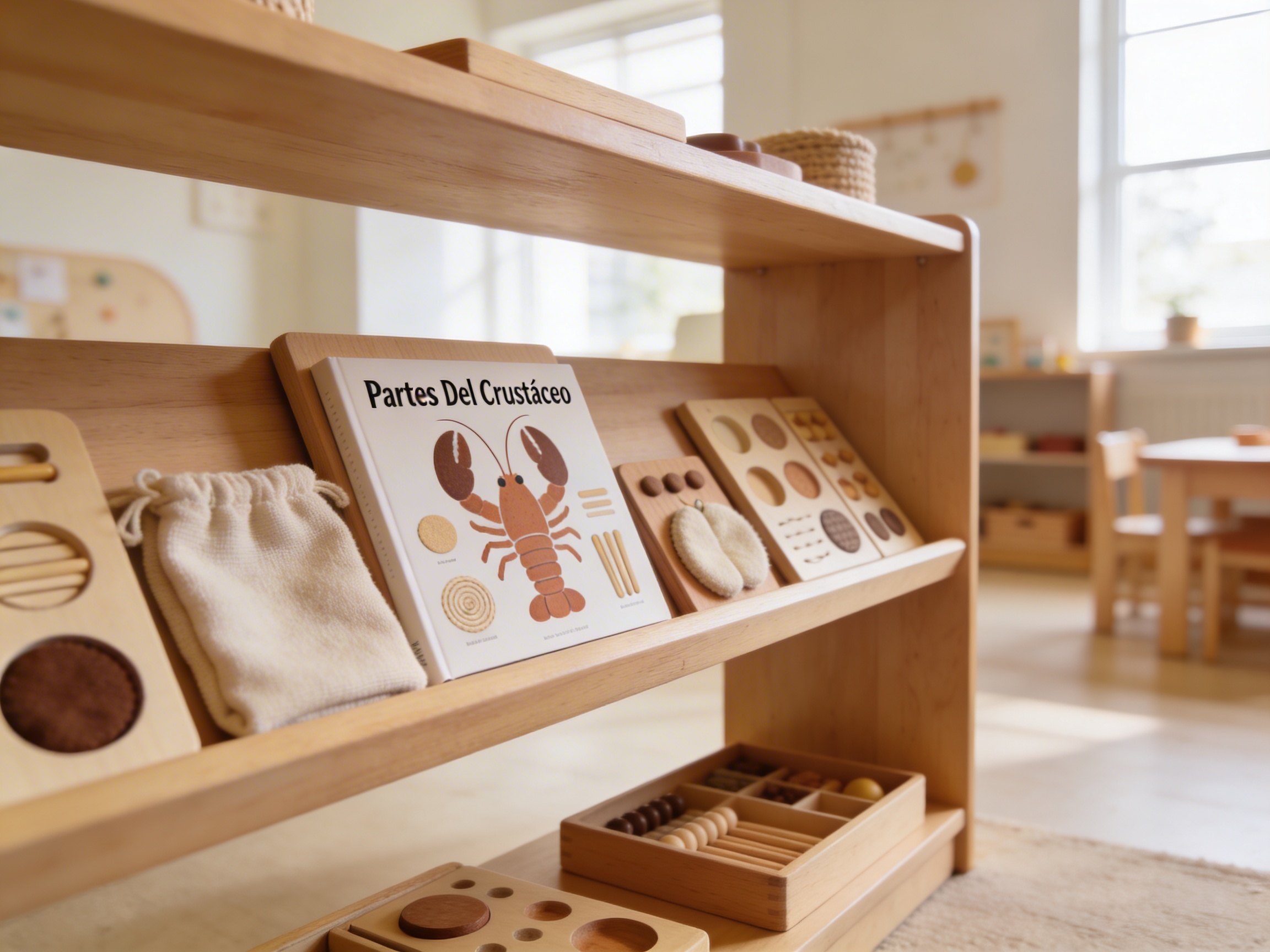
Each order includes everything needed for proper presentation and long-term use.
Follow the Montessori method of presentation for optimal child development.
Introduce 3-4 control cards, naming each lobster part in Spanish while pointing to the color-coded area
Match picture cards to their corresponding control cards by observing the highlighted body parts
Read label cards aloud and place them below their matching pictures
Remove control cards and work with pictures and labels independently
Every material is carefully selected for durability, safety, and authentic Montessori experience.
Sourced from sustainably managed European forests. Beechwood is chosen for its exceptional durability, smooth grain, and natural warmth that invites touch.
Natural, unbleached cotton in child-friendly colors. The fabric provides the right amount of friction for developing fingers while being gentle on sensitive skin.
Water-based, child-safe finish that meets the strictest European safety standards. Designed to withstand years of daily use without chipping or peeling.
Each material supports multiple areas of child development simultaneously.
Introduces zoological concepts and anatomical vocabulary through concrete visual materials.
Builds Spanish vocabulary while reinforcing the connection between spoken and written language.
Color-coded highlighting helps children identify and differentiate anatomical features.
Matching and labeling activities develop focus and attention to detail.
Designed for child-sized hands
Professional tips from AMI-trained guides to maximize the educational value of this material.
“Present alongside a real lobster shell or preserved specimen when possible”
Create a Spanish zoology vocabulary notebook where children illustrate learned terms
Use the color coding to play 'I Spy' games with crustacean parts
Connect to practical life by discussing seafood and fishing in Spanish-speaking cultures
Everything you need to know about this material.
The cards feature essential crustacean anatomy including cefalotórax (cephalothorax), abdomen, antenas (antennae), tenazas (claws), patas (legs), telson, and ojos (eyes). Each part is color-coded on the lobster illustration for easy identification and matching.
Three-part cards consist of a control card (picture with label), a picture card (unlabeled), and a label card. Children match the unlabeled picture to its corresponding label, then use the control card for self-correction. This promotes independent learning and vocabulary development.
Yes, these cards are excellent for introducing Spanish vocabulary to all children. The visual nature of the material, combined with the three-part card format, supports language learning through picture-word association, making them ideal for bilingual education or Spanish language introduction.
The cards are printed on high-quality cardstock and laminated for durability, making them suitable for repeated classroom use. The lamination protects against spills and allows for easy cleaning, ensuring the materials maintain their appearance through years of handling by young children.
Extensions include creating definition booklets, labeling a real lobster shell or model, comparing crustacean anatomy to other arthropods, sorting activities with other animal cards, and incorporating the vocabulary into Spanish conversation practice or nature journaling activities.
Can't find what you're looking for?
Contact Our Experts
Share your experience with this material and help other educators and parents.


