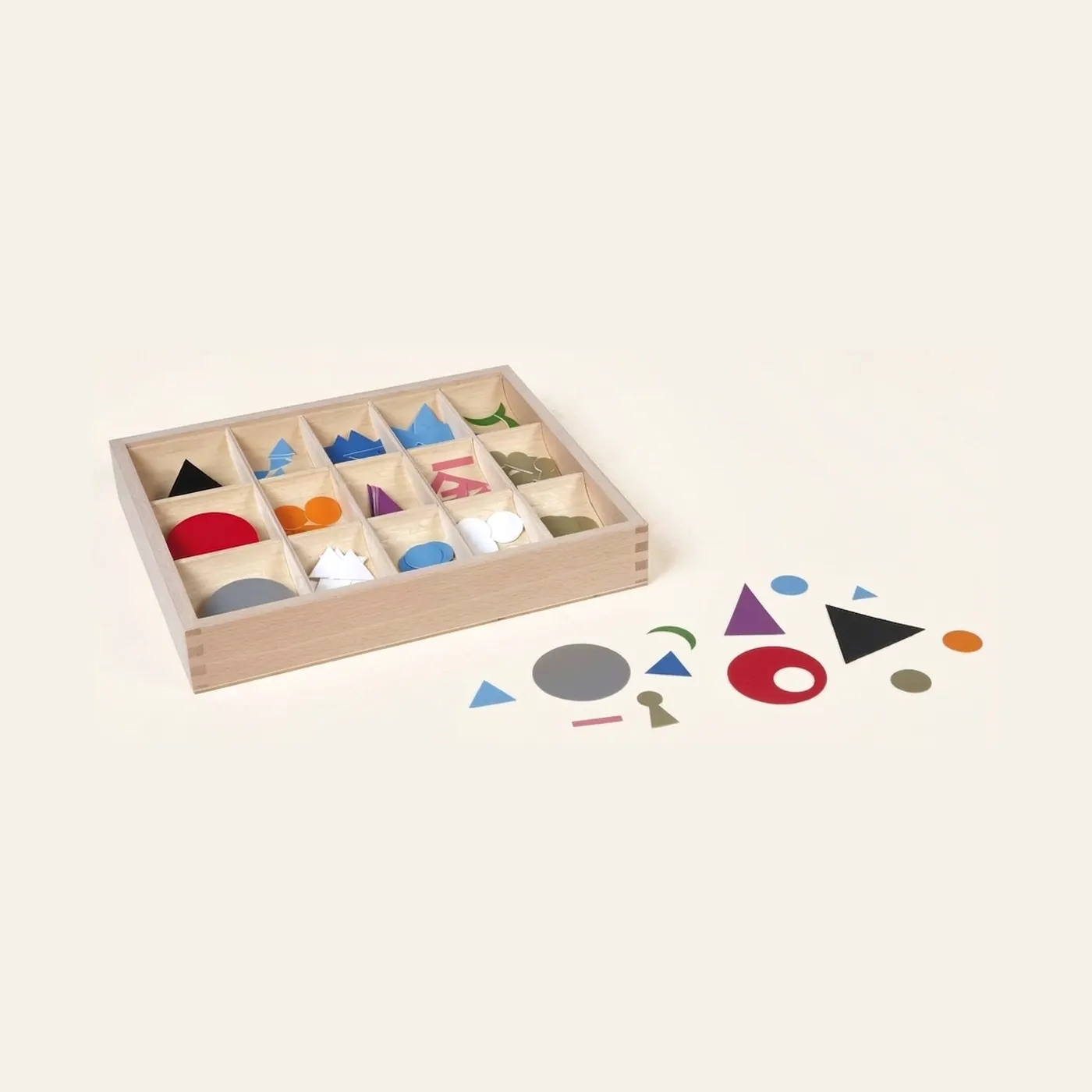
Grammar Symbols Set: Plastic Colour-Coded Parts of Speech
Made by Nienhuis Montessori · shipped by Heutink International (Netherlands) About the maker
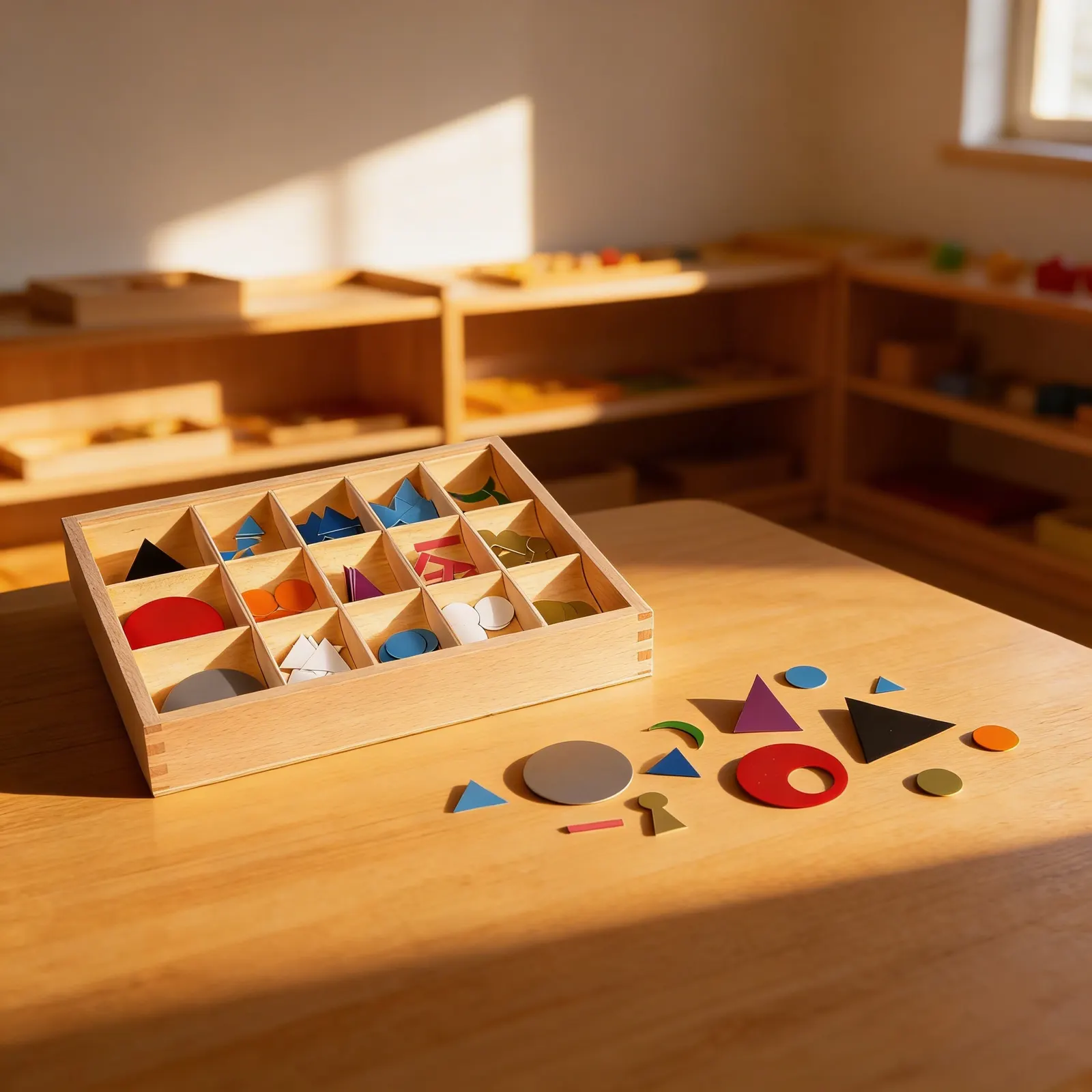
Fifteen symbols in heavy plastic, one for each part of speech, stored in a wooden box. The symbols do the work a definition cannot: a noun is a large black triangle, a verb a red circle, and a child placing them over a sentence sees its shape before knowing any terminology. Because the symbols are objects rather than marks on paper, a sentence can be rearranged and re-symbolised as many times as the child likes. Heavy plastic in a wooden box, for ages 3 to 6.
“The hands are the instruments of man's intelligence.”
The Plastic Grammar Symbols embody Montessori's principle of making abstract concepts concrete through sensorial experience.
- Identify and classify nine basic parts of speech through visual and tactile discrimination
- Analyze sentence structure by physically arranging grammar symbols above written words
- Develop abstract thinking by connecting concrete symbols to grammatical concepts
- Build foundation for advanced language analysis and writing skills
Read More
By representing parts of speech as geometric shapes, children can physically manipulate language structure, satisfying their need for movement while learning. This material bridges the gap between concrete and abstract thinking, allowing the child to literally hold grammar in their hands. The color-coding and distinct shapes appeal to the child's visual and tactile senses, creating multiple pathways for understanding. Following the principle of isolation of difficulty, each symbol represents one grammatical concept, enabling focused exploration. This hands-on approach transforms grammar from an abstract set of rules into a tangible, discoverable system that children can explore independently.
How to present it
Follow the Montessori method of presentation for optimal child development.
Place the grammar symbols box on a mat. Have prepared sentence strips ready. Start with simple sentences containing only article, adjective, and noun (e.g., 'The red ball').
- 1
Introduce one symbol at a time using the three-period lesson. Start with the black triangle for noun
Let the child feel the shape while saying 'This is the noun' - 2
Write a simple sentence on a strip. Read it together with the child
Use words from the child's environment for meaningful connection - 3
Ask the child to place the appropriate symbol above each word
Model the first placement, then step back to allow independent work - 4
Once comfortable with 3-4 symbols, introduce new parts of speech gradually
Follow the child's readiness rather than a fixed timeline - 5
Progress to analyzing sentences from reading materials or child's own writing
This connects grammar work to practical application
Every Child Is a Little Creator

Heritage
Since 1929

In classrooms
Around the world

European brands
Nienhuis, GAM, Educo

AMI approved
To the association standard
Grammar Symbols Set: Plastic Colour-Coded Parts of Speech
