
Positive - Comparative - Superlative
The first photo is the maker's own. The other shots are illustrative.
Inv. no. NIE-565900
- Maker
- Nienhuis Montessori, since 1929
- Approval
- AMI
- Holder
- Clear acrylic or plastic
- Cards
- Printed cardstock
- EAN
- 8719924030209
Final price incl. VAT. Delivery €5.90, €120.10 to go for free delivery.
Advice, warranty and returns are handled by us.
Why it costs €28.90
Behind the price of the original are things you can check yourself.
AMI approval
The material is approved by the Association Montessori Internationale (AMI). Nienhuis has made Montessori materials since 1929.
A verifiable original
The EAN 8719924030209 is on the box. It is the maker's number, not ours.
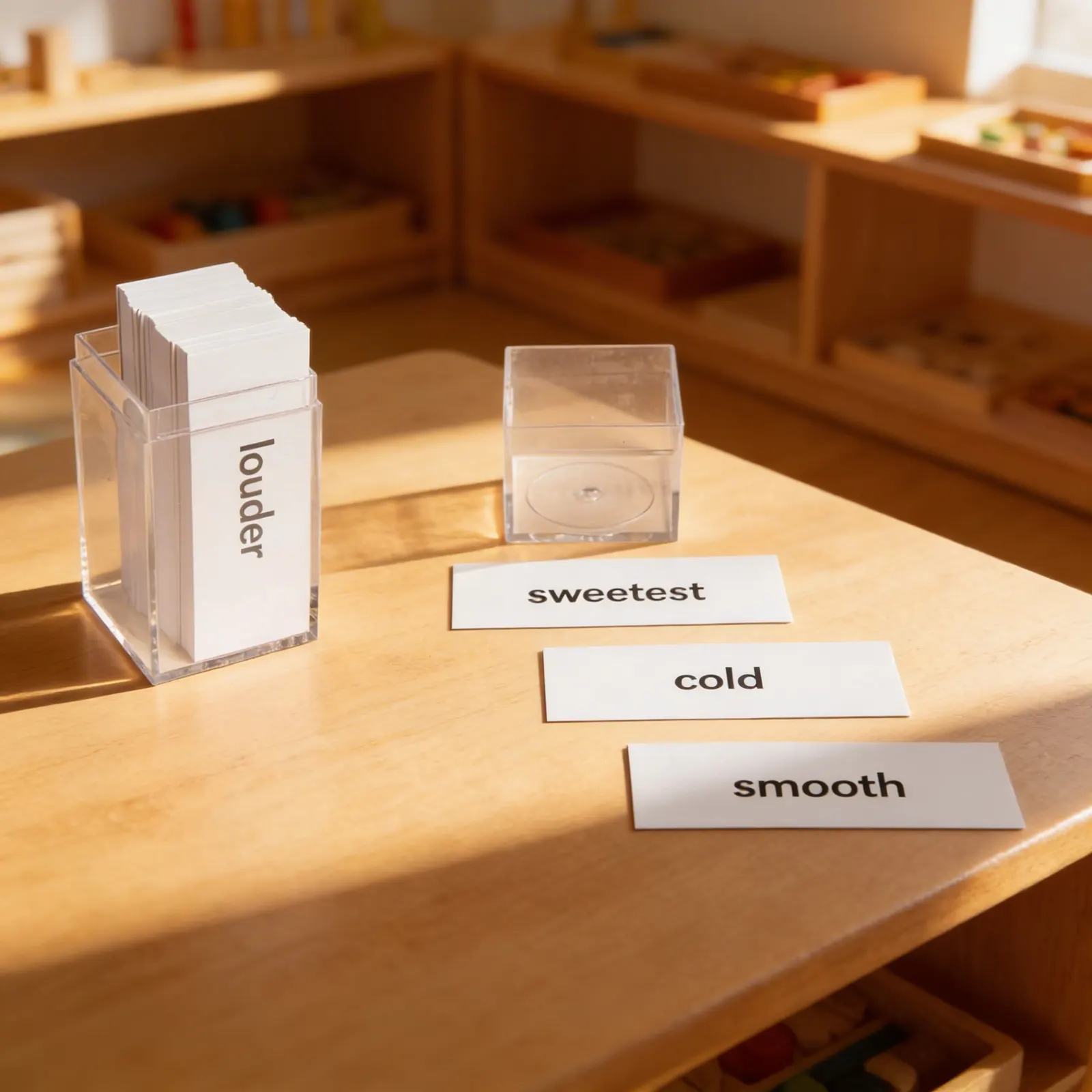
Positive - Comparative - Superlative in a child's hands
A bridge to confident reading and writing, this Positive-Comparative-Superlative material brings children face-to-face with the grammatical concept of degrees of comparison through clear, organized card work. The transparent holder displays adjective cards showing the three forms (such as 'tall, taller, tallest'), helping children visually understand how descriptive words change to show different levels of comparison. Part of the Montessori language curriculum, this material bridges concrete vocabulary work with abstract grammar concepts.
Grammar Understanding
Introduces the concept of degrees of comparison through visual organization and concrete examples.
Language Enrichment
Expands vocabulary while teaching how adjectives change form to express different levels of quality.
Reading Comprehension
Supports understanding of comparative language in books and everyday communication.
Logical Thinking
Develops ability to categorize and understand relationships between related word forms.
How to present it
Place the transparent holder on a table mat. Arrange one complete set of comparison cards (positive, comparative, superlative) in the holder slots.
- 1Present the first adjective in its positive form, reading 'tall'
- 2Show the comparative form 'taller', emphasizing the -er ending
- 3Introduce the superlative 'tallest', highlighting the -est ending
- 4Invite the child to read all three forms in sequence
- 5Continue with 2-3 more adjective sets, letting the child discover patterns
3 tips for parents
- Notice comparison words in everyday speech: 'This apple is bigger than that one'
- Play comparison games during daily activities: 'Who can jump higher?'
- Read books that naturally include comparison language like The Three Bears

If you are not sure it suits your child, we answer in person.
Norbert Kovalčín, founder of Faborino · write to him
There is no review here yet. We will ask you for one after you buy. Write the first review
What's in the Box
- Clear Card Holder: Transparent acrylic display stand
- Grammar Cards: Multiple sets showing adjective degrees
Size and material
| Packaging | 8 × 4 × 4 cm |
| Holder | Clear acrylic or plastic |
| Cards | Printed cardstock |
| Recommended Age | 3-6 years |
Care
Wipe holder with damp cloth; keep cards dry
Frequently Asked Questions
What age is this positive-comparative-superlative material designed for?
This material is designed for children ages 3-6, aligning with the Montessori primary language curriculum when children are developing their understanding of descriptive language and beginning to explore grammar concepts.
How does the transparent holder help with learning?
The transparent holder keeps the adjective cards organized and visible, allowing children to clearly see all three forms of each adjective at once. This visual presentation helps children recognize patterns in how words change across the degrees of comparison.
What types of adjectives are included in this set?
The set includes commonly used adjectives that children encounter in daily life, presented in their three forms (positive, comparative, superlative). Examples include sets like tall/taller/tallest, big/bigger/biggest, and other descriptive words appropriate for young learners.
How does this material connect to other Montessori language work?
This material builds upon earlier vocabulary and classification work, introducing the abstract concept of degrees of comparison. It prepares children for more advanced grammar studies and helps them understand how language can express different levels of qualities and characteristics.
Can children work with this material independently?
Yes, after an initial presentation, children can work independently with these cards. The clear organization and visual format allow for self-directed exploration, matching activities, and practice in recognizing and using the three forms of adjectives correctly.
Product safety
Manufacturer: Nienhuis Montessori, Anders Celsiusstraat 15, 7442 PB Nijverdal, Netherlands
Positive - Comparative - Superlative