
Power Of Two Cube: Binary Progression Mathematical Exploration
Made by Nienhuis Montessori · shipped by Heutink International (Netherlands) About the maker
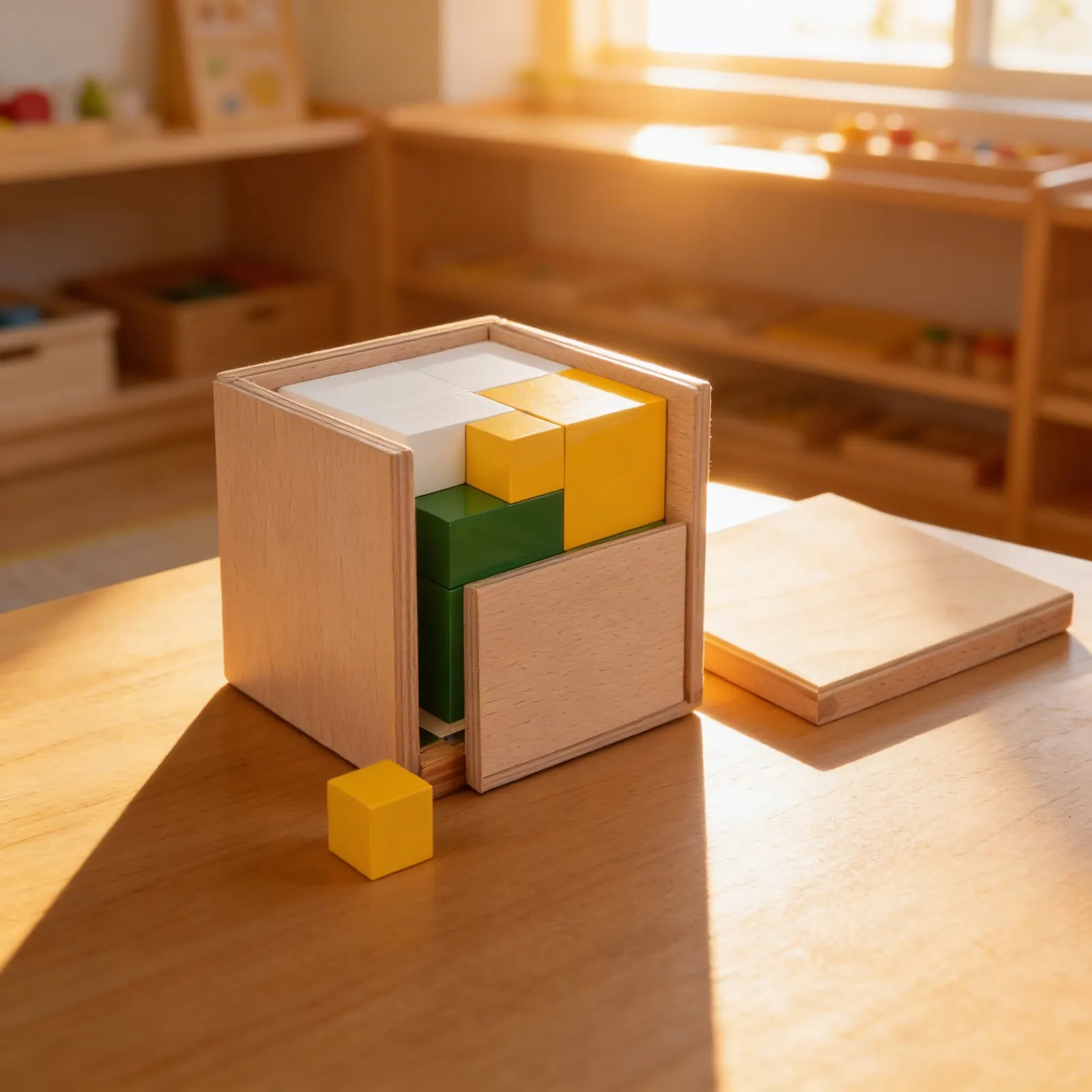
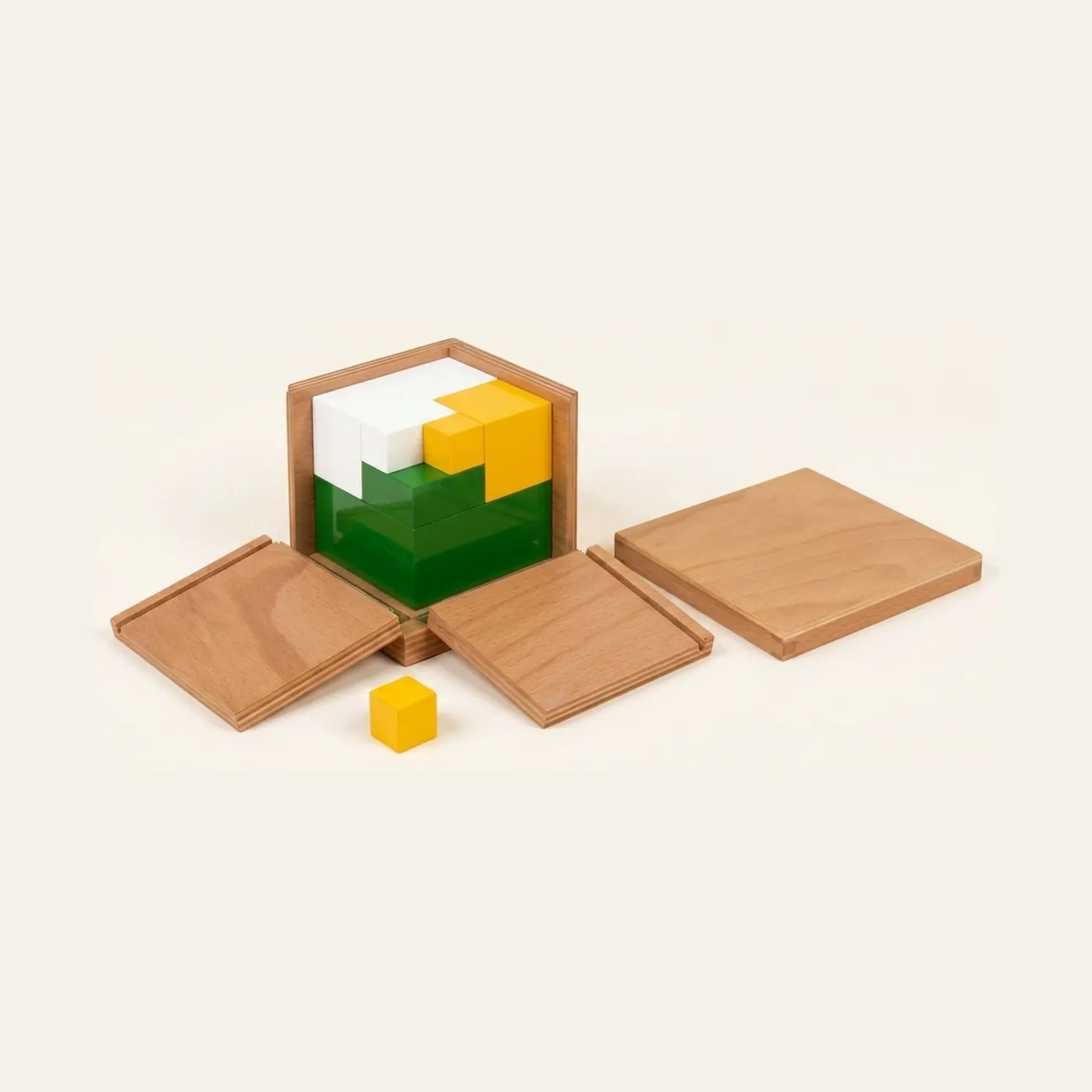
A cube that comes apart into cubes and prisms where each piece is the square of the one before, so the doubling is visible in the sizes rather than stated as a rule. Children usually notice the pattern before they can name it, which is the order that makes it stick. Because the pieces reassemble one way only, the material corrects the child instead of an adult doing it, and the work can be repeated as often as the child wants. Hinged wooden box with lid. Solid wood with non toxic paint, for ages 6 to 12.
“The senses, being explorers of the world, open the way to knowledge.”
The Power of Two Cube embodies Dr. Montessori's principle of mathematical abstraction through sensorial experience.
- Understanding exponential growth and binary progression through concrete manipulation
- Developing spatial reasoning and three-dimensional visualization skills
- Internalizing powers of two (1, 2, 4, 8, 16, 32, 64, 128, 256, 512)
- Strengthening problem-solving abilities through systematic trial and error
Read More
In the elementary years, children possess a 'mathematical mind' that seeks to understand relationships, patterns, and the underlying order of the universe. This material bridges the concrete and abstract by allowing children to physically manipulate binary progression, making visible the exponential nature of powers. Through repeated sensorial exploration, children internalize mathematical concepts before formal abstraction, following Montessori's belief that 'the hand is the instrument of the mind.' The material's self-correcting nature promotes independence and concentration, while its beauty and precision inspire mathematical wonder and respect for exactness.
How to present it
Follow the Montessori method of presentation for optimal child development.
Place the material on a felt mat at a table. Have the child wash hands to protect the wood. Present the empty wooden frame and all cubic pieces arranged from smallest to largest on the mat.
- 1
Invite the child to observe the smallest cube, noting it represents 2⁰ = 1
Use minimal language initially, letting the material speak through manipulation - 2
Show how two unit cubes combine to form 2¹ = 2, continuing this doubling pattern
Allow the child to discover the doubling pattern independently before confirming - 3
Begin building the large cube systematically, starting with the largest piece
Work slowly and precisely, modeling careful placement and spatial analysis - 4
Continue adding pieces, allowing the child to predict which piece comes next
If stuck, suggest feeling the empty space to determine needed dimensions - 5
Complete the cube, then invite the child to disassemble and rebuild independently
Step back completely during the child's turn, intervening only if requested
Every Child Is a Little Creator

Heritage
Since 1929

In classrooms
Around the world

European brands
Nienhuis, GAM, Educo

AMI approved
To the association standard
Power Of Two Cube: Binary Progression Mathematical Exploration
