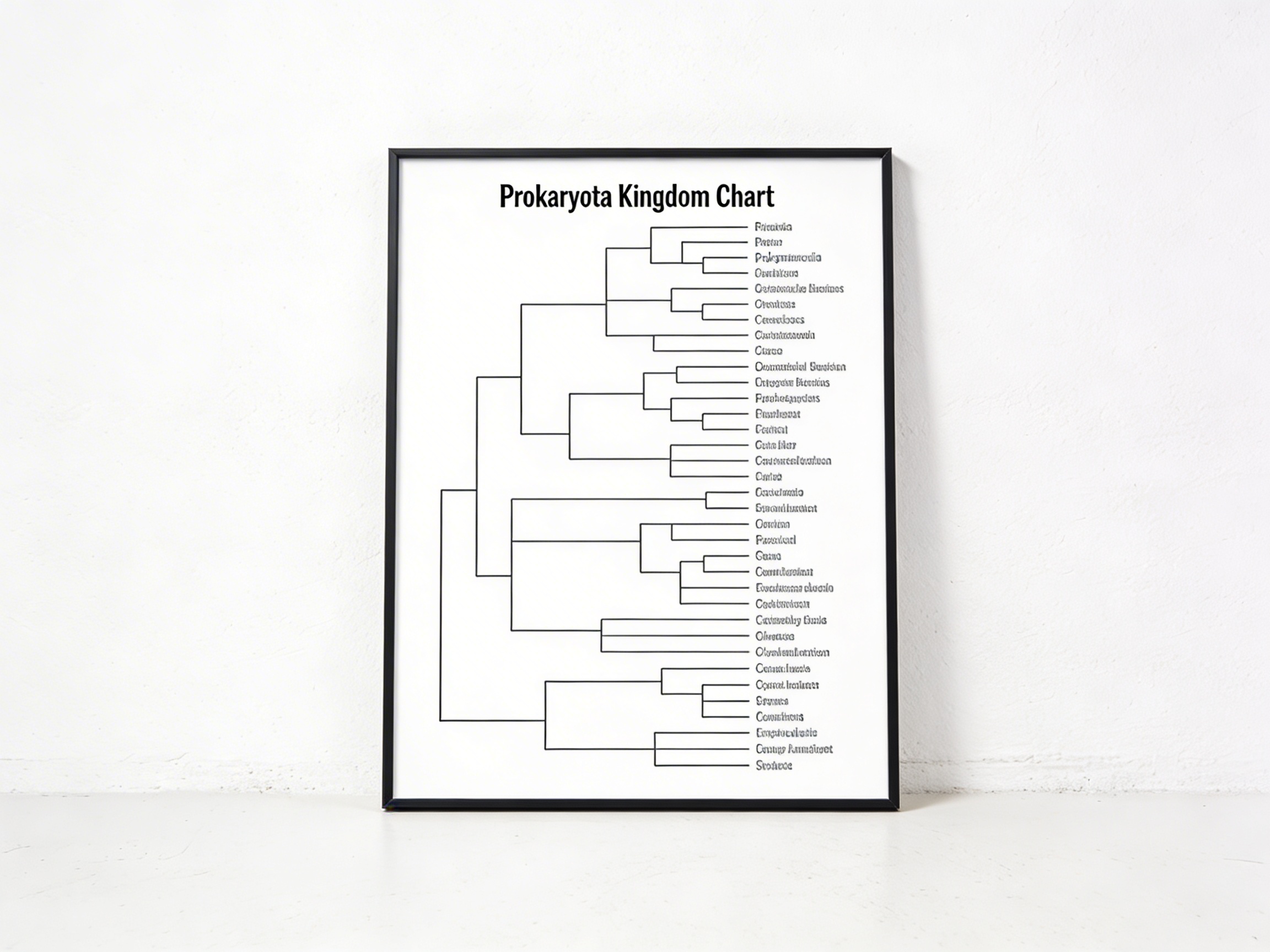
The Prokaryota Kingdom Chart is a Educational Materials Montessori material designed for children aged 3-6, crafted by Nienhuis Montessori to AMI standards.
The Prokaryota Kingdom Chart introduces young learners to the fundamental classification of living organisms, focusing on prokaryotic cells. This educational wall chart presents clear visual representations of bacteria and archaea, helping children understand the microscopic world through age-appropriate imagery and nomenclature. Perfect for introducing elementary biology concepts in the Montessori classroom.
“The child is both a hope and a promise for mankind.”— Maria MontessoriEducation and Peace
“The hands are the instruments of man's intelligence.”
— Maria Montessori, The Absorbent Mind
The Prokaryota Kingdom Chart emerges from Maria Montessori's recognition that children possess a natural curiosity about the living world, including organisms invisible to the naked eye. This wall chart transforms abstract microscopic concepts into concrete visual learning by presenting bacteria and archaea through clear, scientifically accurate illustrations. In the Montessori classroom, the Prokaryota Kingdom Chart serves as a bridge between the child's observable world and the vast unseen universe of single-celled organisms. The chart's age-appropriate imagery allows three to six-year-olds to grasp that life exists beyond what they can directly perceive, fostering scientific thinking from early childhood. By displaying prokaryotic cells in an organized, visually appealing format, this educational material satisfies the child's need to classify and understand their environment systematically. The Prokaryota Kingdom Chart particularly addresses the sensitive period for order and classification, allowing children to place microscopic life within the broader context of living organisms they study through other Montessori biology materials.
Each order includes everything needed for proper presentation and long-term use.
Follow the Montessori method of presentation for optimal child development.
Introduce the chart by explaining that some living things are too small to see without special tools
Point to different prokaryotes on the chart, naming them slowly and clearly
Connect chart images to real-world examples: bacteria in soil, archaea in hot springs
Invite child to draw their own interpretation of a prokaryote after studying the chart
Every material is carefully selected for durability, safety, and authentic Montessori experience.
Sourced from sustainably managed European forests. Beechwood is chosen for its exceptional durability, smooth grain, and natural warmth that invites touch.
Natural, unbleached cotton in child-friendly colors. The fabric provides the right amount of friction for developing fingers while being gentle on sensitive skin.
Water-based, child-safe finish that meets the strictest European safety standards. Designed to withstand years of daily use without chipping or peeling.
Each material supports multiple areas of child development simultaneously.
Introduces fundamental concepts of biological classification and the diversity of microscopic life forms.
Develops ability to distinguish between different cellular structures and organism types through careful observation.
Builds scientific vocabulary with terms like prokaryote, bacteria, and archaea in an age-appropriate context.
Helps children conceptualize the existence of organisms too small to see, developing abstract reasoning skills.
Designed for child-sized hands
Professional tips from AMI-trained guides to maximize the educational value of this material.
“Present the chart after children understand the concept of 'living vs non-living'”
Use three-period lessons to introduce prokaryote vocabulary gradually
Create matching cards with prokaryote images from the chart for additional activities
Link chart study to practical life activities involving fermentation or composting
Everything you need to know about this material.
Yes, the Prokaryota Kingdom Chart is specifically designed for ages 3-6 with age-appropriate visual representations and simple nomenclature. It introduces basic concepts of living organisms through clear, child-friendly imagery that helps young learners begin to understand that there are tiny living things we cannot see with our eyes alone.
The chart presents visual representations of bacteria and archaea, the two main types of prokaryotic organisms. These are shown through simplified, colorful illustrations that help children visualize microscopic life forms while maintaining scientific accuracy appropriate for early learners.
This chart aligns with the Montessori approach to introducing living organisms and classification systems. It serves as a foundation for understanding the diversity of life, preparing children for more complex biology studies. The visual nature supports the Montessori principle of concrete learning before abstract concepts.
While specific dimensions aren't provided, Montessori wall charts are typically printed on durable, high-quality material suitable for classroom use. The chart features clear, vibrant images and text that can be easily seen from a distance, making it ideal for group lessons and individual exploration.
Teachers can introduce the chart through simple language, explaining that prokaryotes are tiny living things that help our world in many ways. Use concrete examples like how some bacteria help make yogurt or how they're important for plants. Pair with magnifying activities or microscope work for older children in the age range.
Can't find what you're looking for?
Contact Our Experts
Share your experience with this material and help other educators and parents.


