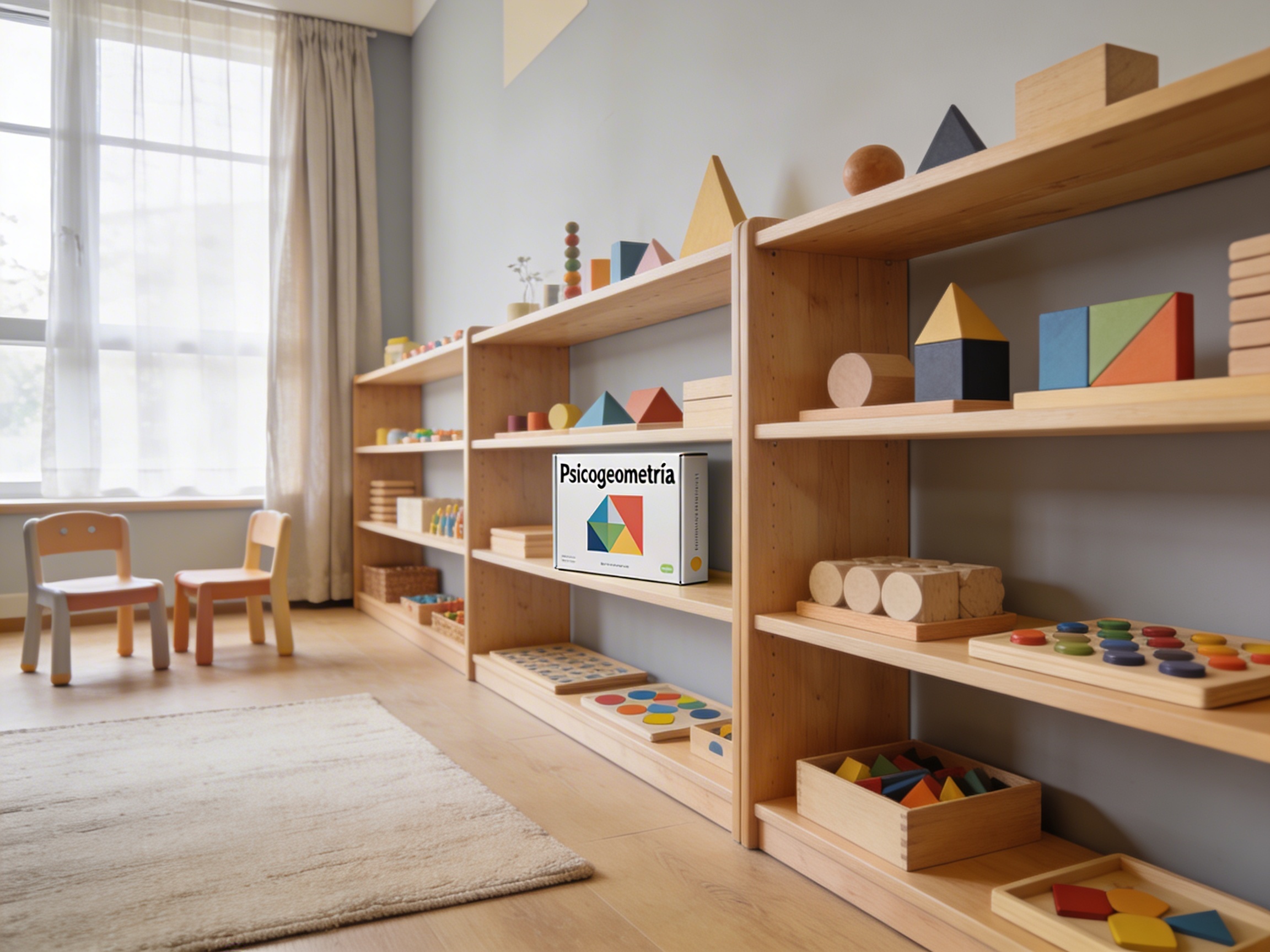
The Psicogeometría is a Educational Materials Montessori material designed for children aged 3-6, crafted by Nienhuis Montessori to AMI standards.
The Psicogeometría material introduces children to fundamental geometric concepts through hands-on exploration and visual discrimination exercises. This comprehensive geometry set supports the development of mathematical thinking by allowing children to manipulate, compare, and classify various geometric forms. Following Montessori principles, it bridges concrete sensorial experiences with abstract mathematical understanding.
“The child is both a hope and a promise for mankind.”— Maria MontessoriEducation and Peace
“The hands are the instruments of man's intelligence.”
— Maria Montessori, The Absorbent Mind
The Psicogeometría set provides young children with tangible geometric forms that transform abstract mathematical concepts into concrete sensorial experiences. Each geometric shape within the Psicogeometría collection serves as a key to unlock spatial reasoning, allowing children to physically handle triangles, circles, squares, and more complex polygons. Through manipulation of these geometric forms, children develop discrimination skills essential for later mathematical work. The Psicogeometría material addresses the developmental need for concrete representation before abstraction, particularly crucial during the 3-6 year period when children construct their mathematical mind. By comparing and classifying the various shapes in the Psicogeometría set, children internalize geometric relationships through their senses rather than through verbal instruction alone. This hands-on exploration with Psicogeometría forms creates neural pathways that connect visual perception with mathematical understanding, preparing the foundation for advanced geometry work in elementary years.
Each order includes everything needed for proper presentation and long-term use.
Follow the Montessori method of presentation for optimal child development.
Invite the child to carry the tray to a workspace
Remove three contrasting shapes and place them on the mat
Trace around each shape with your index finger
Offer the child a turn to trace each shape
Introduce the names using the three-period lesson
Every material is carefully selected for durability, safety, and authentic Montessori experience.
Carefully crafted materials provide clear visual and tactile experiences of geometric concepts
Each material supports multiple areas of child development simultaneously.
Builds foundation for geometry through classification and comparison of shapes
Enhances ability to perceive differences and similarities in geometric forms
Introduces precise mathematical vocabulary for describing shapes and spatial relationships
Bridges concrete sensorial experiences with abstract geometric concepts
Designed for child-sized hands
Professional tips from AMI-trained guides to maximize the educational value of this material.
“Present shapes in order of increasing complexity - start with circle, square, triangle before introducing polygons”
Use precise mathematical language from the beginning - 'vertices' not 'corners', 'edges' not 'sides'
Connect geometric work to other areas - use shapes in art activities or find them in practical life materials
Observe which shapes attract each child - some gravitate toward curves, others toward angular forms
Everything you need to know about this material.
The Psicogeometría set includes fundamental geometric forms such as circles, squares, triangles, rectangles, and polygons in various sizes. These shapes allow children to explore basic geometry concepts through hands-on manipulation and visual comparison exercises.
This material bridges sensorial experiences with abstract mathematical thinking by allowing children to physically handle, sort, and classify geometric shapes. Through these concrete experiences, children develop spatial awareness, pattern recognition, and the foundation for later geometry studies.
Children develop visual discrimination, shape recognition, classification abilities, and spatial reasoning. They also enhance fine motor skills, concentration, and logical thinking while learning geometric vocabulary and relationships between different forms.
The Psicogeometría material is perfect for both home and classroom environments. Its durable construction and self-contained design make it easy to store and use in any learning space, allowing parents to support geometric learning at home.
Children can engage in shape sorting, pattern creation, matching exercises, tracing activities, and constructing geometric designs. They can also explore concepts like symmetry, size gradation, and shape relationships through guided and independent exploration.
Can't find what you're looking for?
Contact Our Experts
Share your experience with this material and help other educators and parents.


