
Push Box: Object Permanence Development Activity
Made by Nienhuis Montessori · shipped by Heutink International (Netherlands) About the maker
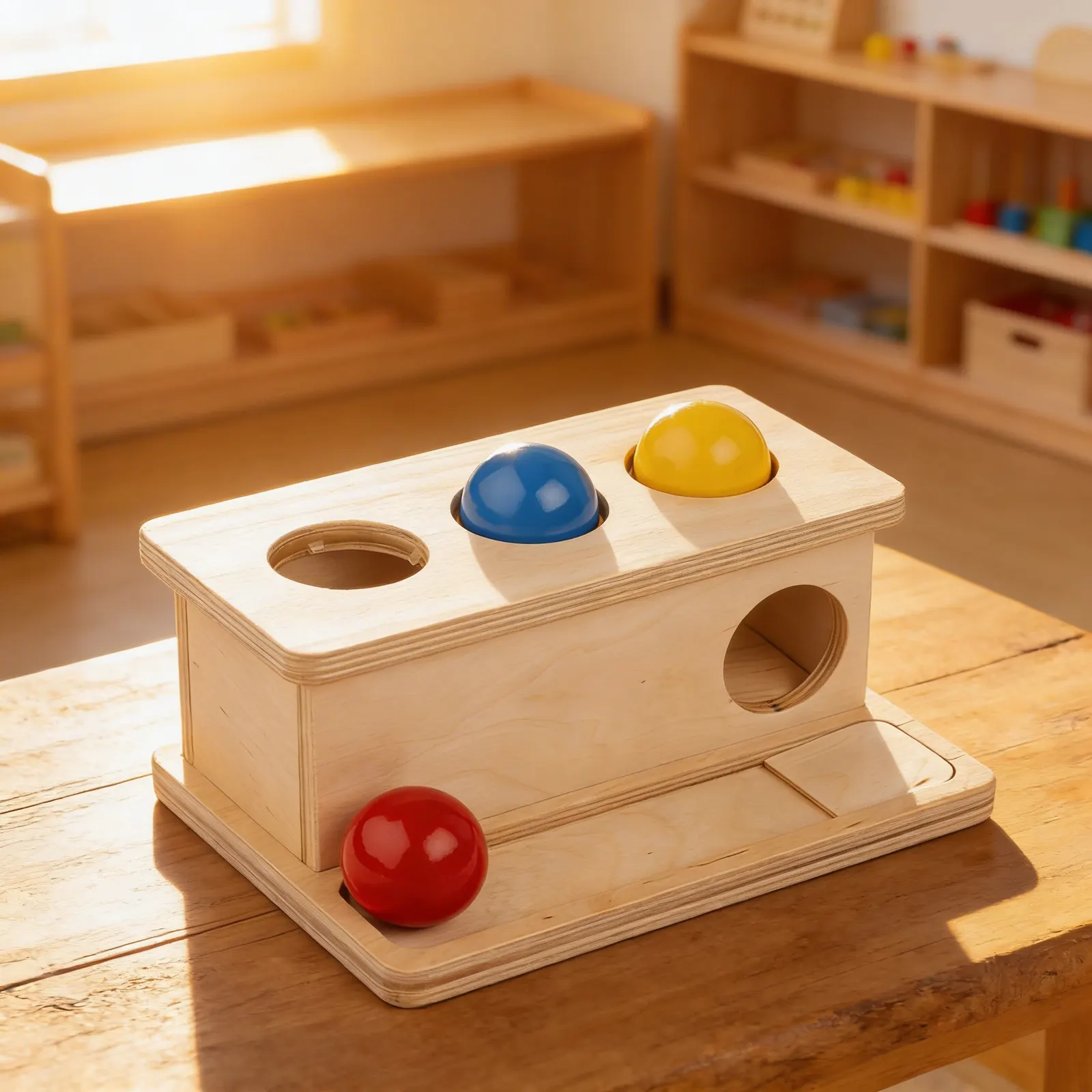
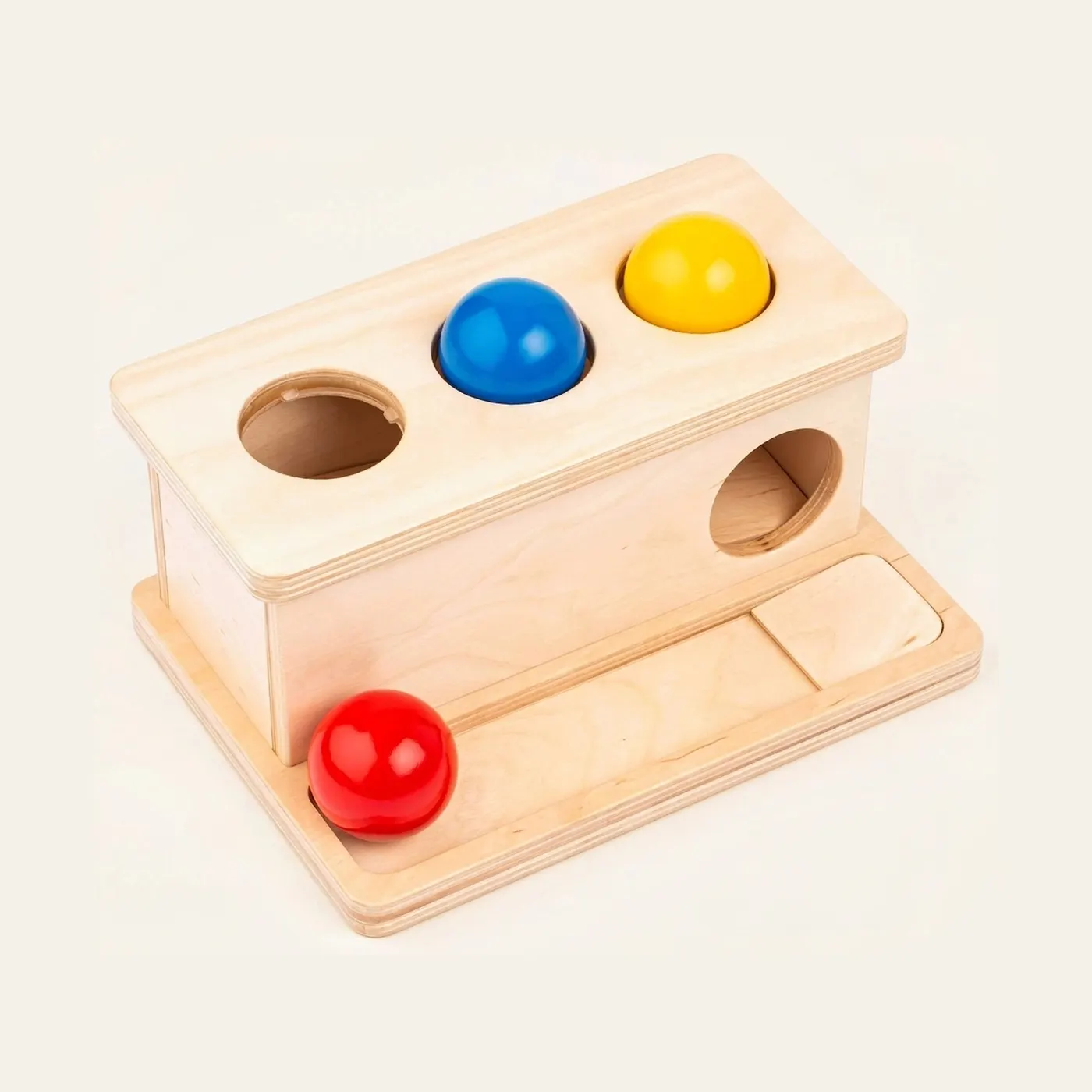
Designed for ages 0-3, this Push Box offers a progressive challenge for young children developing hand-eye coordination and object permanence. The plywood construction features three circular holes on top for pushing balls through, with side access openings and a sliding drawer at the base for retrieval. The design encourages repetitive practice while introducing cause-and-effect understanding through the satisfying drop and collection sequence.
“Children display a universal love of mathematics, which is par excellence the science of precision, order, and intelligence.”
The Push Box emerges from Montessori's understanding that infants and toddlers must experience object permanence through repeated, concrete actions rather than abstract concepts. Young children possess an innate drive to understand that objects continue to exist even when they disappear from view, and the Push Box's three circular holes provide the perfect mechanism for this discovery.
- Develops object permanence understanding through pushing balls into holes
- Refines pincer grasp and finger strength through repeated ball manipulation
- Coordinates hand-eye movements when aligning balls with circular openings
- Builds cause-and-effect reasoning by connecting pushing action with disappearing balls
Read More
When a child pushes a plastic ball through one of the holes, they witness its disappearance and hear it land inside the plywood construction, creating a sensory confirmation of the ball's continued existence. This specific activity satisfies the child's need for cause-and-effect exploration while developing the precise hand movements required for later writing and mathematical manipulation. The Push Box's graduated hole sizes accommodate different developmental stages, allowing the child to progress from larger to smaller openings as their finger dexterity improves. The simple plywood construction eliminates distractions, focusing attention entirely on the fundamental concept being explored. Through countless repetitions with the Push Box, children construct their understanding of spatial relationships and develop the concentration necessary for more complex learning.
How to present it
Follow the Montessori method of presentation for optimal child development.
Place the Push Box on a low table or mat at the child's working height. Set three balls in a small basket to the right of the box. Ensure the drawer is closed initially.
- 1
Sit beside the child and slowly pick up one ball using a three-finger grasp
Move deliberately to allow the child to track your movements - 2
Position the ball over the first hole and gently push it through
Pause after the ball drops to let the child hear the sound - 3
Repeat with remaining balls, then slowly open the drawer to reveal them
Express gentle surprise and delight at finding the balls - 4
Remove balls one by one from the drawer and place back in the basket
Count slowly as you remove each ball if child shows interest - 5
Close the drawer and invite the child to try
Remain silent during their work unless they seek help
Every Child Is a Little Creator

Heritage
Since 1929

In classrooms
Around the world

European brands
Nienhuis, GAM, Educo

AMI approved
To the association standard
Push Box: Object Permanence Development Activity
