
Puzzle Map: Japan
Made by Nienhuis Montessori · shipped by Heutink International (Netherlands) About the maker
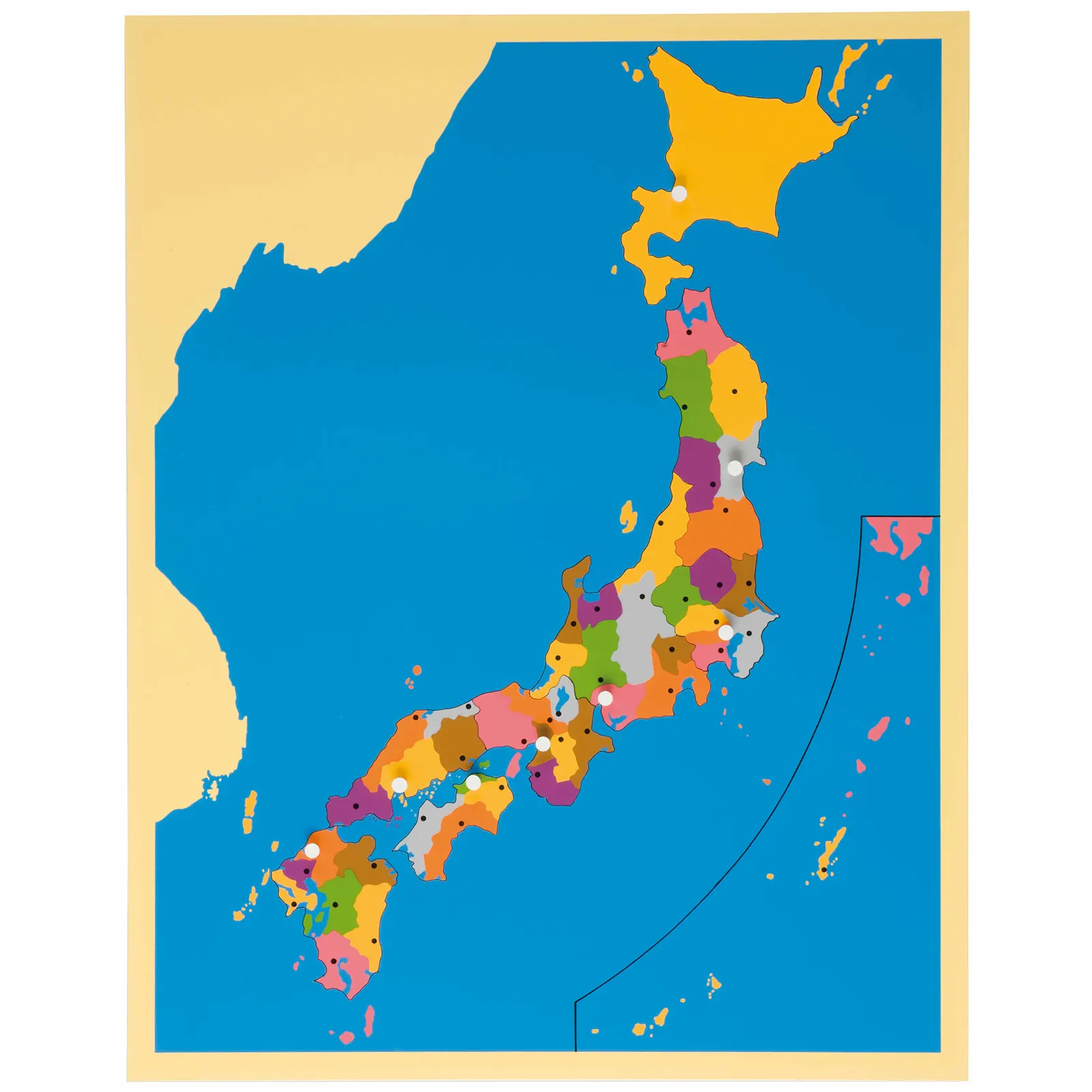
Puzzle Map: Japan gives a child aged three to six a laser cut, silk screened wooden map with a knob on every piece set exactly where the country's capital lies, so lifting and replacing each piece quietly teaches its location before the name is ever read. Painted or lacquered wood and the precise knob grip build the pincer hold that indirectly prepares the hand for later pencil work, while the whole activity lays a first sensorial layer of world geography. The matching control map later checks the same knowledge once names are introduced.
“Children display a universal love of mathematics, which is par excellence the science of precision, order, and intelligence.”
The Puzzle Map of Japan represents Maria Montessori's vision for concrete geography education, where each wooden prefecture piece becomes a tangible connection to place and culture.
- Spatial reasoning through fitting 47 uniquely shaped prefecture pieces
- Geographic vocabulary including prefecture names and capital cities
- Fine motor control through manipulating small wooden pieces
- Cultural awareness of Japan's administrative divisions
Read More
Through manipulating these 47 distinct wooden pieces, children physically construct their understanding of Japan's geographic divisions, moving from sensorial exploration to abstract comprehension. The puzzle's design with Hokkaido as a separate piece mirrors Japan's actual island geography, while the traditional blue surrounding waters establish spatial relationships. Each prefecture's painted surface and capital city marker transforms abstract political boundaries into concrete, memorable forms that children can trace, lift, and position. This wooden map serves as a bridge between the child's immediate environment and the wider world, cultivating both geographic literacy and cultural awareness through repeated hands-on assembly.
How to present it
Follow the Montessori method of presentation for optimal child development.
Place the puzzle map on a work mat at the child's table. Have a cloth nearby for handling pieces. Ensure all 47 prefecture pieces are present in the puzzle frame.
- 1
Invite the child to remove all pieces, starting with Hokkaido
Use slow, deliberate movements to model careful handling - 2
Mix the pieces on the mat, then select one to examine its shape
Trace the outline with your finger before placing - 3
Find where the piece fits by comparing its shape to spaces in the frame
Start with larger, distinctive prefectures like Hokkaido - 4
Continue until all 47 prefectures are correctly placed
Name each prefecture as you work for vocabulary building - 5
Point to capital city markers and name several capitals
Connect capitals to prefectures the child has successfully placed
Every Child Is a Little Creator

Heritage
Since 1929

In classrooms
Around the world

European brands
Nienhuis, GAM, Educo

AMI approved
To the association standard
Puzzle Map: Japan
