
Puzzle Map: Seas And Oceans
Made by Nienhuis Montessori · shipped by Heutink International (Netherlands) About the maker
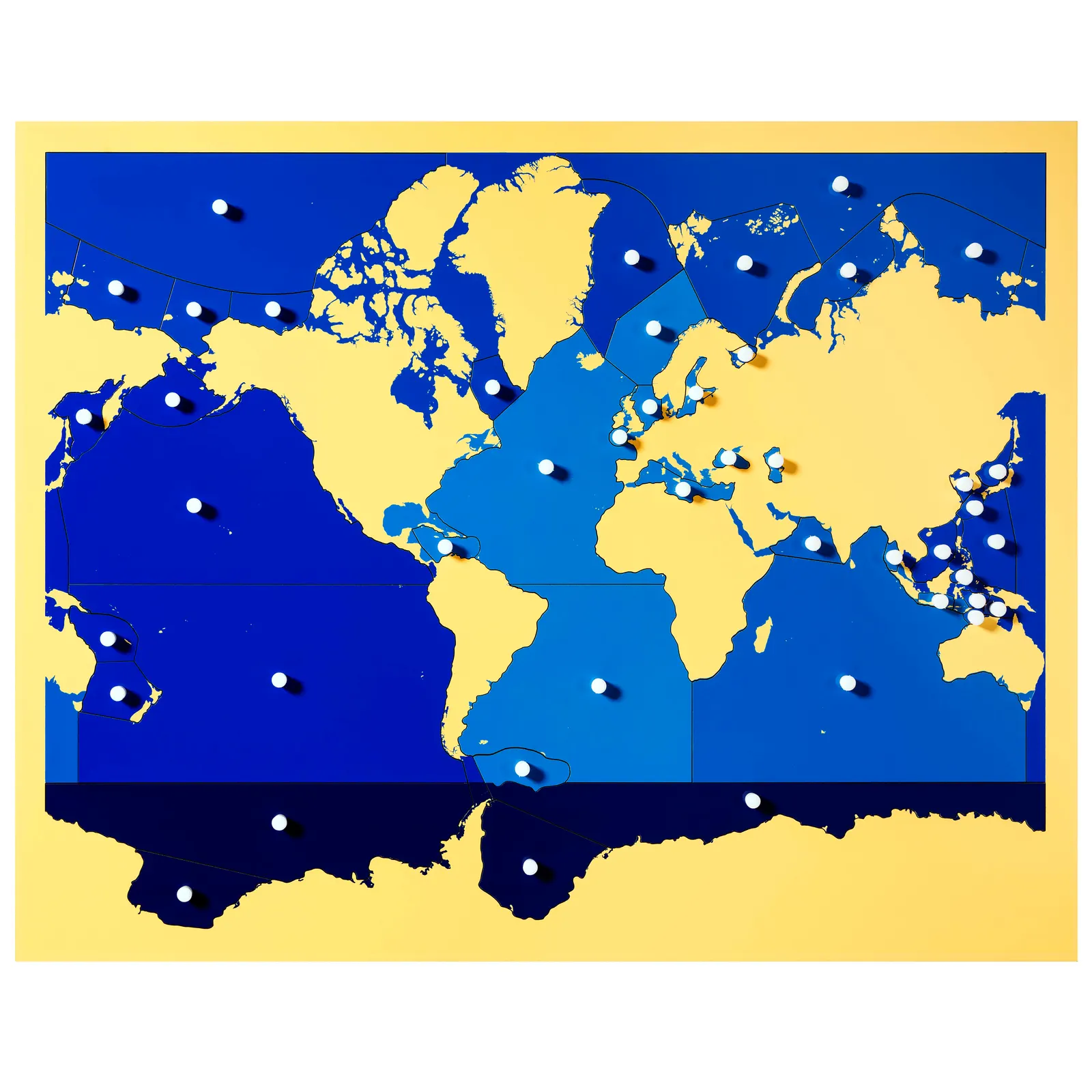
Puzzle Map: Seas and Oceans gives a child aged three to six a wooden piece for every sea and ocean, each fitted with a small knob for a precise pincer grip that indirectly prepares the hand for later pencil work. Lifting, placing and comparing the pieces against the frame builds a first sensorial map of the world's water long before names are attached, the very foundation the matching Control Map later checks against. It is sold as its own piece, separate from the control map used alongside it. Painted wood keeps every piece sturdy for years of hands on repetition.
“The greatest sign of success for a teacher is to be able to say, 'The children are now working as if I did not exist.'”
The Puzzle Map: Seas and Oceans introduces geography through water, addressing how three-year-olds first understand Earth as predominantly blue.
- Identifies and names five major oceans through puzzle piece manipulation
- Develops spatial reasoning by fitting ocean pieces into their specific boundaries
- Builds geographic vocabulary specific to seas, oceans, and water bodies
- Strengthens fine motor control through handling irregularly-shaped ocean pieces
Read More
Unlike traditional continent-focused maps, this puzzle's removable ocean pieces acknowledge that water bodies are distinct geographical entities deserving individual recognition. The fixed continents create a stable reference frame while the moveable blue pieces invite exploration of Earth's aquatic divisions. White identification dots on each ocean piece transform abstract water masses into concrete, nameable entities. This reversal of typical geography materials, where continents move and oceans remain static, reflects how young children perceive water as active and land as fixed. The puzzle's value reflects its specialized design where ocean boundaries become tangible through physical manipulation. By age six, children who work with this seas-focused puzzle develop equal familiarity with Pacific, Atlantic, Indian, Arctic, and Southern Oceans as they do with continents, creating balanced geographical awareness rooted in both land and water.
How to present it
Follow the Montessori method of presentation for optimal child development.
Place the puzzle map on a work mat with ocean pieces arranged randomly beside it. Have a small pitcher of water and blue cloth ready for the three-period lesson.
- 1
Invite the child to observe the map with continents fixed in place
Run your finger along the empty ocean spaces to show where pieces will fit - 2
Select the Pacific Ocean piece and name it while showing its white dot
Use the dot as a consistent reference point for orientation - 3
Demonstrate fitting the Pacific piece into its space, noting how it touches specific continents
Move slowly to show how the irregular edges match perfectly - 4
Continue with Atlantic and Indian Oceans, creating a three-period lesson
After placing each piece, trace its borders with your finger - 5
Invite the child to remove and replace ocean pieces independently
Stay silent during their work unless they request specific ocean names
Every Child Is a Little Creator

Heritage
Since 1929

In classrooms
Around the world

European brands
Nienhuis, GAM, Educo

AMI approved
To the association standard
Puzzle Map: Seas And Oceans
