
Pythagoras Board Activity Set
The first photo is the maker's own. The other shots are illustrative.
Inv. no. NIE-062201
- Maker
- Nienhuis Montessori, since 1929
- Approval
- AMI
- Storage Box
- Natural wood
- Activity Cards
- Laminated cardstock
- EAN
- 8719924013646
Final price incl. VAT. Delivery €5.90, €80.10 to go for free delivery.
Advice, warranty and returns are handled by us.
Why it costs €68.90
Behind the price of the original are things you can check yourself.
AMI approval
The material is approved by the Association Montessori Internationale (AMI). Nienhuis has made Montessori materials since 1929.
A verifiable original
The EAN 8719924013646 is on the box. It is the maker's number, not ours.
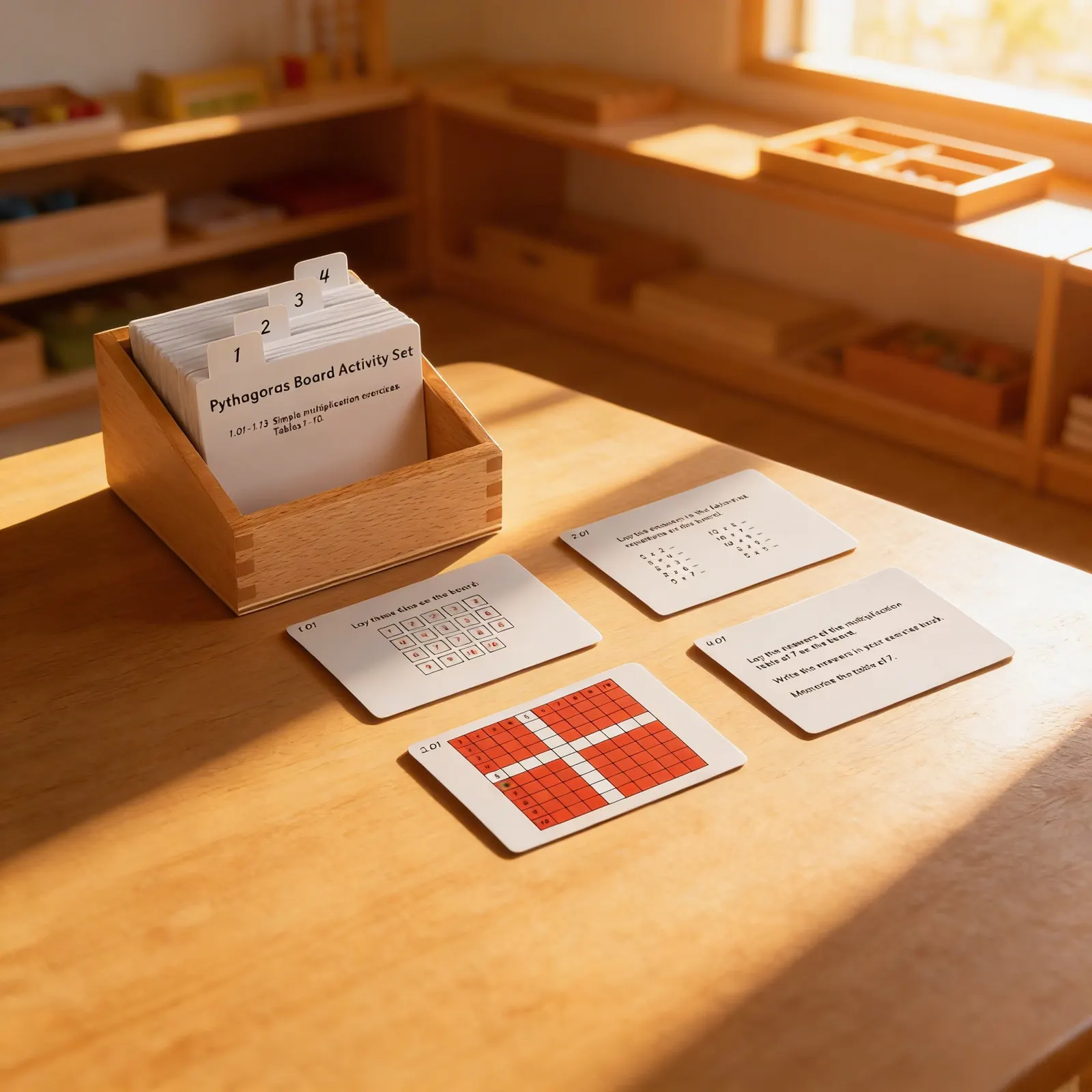
Pythagoras Board Activity Set in a child's hands
Exercise cards with divider tabs in a wooden box, extending the pythagoras board. The board lays out the multiplication tables as a square, and its whole argument is visual: the diagonal, the symmetry either side of it, the way the same product turns up twice. None of that is noticed by a child who uses the board once. These cards give the reasons to keep coming back until the pattern is seen rather than pointed out. Pythagoras board sold separately. Wood and laminated cardstock, for ages 3 to 12.
Mathematical Reasoning
Builds understanding of multiplication through visual patterns and systematic exploration of number relationships.
Abstract Thinking
Progresses from concrete grid manipulation to abstract mathematical concepts including the Pythagorean theorem.
Order and Sequence
Numbered dividers teach organization while sequential exercises develop systematic problem-solving approaches.
Pattern Recognition
Visual multiplication grids help children discover and internalize mathematical patterns naturally.
How to present it
Place the wooden storage box on a mat. Remove all numbered cards and sort them by value. Set out the first exercise card showing the empty multiplication grid.
- 1Begin with the ones family, placing cards 1-10 in the first row
- 2Continue with twos family (2,4,6,8,10,12,14,16,18,20), observing skip counting
- 3Fill subsequent rows, noticing when numbers repeat in different positions
- 4Complete the entire grid, then use exercise cards for pattern activities
3 tips for parents
- Practice skip counting during daily activities before introducing the board
- Focus on one multiplication family per session to avoid overwhelm
- Celebrate pattern discoveries rather than speed of completion

If you are not sure it suits your child, we answer in person.
Norbert Kovalčín, founder of Faborino · write to him
There is no review here yet. We will ask you for one after you buy. Write the first review
What's in the Box
- Wooden Storage Box: With solid construction
- Numbered Divider Cards: Cards labeled 1-4 for organization
- Multiplication Grid Cards: Visual pattern representations
- Exercise Cards: Progressive difficulty levels
- Pythagorean Theorem Cards: Advanced visual representations
Size and material
| Packaging | 14 × 13 × 11 cm |
| Storage Box | Natural wood |
| Activity Cards | Laminated cardstock |
| Recommended Age | 6-12 years |
Care
Wipe wooden box with damp cloth, clean cards with dry cloth
Frequently Asked Questions
What age is the Pythagoras Board Activity Set most appropriate for?
While labeled for ages 3-6, this material is typically introduced around age 5-6 when children have mastered skip counting and basic number concepts. It's most beneficial for children transitioning from concrete to abstract mathematical thinking.
How does the Pythagoras Board differ from traditional multiplication tables?
The Pythagoras Board provides a visual, hands-on approach where children physically place number cards in a grid pattern, discovering multiplication relationships through manipulation rather than memorization. This concrete experience helps children understand the concept before moving to abstract multiplication facts.
What skills should my child have before using this material?
Children should be comfortable with counting to 100, understand quantity and numeral recognition, and have experience with skip counting. Prior work with the golden bead material and stamp game provides helpful preparation for understanding multiplication as repeated addition.
What's included in the complete set?
The set includes a wooden storage box, numbered divider cards from 1-10, progressive exercise cards, and typically 100 small numbered tiles or cards. The exercise cards guide children from simple patterns to complex multiplication relationships.
How does this material support algebraic thinking?
By exploring number patterns visually, children discover relationships like commutativity (3×4 = 4×3) and begin recognizing square numbers and factors. This pattern recognition and understanding of mathematical relationships forms the foundation for later algebraic concepts.
Product safety
Manufacturer: Nienhuis Montessori, Anders Celsiusstraat 15, 7442 PB Nijverdal, Netherlands
Pythagoras Board Activity Set