
Quantity Splitting BoxTwo-Tier Mathematical Sorting Activity
The first photo is the maker's own. The other shots are illustrative.
Inv. no. NIE-320000
- Maker
- Nienhuis Montessori, since 1929
- Approval
- AMI
- Primary Material
- Beechwood
- Lid Material
- Plywood
- EAN
- 8719924023980
Final price incl. VAT. Delivery €5.90, €75.10 to go for free delivery.
Advice, warranty and returns are handled by us.
Why it costs €73.90
Behind the price of the original are things you can check yourself.
AMI approval
The material is approved by the Association Montessori Internationale (AMI). Nienhuis has made Montessori materials since 1929.
A verifiable original
The EAN 8719924023980 is on the box. It is the maker's number, not ours.
Quantity Splitting Box in a child's hands
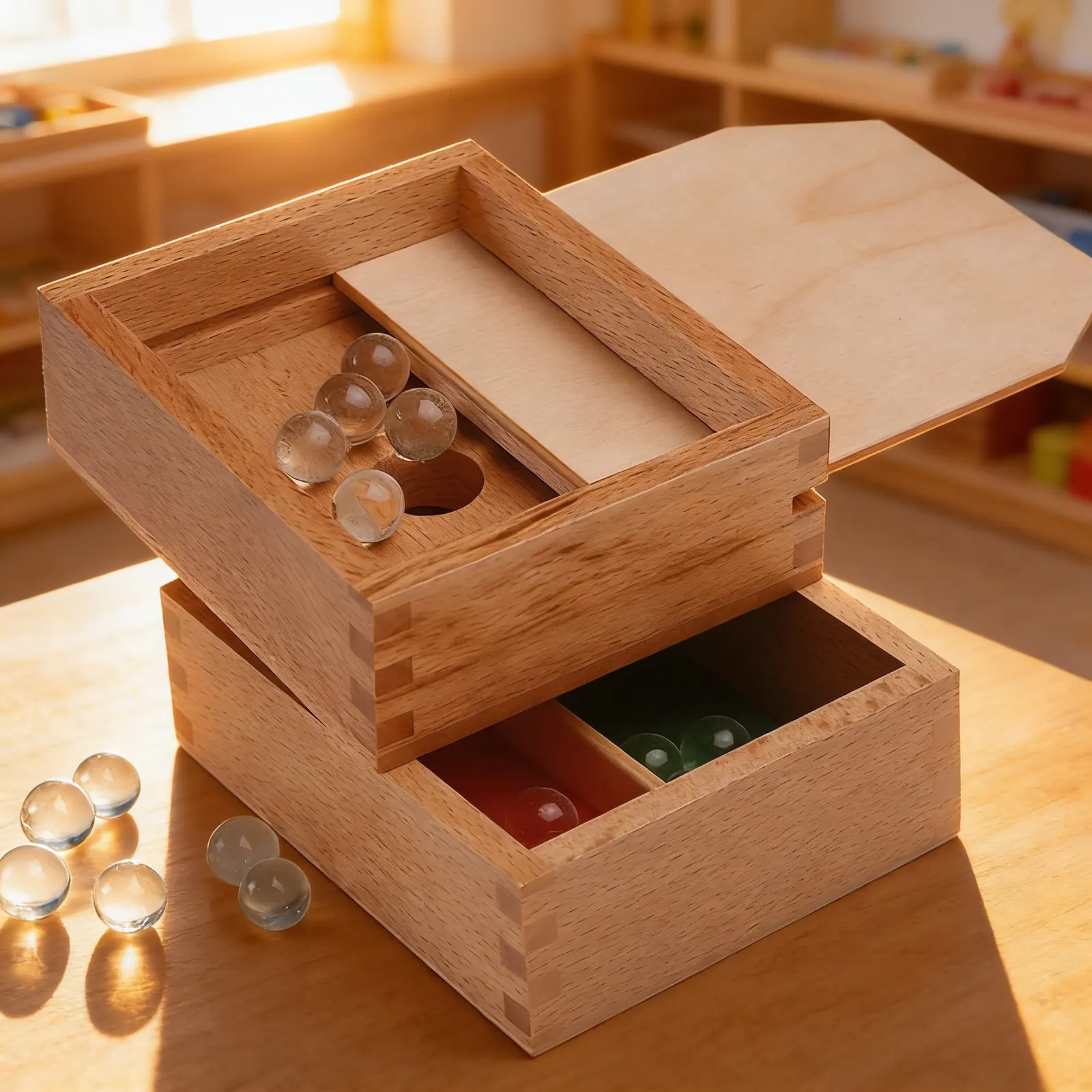
Two stacking beechwood boxes and twenty marbles, for the combinations up to twenty that classroom observation shows children find hardest to hold. The upper box has a sliding panel and a sloping floor with a hole in the middle; marbles dropped in fall through into the lower box, which is divided into two compartments lined with a green and a red felt. A count goes in, the split is out of the child's hands, and what comes out is one of the pairs that makes it. Instructions are included. Beechwood, plywood and marbles, for ages 3 to 6.
Mathematical Reasoning
Splitting quantities develops understanding of division, equal distribution, and number relationships through concrete manipulation.
Fine Motor Control
Precise marble placement and sliding lid operation refine pincer grip and hand-eye coordination.
Visual Discrimination
Sorting colored marbles into compartments strengthens visual perception and classification skills.
Concentration Development
The systematic process of distributing marbles equally requires sustained focus and attention to detail.
How to present it
Place the box on a tray with the sliding lid closed. Ensure all marbles are in the top compartment. Position at child's dominant hand side on the table.
- 1Invite the child, demonstrating how to carry the tray with two hands to the table
- 2Slide open the lid using thumb and index finger, revealing the marbles
- 3Select one marble using three-finger grip and place it in the first compartment below
- 4Continue placing one marble in each compartment until all are distributed equally
- 5Observe the equal quantities, then return marbles one by one to the top compartment
3 tips for parents
- At home, practice similar distribution activities using egg cartons and dried beans
- Allow your child to help distribute snacks equally among family members
- Resist counting aloud - let the visual and tactile experience speak first

If you are not sure it suits your child, we answer in person.
Norbert Kovalčín, founder of Faborino · write to him
There is no review here yet. We will ask you for one after you buy. Write the first review
What's in the Box
- Wooden splitting box: Two-tier design with sliding lid
- Glass marbles: Approx. 15 pieces in assorted colors
Size and material
| Packaging | 15 × 16 × 11 cm |
| Primary Material | Beechwood |
| Lid Material | Plywood |
| Marbles | Glass |
| Recommended Age | 3-6 years |
Care
Wipe with slightly damp cloth, dry immediately
Frequently Asked Questions
What mathematical concepts does the Quantity Splitting Box teach?
The Quantity Splitting Box introduces one-to-one correspondence, quantity distribution, early division concepts, and number sense. Children learn to split quantities equally, compare amounts, and understand the relationship between wholes and parts through hands-on manipulation.
How many marbles come with the Quantity Splitting Box?
The box typically includes 20-30 colored glass marbles stored in the sliding lid compartment. The exact quantity allows children to practice splitting numbers into equal groups of 2, 3, 4, 5, or more, supporting various mathematical explorations.
What is the difference between this and other Montessori math materials?
While classified as Sensorial, the Quantity Splitting Box bridges sensorial and mathematical learning. Unlike abstract counting materials, it provides concrete, visual representation of division through physical distribution, making it ideal for introducing mathematical concepts before formal math materials.
How do children progress with the Quantity Splitting Box activities?
Children begin by freely exploring marble distribution, then progress to equal sorting (dividing marbles evenly), pattern creation, and eventually understanding remainders. Extensions include skip counting, introduction to fractions, and preparation for division operations.
Is the Quantity Splitting Box safe for 3-year-olds given the small marbles?
Yes, when used under appropriate supervision. The glass marbles are specifically chosen for their weight and sensorial quality. Always ensure children who still mouth objects are closely supervised, and consider the individual child's readiness for materials with small parts.
Product safety
Manufacturer: Nienhuis Montessori, Anders Celsiusstraat 15, 7442 PB Nijverdal, Netherlands
Quantity Splitting Box