
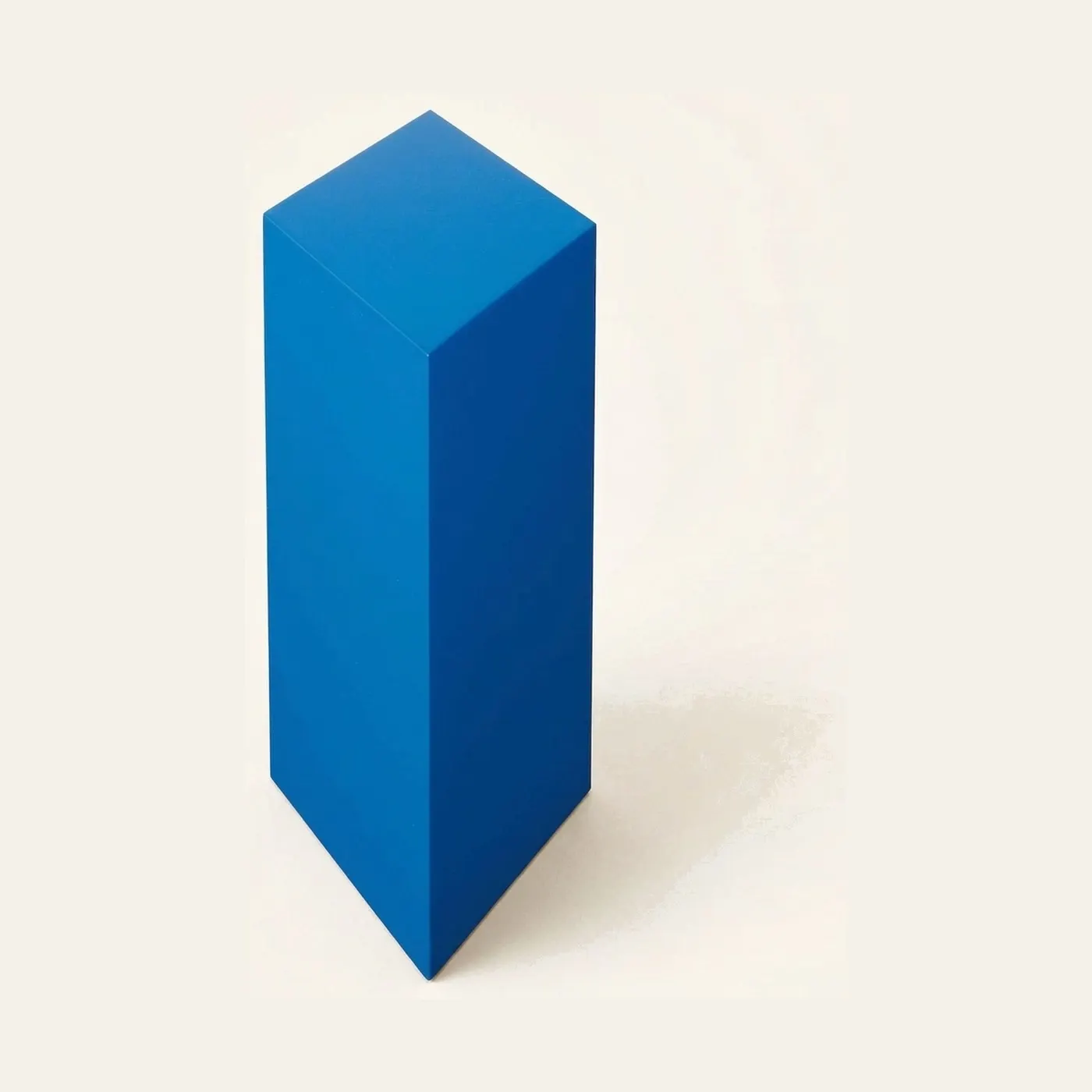
Rhombic Based Prism: Complex 3D Geometric Form with Triangular Top
Made by Nienhuis Montessori · shipped by Heutink International (Netherlands) About the maker
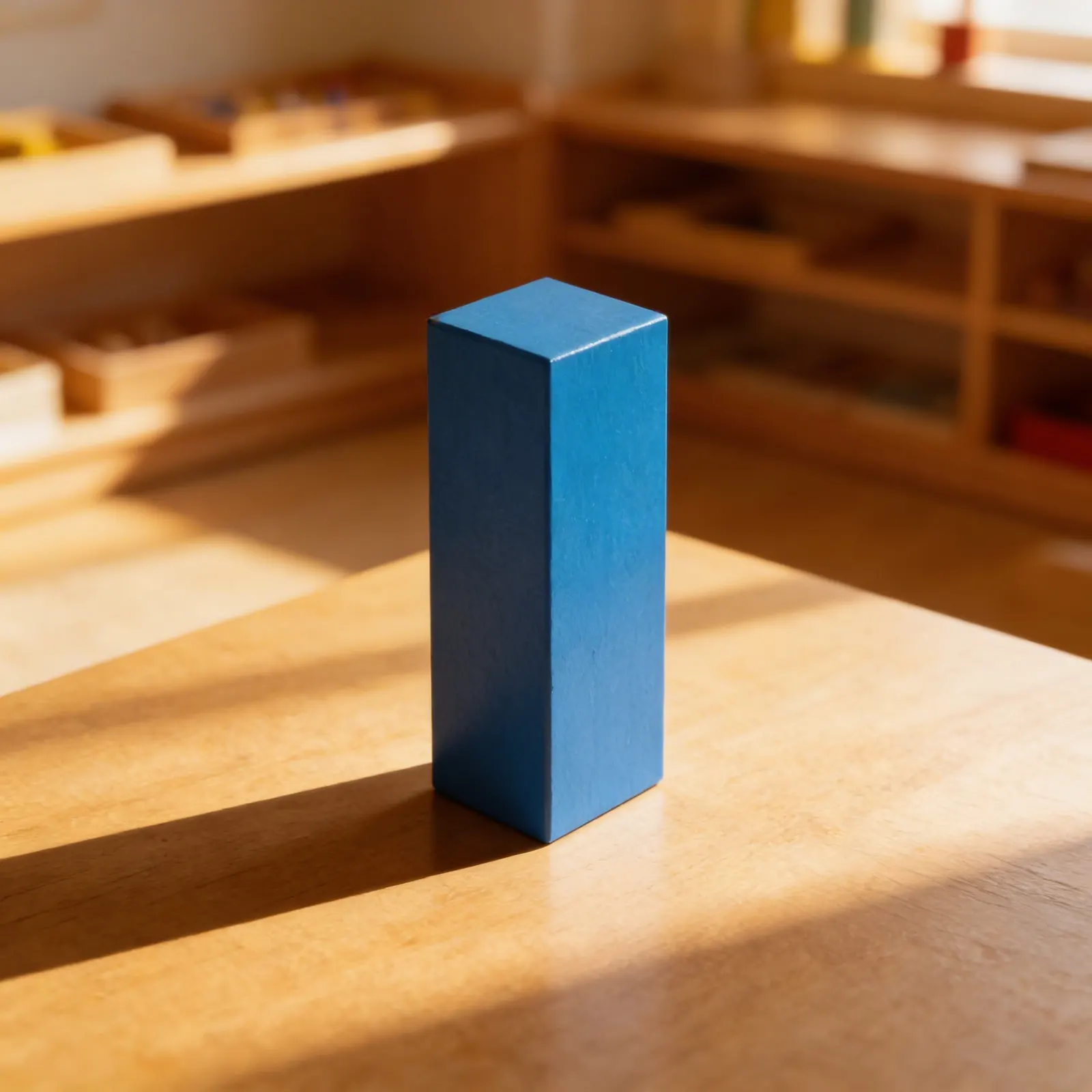
A rhombic based prism from the blue geometric solids, the awkward one in the set and the more useful for it. A rhombus is a square that has been pushed over, and a prism built on one keeps the same base area while looking nothing like the square prism beside it. That is the whole lesson about area surviving a shear, met by hand rather than by formula. Derived from a base of 10 x 10 cm and a height of 20 cm. Sold individually. Solid hardwood, for ages 6 to 12.
“The greatest sign of success for a teacher is to be able to say, 'The children are now working as if I did not exist.'”
The Rhombic Based Prism embodies Montessori's principle of isolating difficulty by presenting one complex geometric concept through a concrete, manipulable form.
- Recognition and naming of rhombic bases and their properties in three-dimensional forms
- Understanding the relationship between rhombus (2D) and rhombic-based solids (3D)
- Development of spatial reasoning through analysis of tapering geometric forms
- Refinement of stereognostic sense through tactile exploration of edges, vertices, and faces
Read More
As part of the geometric solids, it serves as a bridge between the sensorial experiences of early childhood and the abstract mathematical thinking of the elementary years. This material respects the child's need for sensorial exploration while introducing sophisticated geometric concepts. Through handling this solid, children develop what Montessori called 'stereognostic sense' - the ability to recognize forms through touch and movement. The material's precision and beauty invite repeated exploration, allowing children to internalize the properties of this unique form through their senses before moving to abstract understanding.
How to present it
Follow the Montessori method of presentation for optimal child development.
Place the rhombic based prism on a felt mat alongside other geometric solids. Have a tray with modeling clay, paper, and pencils nearby for extension work.
- 1
Invite the child to explore the solid with both hands, tracing all edges and vertices with fingertips
Encourage slow, deliberate movements to fully experience the form - 2
Introduce the nomenclature: 'This is a rhombic based prism.' Point to the rhombic base and trace its four equal sides
Use precise geometric language consistently - 3
Compare the rhombic base to the triangular apex, noting how the form tapers
Have the child close their eyes and feel the transition from base to apex - 4
Count and identify all faces, edges, and vertices together
Record findings on paper to reinforce mathematical thinking - 5
Create impressions of each face in clay to explore the 2D shapes that compose the solid
This helps children see the relationship between 2D and 3D forms
Every Child Is a Little Creator

Heritage
Since 1929

In classrooms
Around the world

European brands
Nienhuis, GAM, Educo

AMI approved
To the association standard
Rhombic Based Prism: Complex 3D Geometric Form with Triangular Top
