
Roman Numeral Overview
The first photo is the maker's own. The other shots are illustrative.
Inv. no. NIE-ELC3011
- Maker
- Nienhuis Montessori, since 1929
- Material
- Durable plastic
- Finish
- Pre-cut with rounded corners
- EAN
- 8719924043766
Final price incl. VAT. Delivery €5.90, €102.10 to go for free delivery.
Advice, warranty and returns are handled by us.
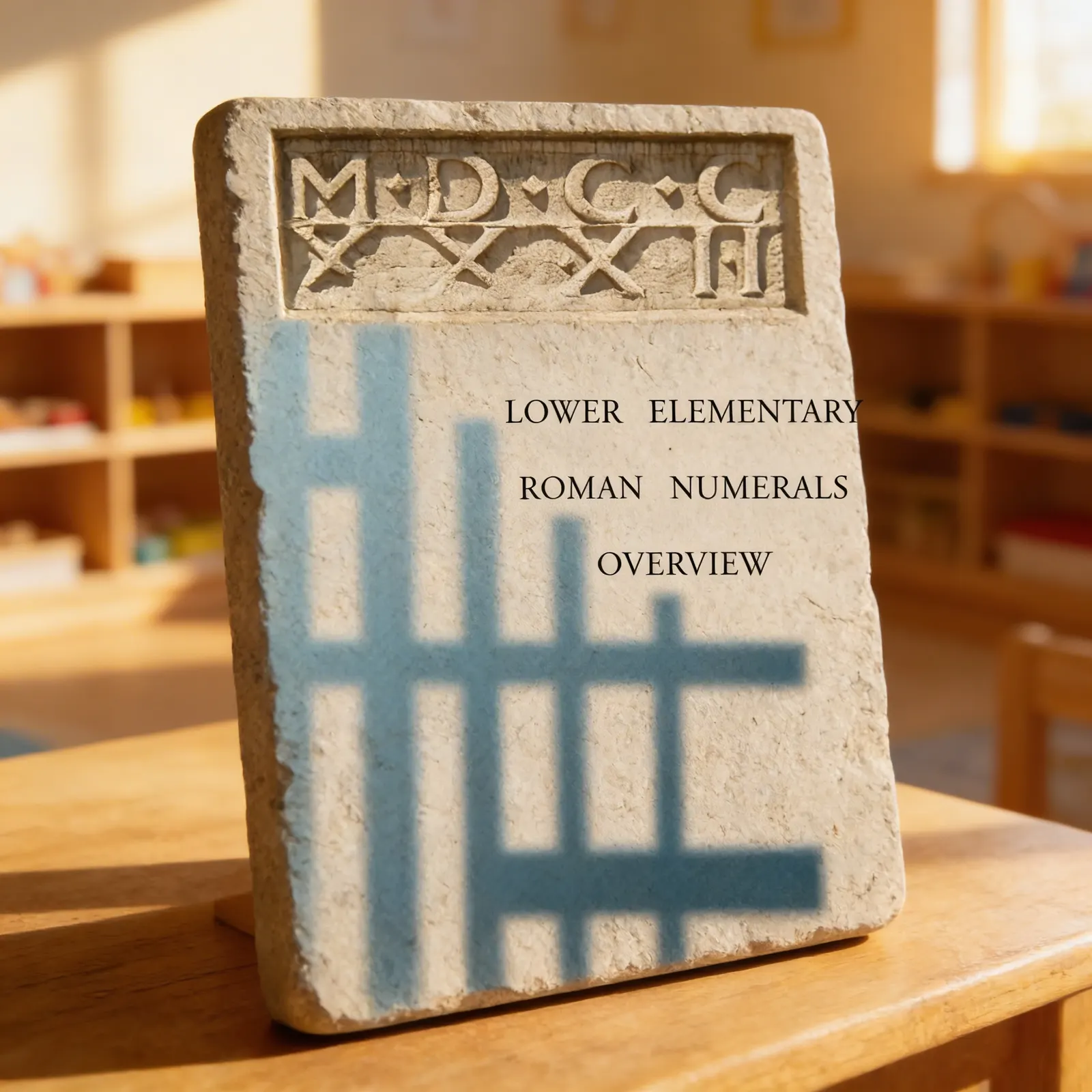
Roman Numeral Overview in a child's hands
The Roman Numeral Overview board lays the groundwork for understanding the ancient number system through tactile exploration of carved or printed numerals from I to X. This wooden display board features raised or recessed Roman numerals within a framed border, freeing children to trace and internalize these historical mathematical symbols. The material bridges cultural mathematics education with sensorial learning, preparing children for advanced number concepts.
Cultural Mathematics
Introduces historical number systems, enriching mathematical understanding with cultural context.
Symbol Recognition
Develops ability to recognize and differentiate Roman numerals through repeated tactile exploration.
Number Correspondence
Builds connections between Roman symbols and quantity concepts already mastered with golden beads.
Fine Motor Refinement
Tracing carved or raised numerals strengthens finger muscles needed for writing.
How to present it
Place the Roman Numeral Overview board on a mat at the child's workspace. Have sandpaper letters nearby if the child needs additional tactile reinforcement. Ensure good lighting to see the raised or recessed details clearly.
- 1Introduce numerals I, V, and X first, demonstrating slow tracing with index and middle fingers
- 2Show how I represents one unit by counting on fingers while tracing
- 3Demonstrate V as five, showing an open hand while tracing the numeral
- 4Present combinations like II, III, and IV, explaining the additive principle
- 5Practice identifying numerals in random order after systematic introduction
3 tips for parents
- Point out Roman numerals in everyday life: clocks, building dates, book chapters
- Create a Roman numeral hunt during family outings to reinforce learning
- Avoid rushing through all numerals; mastery of I-V is more valuable than superficial knowledge of I-X

If you are not sure it suits your child, we answer in person.
Norbert Kovalčín, founder of Faborino · write to him
There is no review here yet. We will ask you for one after you buy. Write the first review
What's in the Box
- Roman Numeral Board: With numerals I through X
Size and material
| Packaging | 28 × 22 × 2 cm |
| Material | Durable plastic |
| Finish | Pre-cut with rounded corners |
| Recommended Age | 6-12 years |
Care
Wipe with slightly damp cloth, dry immediately
Frequently Asked Questions
At what age should children start learning Roman numerals in Montessori?
While the board is suitable for ages 3-6, Roman numerals are typically introduced around age 5-6, after children have mastered Arabic numerals 1-10 and have strong number recognition skills.
How does this material help children understand Roman numerals?
The tactile design allows children to trace the raised or recessed numerals with their fingers, creating muscle memory while learning the visual patterns. This sensorial approach helps children internalize the symbols before abstract use.
What prerequisite skills should children have before using this material?
Children should be comfortable with quantities 1-10, have experience with sandpaper numerals, and demonstrate readiness for cultural studies. Basic one-to-one correspondence and number sequencing skills are essential.
How do I present this material to a young child?
Begin with a three-period lesson for numerals I-III, having the child trace each symbol while saying its value. Gradually introduce additional numerals, always connecting them to known quantities using concrete materials like counters.
Can this board be used alongside regular number work?
Yes, it enriches mathematical understanding by showing different cultural representations of numbers. Use it as a parallel activity to Arabic numeral work, helping children understand that numbers can be represented in various ways across cultures.
Product safety
Manufacturer: Nienhuis Montessori, Anders Celsiusstraat 15, 7442 PB Nijverdal, Netherlands
Roman Numeral Overview