
Rough And Smooth Boards Set (Nienhuis)
The first photos are the maker's own. The other shots are illustrative.
Inv. no. NIE-0012A0
- Maker
- Nienhuis Montessori, since 1929
- Approval
- AMI
- Product size
- 24 × 13 cm
- Frame
- Natural wood
- Rough Surfaces
- Graduated sandpaper
- EAN
- 8719924000141
Final price incl. VAT. Delivery €5.90, €105.10 to go for free delivery.
Advice, warranty and returns are handled by us.
Why it costs €43.90
Behind the price of the original are things you can check yourself.
AMI approval
The material is approved by the Association Montessori Internationale (AMI). Nienhuis has made Montessori materials since 1929.
A verifiable original
The EAN 8719924000141 is on the box. It is the maker's number, not ours.
Rough And Smooth Boards Set (Nienhuis) in a child's hands
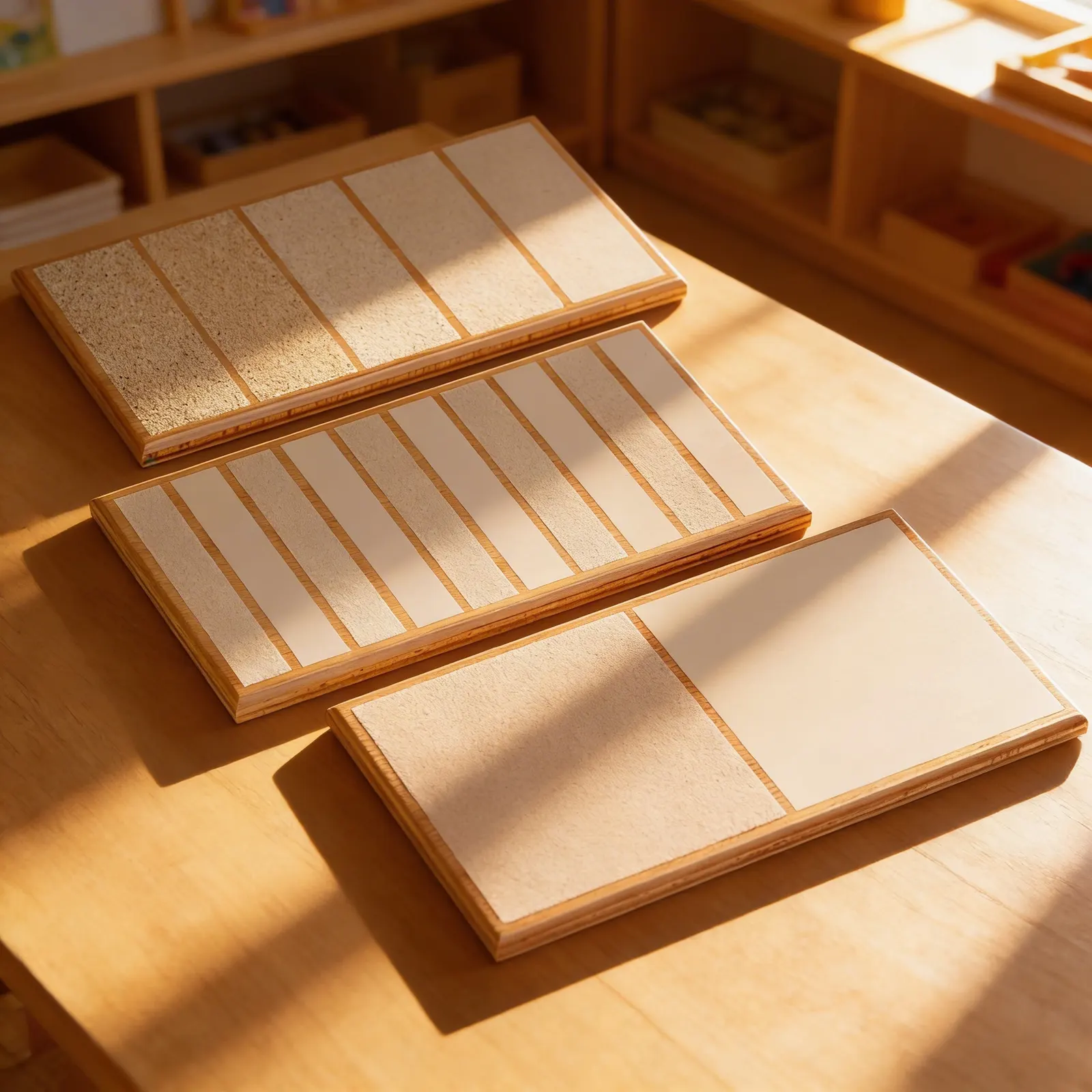
Three boards of 24 by 13 cm with sandpaper strips mounted on smooth wood, and they are meant to be worked in order. The first sets rough against smooth with nothing in between, which is the only contrast a young hand can be certain of. The second coordinates the finger movement itself and builds the dexterity the later work assumes. The third grades texture from fine to coarse, so the answer is no longer yes or no but where along a range. Wood with sandpaper, for ages 3 to 6.
Tactile Discrimination
Refines the sense of touch through systematic exploration of texture differences, building sensory awareness and vocabulary.
Writing Preparation
Develops the light touch and finger sensitivity essential for proper pencil grip and controlled writing movements.
Language Development
Introduces comparative and superlative concepts while building descriptive vocabulary for textures and sensations.
Concentration Building
The focused tactile work requires sustained attention, strengthening the child's ability to concentrate on subtle sensory information.
How to present it
Place the first board (alternating rough and smooth strips) on a table mat. Ensure hands are clean and dry. Have a small pitcher of warm water and towel nearby to sensitize fingertips if needed.
- 1Sensitize fingertips by dipping them briefly in warm water and drying
- 2Demonstrate touching the smooth section with two fingers, moving left to right slowly
- 3Touch the rough section with the same gentle, left-to-right motion
- 4Invite the child to feel both textures using the same movements
- 5Introduce vocabulary: 'This is rough' and 'This is smooth' while touching each
- 6Proceed to the three-period lesson for language acquisition
3 tips for parents
- Create texture matching games at home using fabric squares or household items
- During daily activities, use descriptive texture words: 'The towel feels rough, your shirt feels smooth'
- Let your child explore safe textures during cooking: smooth eggs shells, rough salt crystals

If you are not sure it suits your child, we answer in person.
Norbert Kovalčín, founder of Faborino · write to him
There is no review here yet. We will ask you for one after you buy. Write the first review
What's in the Box
- Graduated Texture Board: Multiple sandpaper grades from coarse to fine
- Alternating Strips Board: Narrow rough and smooth strips
- Large Panel Board: Contrasting rough and smooth sections
Size and material
| Product size | 24 × 13 cm |
| Packaging | 24 × 13 × 3 cm |
| Frame | Natural wood |
| Rough Surfaces | Graduated sandpaper |
| Smooth Surfaces | Laminate finish |
| Recommended Age | 3-6 years |
Care
Wipe wooden frames with damp cloth; avoid wetting sandpaper surfaces
Frequently Asked Questions
What are the three boards included in this set and how do they differ?
The set includes three boards: Board 1 alternates rough and smooth strips for contrast recognition, Board 2 features graduated sandpaper from roughest to smoothest for grading exercises, and Board 3 contains the finest gradations to refine tactile discrimination. Each board serves a specific developmental purpose in the sensorial curriculum.
How does this material prepare children for writing?
The boards develop the lightness of touch essential for proper pencil grip and control. By tracing the sandpaper surfaces with their fingertips, children strengthen the same muscles used in writing while developing sensitivity to pressure. This tactile preparation complements the direct preparation provided by the sandpaper letters.
What is the proper presentation technique for these boards?
Demonstrate using the first two fingers (writing fingers) with a light, sweeping motion from left to right. Show the contrast between rough and smooth on Board 1, then grade the textures on Board 2 from roughest to smoothest. Board 3 requires the most refined touch. Always model the vocabulary: 'rough,' 'smooth,' 'rougher,' 'roughest,' 'smoother,' 'smoothest.'
Can children use these boards with closed eyes?
Yes, working blindfolded is an excellent extension that isolates the tactile sense and increases concentration. Start with Board 1 for clear contrast recognition, then progress to grading exercises with Board 2. This stereognostic activity strengthens the child's ability to discriminate through touch alone.
What activities can extend learning with these boards?
Extensions include matching fabric textures, creating texture books, grading natural materials like leaves or shells, and playing texture matching games. Children can also explore textures in the environment, use comparative and superlative language in descriptions, and combine with other sensorial materials for integrated lessons.
Product safety
Manufacturer: Nienhuis Montessori, Anders Celsiusstraat 15, 7442 PB Nijverdal, Netherlands
Rough And Smooth Boards Set (Nienhuis)