
Rough Gradation Tablets: Tactile Discrimination Activity
Made by Nienhuis Montessori · shipped by Heutink International (Netherlands) About the maker
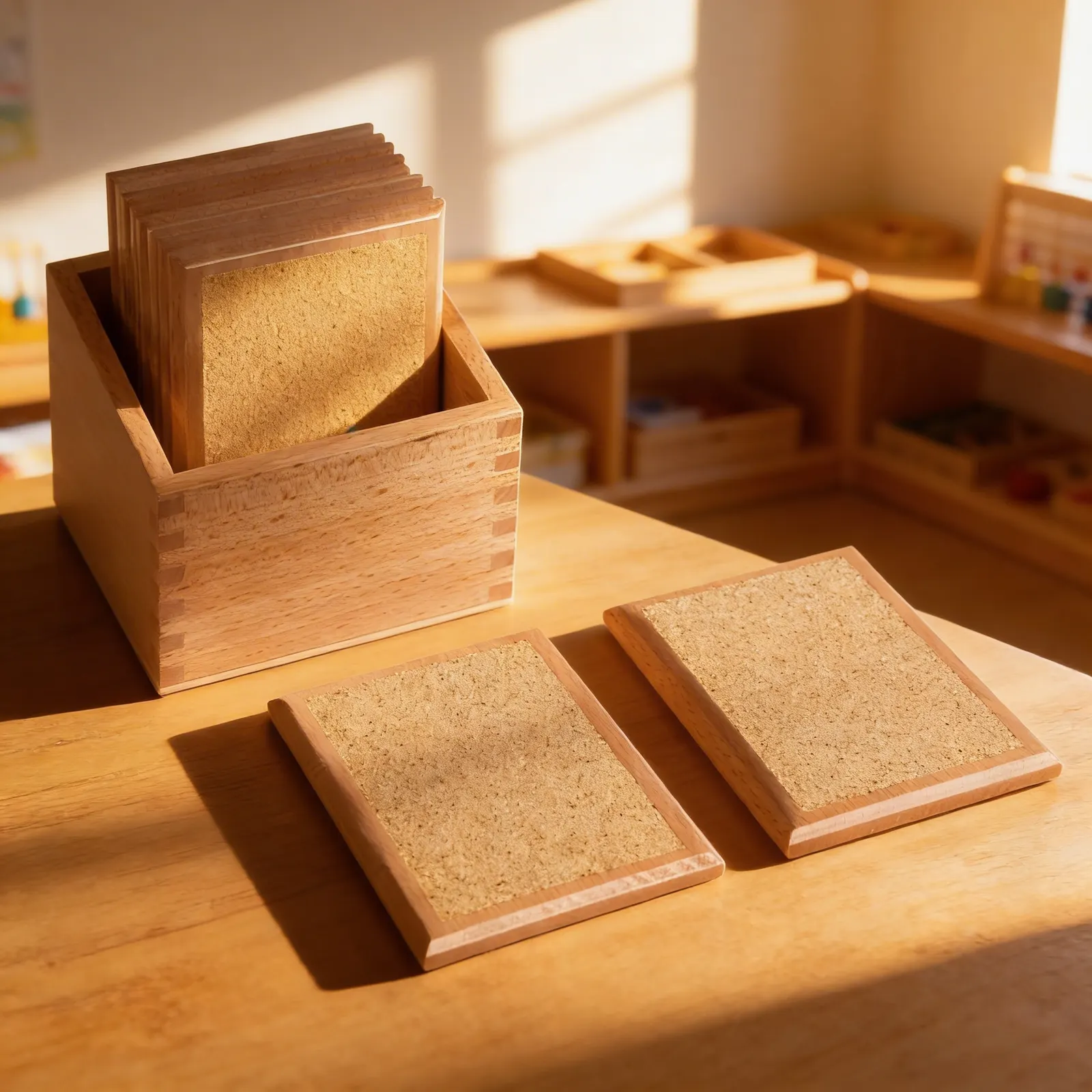
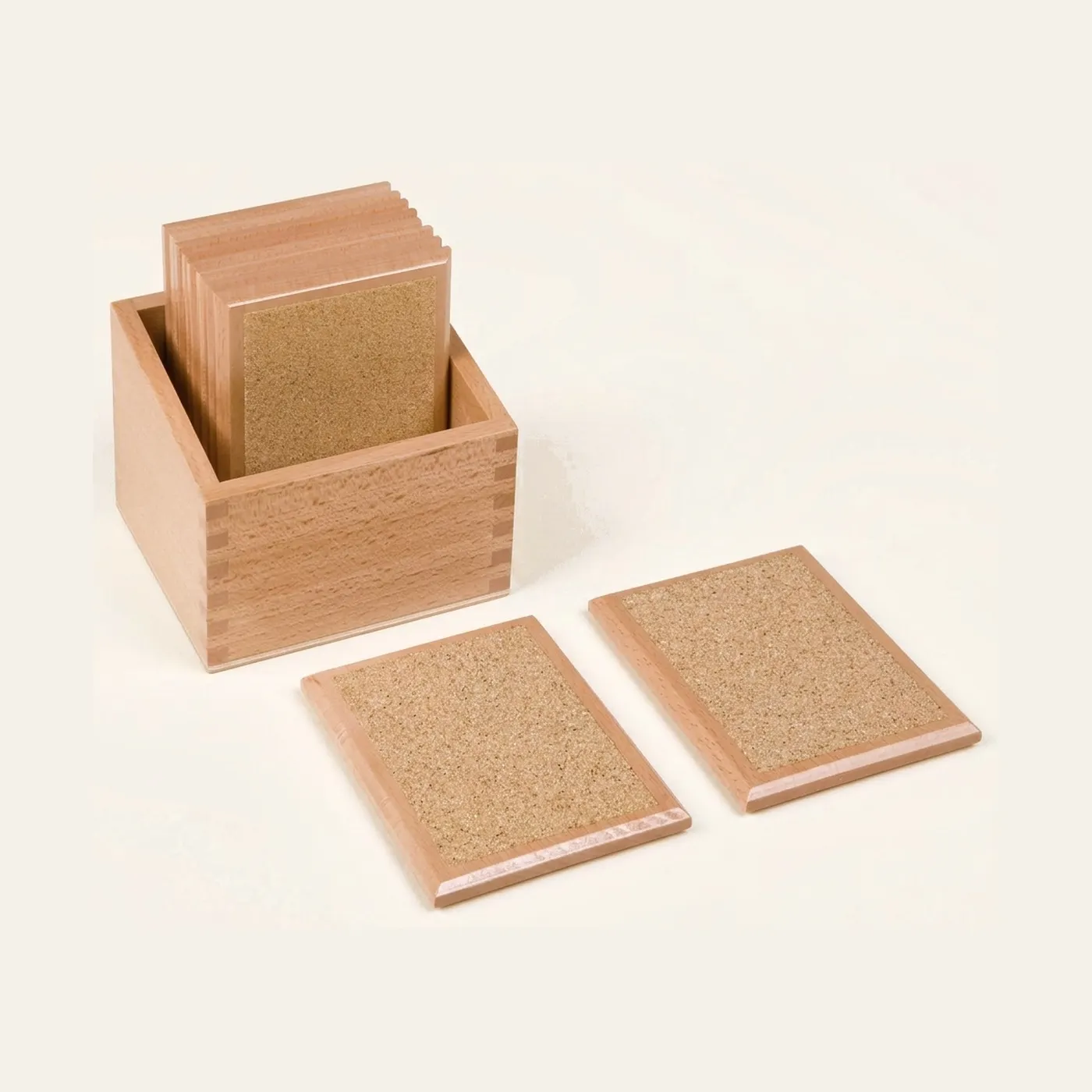
Five pairs of sandpaper in graded roughness, mounted on solid beechwood tablets of 12 by 9 cm, with a box to keep them in. Pairing them is done with the eyes closed, and it has to be, because sandpaper grades look far more alike than they feel. Five grades is a deliberate limit: enough that the middle three are genuinely hard to tell apart, few enough that a child can hold the whole range in their fingers at once. Beechwood with graded sandpaper, for ages 3 to 6.
“The child is both a hope and a promise for mankind.”
The Rough Gradation Tablets embody Dr. Montessori's principle of education through the senses, recognizing that young children learn through concrete, sensorial experiences. This material isolates the tactile sense, allowing the child to focus solely on the quality of texture without visual distraction.
- Refined tactile discrimination and sensitivity to texture gradations
- Development of the lightness of touch needed for writing
- Strengthened pincer grip and hand control through tracing movements
- Enhanced concentration through focused sensorial exploration
Read More
Through repeated exploration of these graduated surfaces, children develop refined tactile discrimination - a foundation for later academic work. The material's self-correcting nature supports the child's natural drive toward precision and order. As children trace the sandpaper surfaces, they simultaneously prepare their hands for writing movements, demonstrating Montessori's integrated approach where indirect preparation weaves through all activities. The gradation aspect satisfies the child's mathematical mind, introducing the concept of series and sequence through touch.
How to present it
Follow the Montessori method of presentation for optimal child development.
Place the box of tablets on a table mat. Ensure hands are clean and warm. Sit to the child's dominant side.
- 1
Remove the first tablet (roughest) and demonstrate tracing with two fingers (index and middle) moving from top to bottom slowly
Use the same fingers children will later use to hold a pencil - 2
Invite the child to trace the same tablet, observing their touch pressure
Model a light, gentle touch if the child presses too hard - 3
Introduce the smoothest tablet for contrast, using the same tracing motion
Pause between tablets to heighten sensory awareness - 4
Mix these two tablets and invite the child to find the rough one with eyes closed
This builds confidence before introducing the full gradation - 5
Gradually introduce middle gradations, always working with contrasts first
Start with every other tablet before attempting the complete series - 6
Once familiar with all tablets, invite the child to grade from roughest to smoothest
Let the child self-correct by re-feeling tablets when uncertain
Every Child Is a Little Creator

Heritage
Since 1929

In classrooms
Around the world

European brands
Nienhuis, GAM, Educo

AMI approved
To the association standard
Rough Gradation Tablets: Tactile Discrimination Activity
