
Sandpaper CapitalsInternational Cursive
The first photo is the maker's own. The other shots are illustrative.
Inv. no. NIE-005700
- Maker
- Nienhuis Montessori, since 1929
- Approval
- AMI
- Cards
- Sturdy cardboard
- Letters
- Fine-grain sandpaper
- EAN
- 8719924003470
Final price incl. VAT. Delivery €5.90, €15.10 to go for free delivery.
Advice, warranty and returns are handled by us.
Why it costs €133.90
Behind the price of the original are things you can check yourself.
AMI approval
The material is approved by the Association Montessori Internationale (AMI). Nienhuis has made Montessori materials since 1929.
A verifiable original
The EAN 8719924003470 is on the box. It is the maker's number, not ours.
Sandpaper Capitals in a child's hands
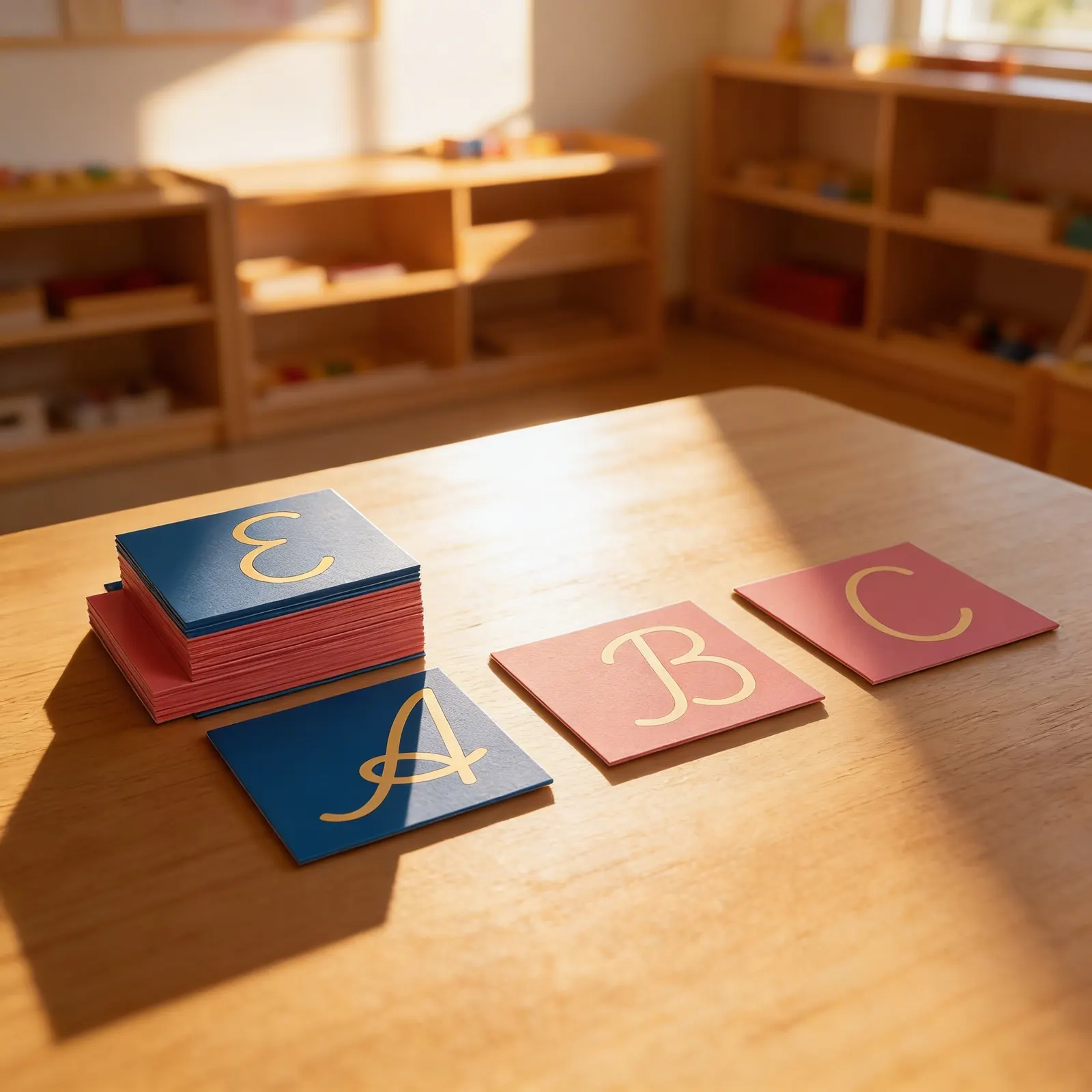
Capitals in international cursive, cut from sandpaper so the fingertip follows the letter in the direction it is written. Consonants sit on pink boards and vowels on blue, which sorts the alphabet into its two kinds by colour before anyone explains what a vowel is. Tracing is not decoration here: it lays down the movement the hand will later make with a pencil, which is why children who have traced write more fluently than children who have only copied. Sandpaper on card, for ages 3 to 6.
Tactile Letter Recognition
Tracing sandpaper letters develops the finger strength and movement patterns essential for writing, while the texture reinforces letter formation through touch.
Visual Discrimination
Color-coding helps children distinguish between vowels and consonants, supporting early phonemic awareness and letter classification skills.
Cursive Writing Preparation
International cursive capitals introduce the flowing movements of cursive script, preparing the hand for continuous writing motion.
Concentration Development
The focused tracing activity strengthens attention span while integrating visual, tactile, and kinesthetic learning pathways.
How to present it
Place the sandpaper capitals on a mat or table. Select 2-3 letters to introduce, ensuring contrast in formation (e.g., curved C, straight I, complex G). Have a small tray with chalk and chalkboard nearby for extension work.
- 1Demonstrate tracing the first letter with your dominant writing fingers (index and middle), moving slowly and deliberately while saying the letter's sound
- 2Invite the child to trace the same letter, observing their finger position and movement direction
- 3Introduce the second letter using the same process, then offer both for the child to trace
- 4Play the three-period lesson: 'This is...', 'Show me...', 'What is...' using the letter sounds
3 tips for parents
- Practice tracing letters in everyday textures at home: flour, sand, or steamy windows to reinforce the movements
- Focus on the letter's sound rather than its name when your child shows you their work
- Resist correcting reversed tracing - simply model the correct direction during your next interaction

If you are not sure it suits your child, we answer in person.
Norbert Kovalčín, founder of Faborino · write to him
There is no review here yet. We will ask you for one after you buy. Write the first review
What's in the Box
- Sandpaper Capital Letters: Approx. 26 cards with cursive capitals
- Storage Box: For organized card storage
Size and material
| Packaging | 26 × 20 × 11 cm |
| Cards | Sturdy cardboard |
| Letters | Fine-grain sandpaper |
| Recommended Age | 3-6 years |
Care
Gently dust with soft brush; avoid moisture
Frequently Asked Questions
What is the difference between international cursive and regular cursive?
International cursive is a standardized form of cursive writing used in many Montessori environments worldwide. It features simplified, consistent letter formations that are easier for young children to learn and replicate compared to traditional regional cursive styles.
Why are the cards color-coded pink and blue?
In Montessori language materials, pink consistently represents vowels and blue represents consonants. This color-coding system helps children visually distinguish between vowel and consonant sounds, supporting their phonetic awareness and reading development.
How does the sandpaper texture benefit learning?
The sandpaper texture provides crucial tactile feedback that helps children form muscle memory for proper letter formation. As children trace the letters with their fingers, the rough texture naturally guides their movements and creates a multi-sensory learning experience that enhances retention.
Should children learn cursive capitals before lowercase letters?
In Montessori, children typically begin with lowercase sandpaper letters since most written text uses lowercase. However, these cursive capitals complement the lowercase set and are introduced when children show readiness, usually after mastering lowercase letters.
What activities can be done with these sandpaper capitals?
Children trace the letters with their dominant writing fingers while learning the letter sounds, practice air writing after tracing, match the sandpaper letters to objects beginning with that sound, and use them for initial sound games and early spelling activities.
Product safety
Manufacturer: Nienhuis Montessori, Anders Celsiusstraat 15, 7442 PB Nijverdal, Netherlands
Sandpaper Capitals