
Sandpaper LettersInternational Cursive Script on Wood
The first photo is the maker's own. The other shots are illustrative.
Inv. no. NIE-005400
- Maker
- Nienhuis Montessori, since 1929
- Approval
- AMI
- Boards
- Smooth beechwood
- Letters
- Fine-grade sandpaper, laser-cut
- EAN
- 8719924003166
Final price incl. VAT. Delivery €5.90, €61.10 to go for free delivery.
Advice, warranty and returns are handled by us.
Why it costs €87.90
Behind the price of the original are things you can check yourself.
AMI approval
The material is approved by the Association Montessori Internationale (AMI). Nienhuis has made Montessori materials since 1929.
A verifiable original
The EAN 8719924003166 is on the box. It is the maker's number, not ours.
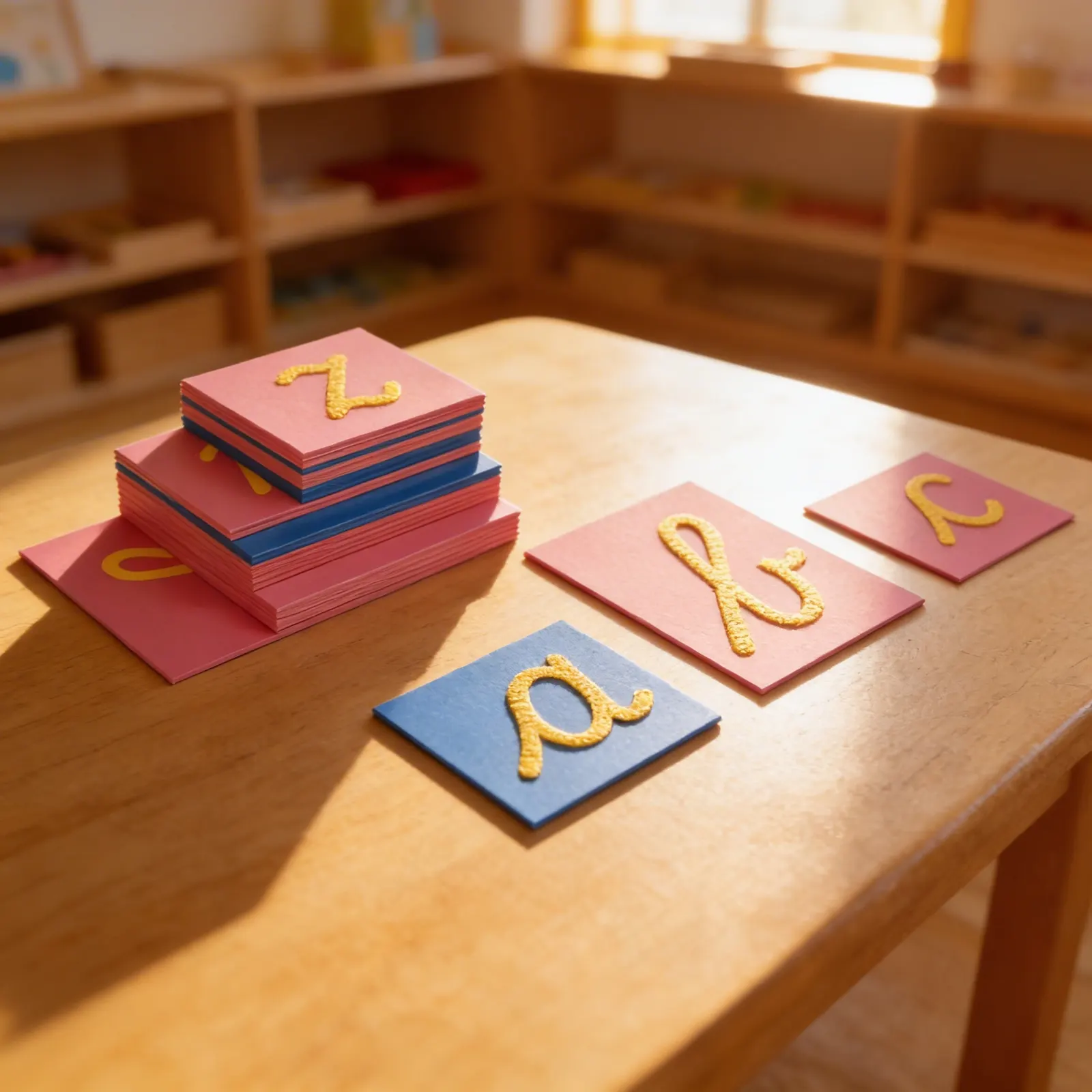
Sandpaper Letters in a child's hands
The lower case cursive alphabet in sandpaper on wooden boards, consonants on pink and vowels on blue. A child traces each letter in the direction it is written, so the hand learns the movement of writing before a pencil is involved and long before the letter has to be read. Each board has a clear space on the left and right to steady it with one hand while the other traces, which is why these are boards and not cards. Beechwood with fine sandpaper, for ages 3 to 6.
Phonemic Awareness
Each letter is presented with its sound, connecting symbol to speech
Writing Preparation
Tracing builds the muscle memory needed for holding a pencil
Multi-Sensory Learning
Touch, sight, and hearing engaged simultaneously
Reading Foundation
Knowing letter sounds is the essential first step to decoding words
How to present it
- 11
- 22
- 33
- 44
2 tips for parents
- Play sound games in everyday life: 'What sound does Mmommy start with?'
- Never correct the child, if they mix up letters, simply represent the correct one next time

If you are not sure it suits your child, we answer in person.
Norbert Kovalčín, founder of Faborino · write to him
There is no review here yet. We will ask you for one after you buy. Write the first review
What's in the Box
- Consonant boards: 21 pink boards with sandpaper consonants in cursive
- Vowel boards: 5 blue boards with sandpaper vowels in cursive
Size and material
| Packaging | 28 × 5 × 8 cm |
| Boards | Smooth beechwood |
| Letters | Fine-grade sandpaper, laser-cut |
| Background | Pink (consonants) and blue (vowels) |
| Recommended Age | 3-5 years |
| Montessori Level | Primary (Casa) |
Care
| Cleaning | Wipe boards with dry cloth. Do not wet sandpaper. |
| Storage | Store upright in letter box or on shelf |
Frequently Asked Questions
Why are Sandpaper Letters taught with sounds, not letter names?
Montessori teaches phonetic sounds (/b/, /k/, /m/) rather than letter names (bee, cee, em) because sounds are what children need for reading and writing. When children know sounds, they can immediately blend them to read words, making literacy acquisition natural and intuitive.
What is the three-period lesson for Sandpaper Letters?
Period 1: Teacher traces the letter saying its sound. Period 2: Child identifies letters by sound ('Show me /b/'). Period 3: Child names the sound when shown a letter ('What is this?'). Only 2-3 new letters are introduced at a time.
At what age should Sandpaper Letters be introduced?
Typically between ages 3-4 years, when children show interest in letters and have developed sufficient tactile sensitivity through preliminary sensorial work. The child should be able to trace shapes with controlled finger movements.
Why are vowels and consonants on different colored boards?
Vowels are mounted on blue boards and consonants on pink boards (or vice versa depending on the edition). This color distinction helps children unconsciously categorize letters, preparing them for later grammar work where parts of speech are color-coded.
How do Sandpaper Letters prepare children for writing?
Tracing the textured letter surfaces builds muscle memory for letter formation. The sandpaper provides tactile feedback, children feel when their finger strays from the correct path. This multi-sensory approach connects sound, sight, and touch for deep learning.
Product safety
Manufacturer: Nienhuis Montessori, Anders Celsiusstraat 15, 7442 PB Nijverdal, Netherlands
Sandpaper Letters