
Sandpaper LettersInternational Print
The first photo is the maker's own. The other shots are illustrative.
Inv. no. NIE-005405
- Maker
- Nienhuis Montessori, since 1929
- Approval
- AMI
- Letter Surface
- Fine-grit sandpaper
- Card Base
- Sturdy cardboard
- EAN
- 8719924003197
Final price incl. VAT. Delivery €5.90, €39.10 to go for free delivery.
Advice, warranty and returns are handled by us.
Why it costs €109.90
Behind the price of the original are things you can check yourself.
AMI approval
The material is approved by the Association Montessori Internationale (AMI). Nienhuis has made Montessori materials since 1929.
A verifiable original
The EAN 8719924003197 is on the box. It is the maker's number, not ours.
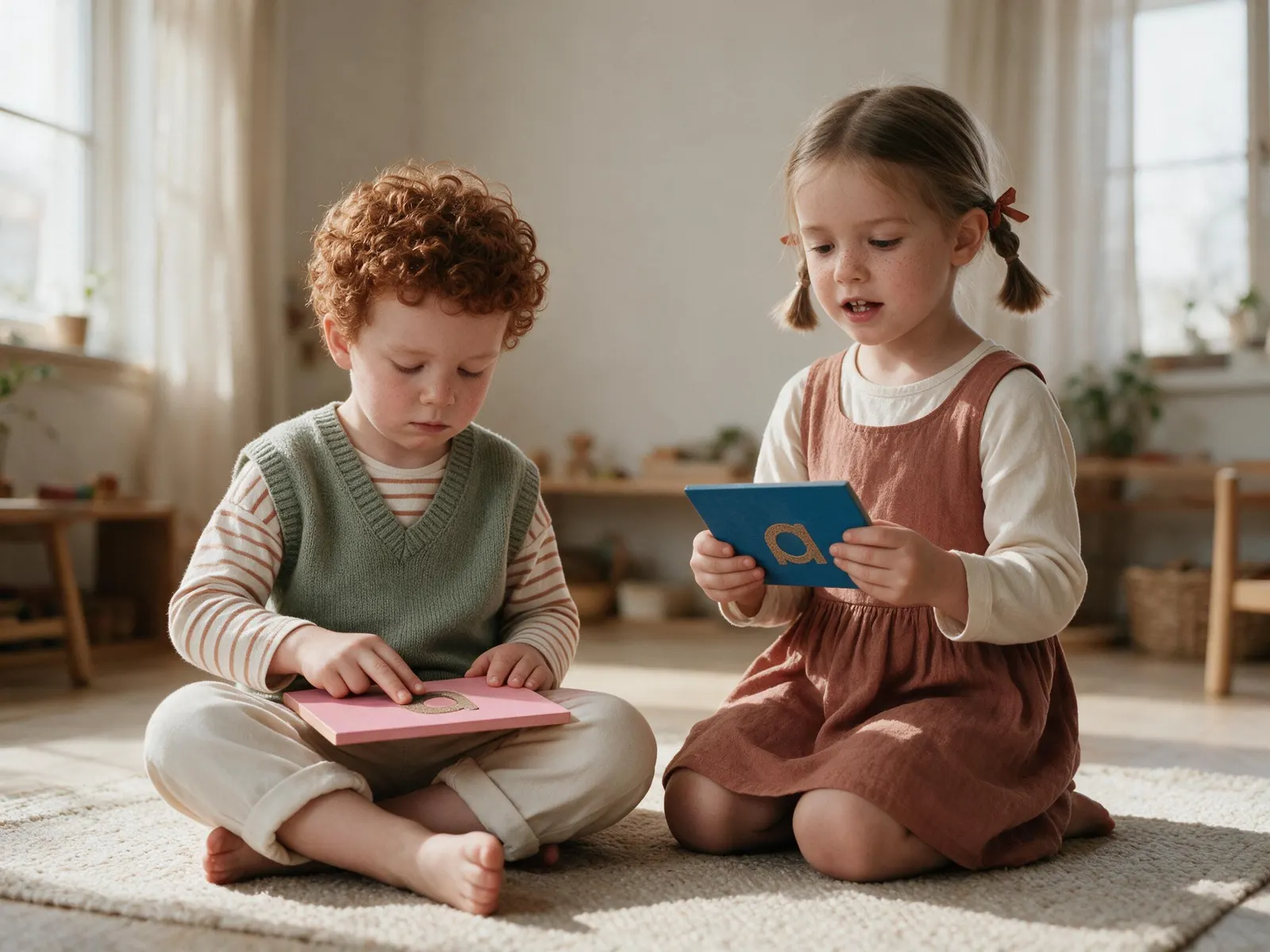
Sandpaper Letters in a child's hands
A bridge to confident reading and writing, these Sandpaper Letters in International Print introduce children to lowercase letter formation through tactile exploration. Each letter is carefully crafted from sandpaper and mounted on blue (vowels) and pink (consonants) boards, letting young learners trace letter shapes while developing muscle memory for writing. This foundational Montessori material bridges the gap between recognizing letter sounds and the physical act of writing.
Pre-Writing Skills
Tracing sandpaper letters develops the muscle memory and finger strength needed for writing, preparing the hand for pencil grip.
Sensory Learning
The tactile experience of sandpaper engages multiple senses, creating stronger neural pathways for letter recognition.
Letter-Sound Connection
Children learn to associate the physical shape of letters with their sounds, building phonemic awareness.
Visual Discrimination
Color-coding helps children distinguish between vowels and consonants while learning letter characteristics.
How to present it
Place 3-4 contrasting letters on a mat. Sit to the child's right if you're right-handed. Have a small tray of sand or cornmeal nearby for additional practice.
- 1Take the first card and trace the letter slowly with your index and middle fingers while producing its phonetic sound
- 2Invite the child to trace the same letter while you guide their hand if needed, repeating the sound
- 3Play the three-period lesson: 'This is /m/', 'Show me /m/', 'What is this?'
- 4Have the child trace the letter in sand or cornmeal after mastering the sandpaper version
3 tips for parents
- Focus on letter sounds rather than names - say /m/ not 'em' when your child traces 'm'
- Point out matching letters in books and signs to reinforce recognition
- Resist rushing to paper and pencil - thorough sandpaper work prevents poor writing habits

If you are not sure it suits your child, we answer in person.
Norbert Kovalčín, founder of Faborino · write to him
There is no review here yet. We will ask you for one after you buy. Write the first review
What's in the Box
- Sandpaper Letter Cards: Approx. 26 lowercase letters
- Color Coding: Blue cards for vowels, pink for consonants
Size and material
| Packaging | 20 × 15 × 11 cm |
| Letter Surface | Fine-grit sandpaper |
| Card Base | Sturdy cardboard |
| Recommended Age | 3-6 years |
Care
Gently wipe cards with dry cloth; avoid moisture
Frequently Asked Questions
What is the difference between International Print and other sandpaper letter styles?
International Print uses a simplified, single-story 'a' and 'g' that matches most printed materials children encounter. This style is commonly used in European and international Montessori schools, making it easier for children to connect their handwriting practice with reading printed books.
Why are vowels on pink cards and consonants on blue cards?
The color coding helps children visually distinguish between vowels and consonants, which is fundamental for understanding word construction and spelling patterns. This Montessori convention makes it easier for children to identify the five vowels that appear frequently in every word.
How do sandpaper letters help with writing preparation?
The rough texture provides sensory feedback as children trace each letter, developing muscle memory and proper letter formation habits. This tactile experience strengthens the hand muscles and establishes correct movement patterns before children attempt writing with a pencil.
At what age should children start using sandpaper letters?
Most children are ready around age 3-3.5 when they show interest in letters and have developed sufficient fine motor control. The material remains useful through age 6 as children refine their letter recognition and prepare for cursive writing.
What activities can be done with sandpaper letters beyond tracing?
Children can match objects to initial sounds, play sound games, trace letters in sand trays, create words with moveable alphabets, and practice air writing. Teachers often combine them with language objects for vocabulary building and phonemic awareness exercises.
Product safety
Manufacturer: Nienhuis Montessori, Anders Celsiusstraat 15, 7442 PB Nijverdal, Netherlands
Sandpaper Letters