
Sandpaper Letters: US Cursive
Made by Nienhuis Montessori · shipped by Heutink International (Netherlands) About the maker
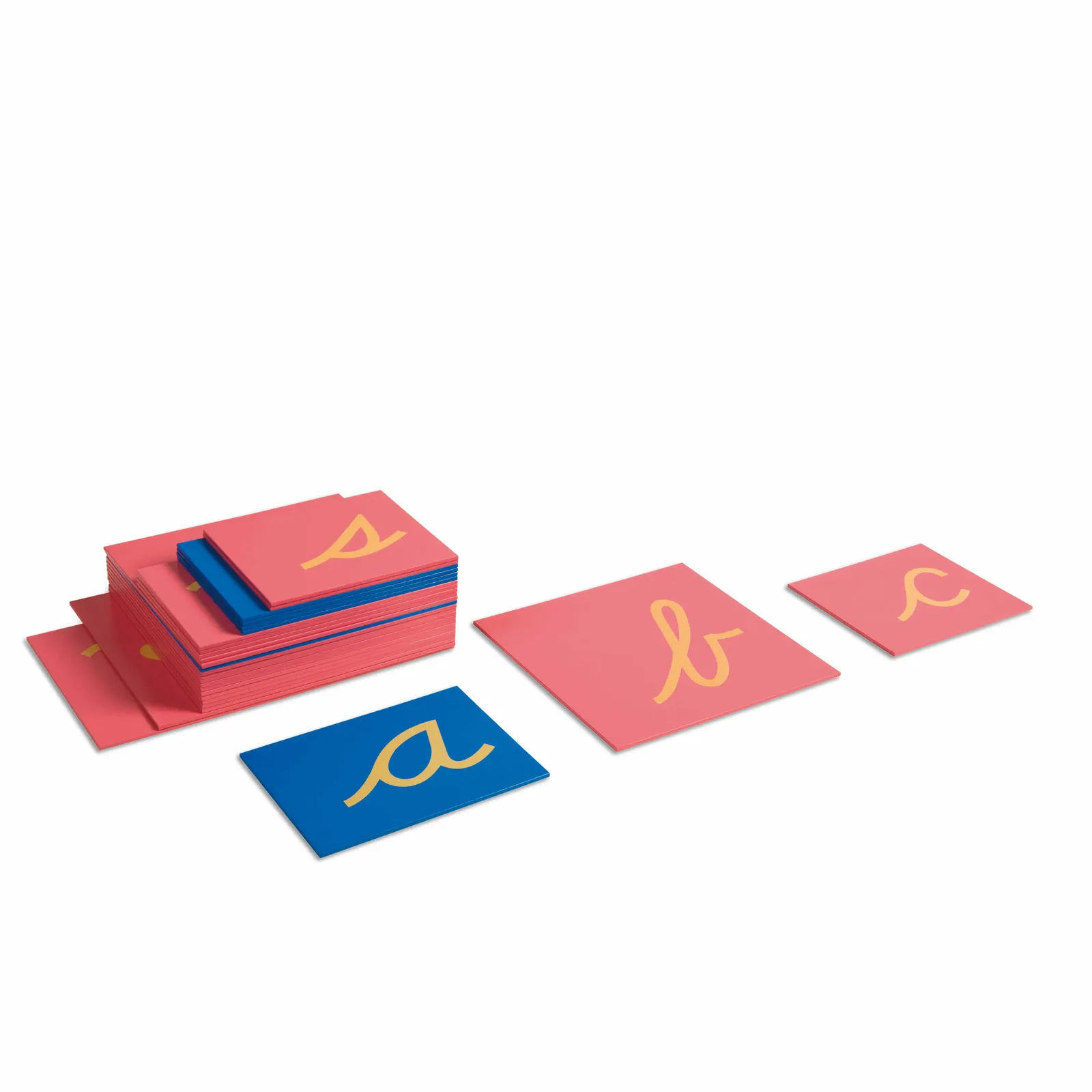
Sandpaper Letters, US Cursive give children a tactile, lower case letter set on cardboard boards covered in sandpaper, guiding the hand through the exact style and direction each cursive letter is written. Consonants are mounted on pink boards and vowels on blue, and each board leaves space on either side so a child ages 3 to 6 can steady it with one hand while tracing the rough letter with the other. This repeated tracing builds the muscle memory needed before handwriting begins.
“The child is both a hope and a promise for mankind.”
The Sandpaper Letters fulfill the young child's need to connect abstract symbols with concrete sensory experiences. Each textured cursive letter provides tactile feedback that engages the child's muscular memory while they trace, creating neural pathways essential for writing.
- Associates phonetic sounds with cursive letter symbols through tactile tracing
- Develops muscle memory for correct cursive letter formation
- Distinguishes between consonants and vowels using color coding
- Builds light touch and controlled finger movements needed for writing
Read More
The sandpaper's resistance gives immediate sensory information about correct letter formation, while the color-coded cards (pink consonants, blue vowels) create visual organization that helps children categorize sounds. This multi-sensory approach, seeing the cursive form, feeling the sandpaper texture, and hearing the phonetic sound, addresses the child's developmental need to explore language through their senses. The US cursive style of these particular letters introduces flowing movements that prepare the hand for connected writing. By isolating each letter on its own card, children can focus completely on one symbol at a time, building their understanding of how spoken sounds transform into written language through repeated tactile exploration.
How to present it
Follow the Montessori method of presentation for optimal child development.
Place 3-4 sandpaper letters in a basket. Sit beside the child at their table with letters between you.
- 1
Select one letter and place it in front of the child. Trace it slowly with your index and middle fingers while saying its phonetic sound
Use the same fingers and direction the child will use for writing - 2
Invite the child to trace the letter. As they trace, softly repeat the phonetic sound
Watch that they start at the correct point and follow proper stroke order - 3
After several traces, make the sound and ask the child to identify the letter
Keep sessions short, quality of attention matters more than quantity - 4
Introduce the second and third letters using the same process
Choose letters with contrasting sounds and shapes initially
Every Child Is a Little Creator

Heritage
Since 1929

In classrooms
Around the world

European brands
Nienhuis, GAM, Educo

AMI approved
To the association standard
Sandpaper Letters: US Cursive
