
Sensorial Decanomial
The first photo is the maker's own. The other shots are illustrative.
Inv. no. NIE-018600
- Maker
- Nienhuis Montessori, since 1929
- Approval
- AMI
- Primary Material
- Solid wood
- Finish
- Paint in multiple colors
- EAN
- 8719924009809
Final price incl. VAT. Delivery €5.90, €23.10 to go for free delivery.
Advice, warranty and returns are handled by us.
Why it costs €125.90
Behind the price of the original are things you can check yourself.
AMI approval
The material is approved by the Association Montessori Internationale (AMI). Nienhuis has made Montessori materials since 1929.
A verifiable original
The EAN 8719924009809 is on the box. It is the maker's number, not ours.
Sensorial Decanomial in a child's hands
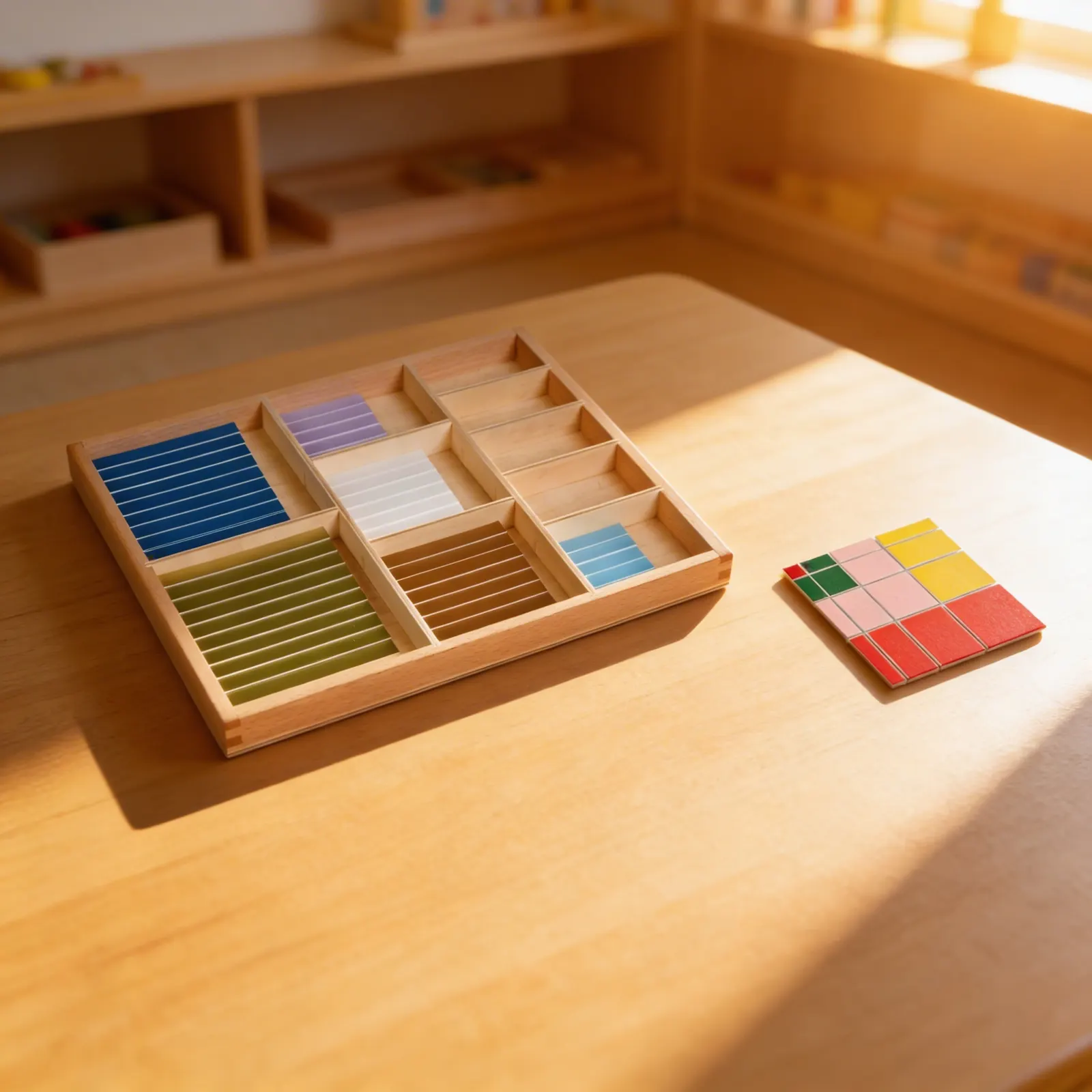
Squares and rectangles laid out by size and colour until they complete the square of the decanomial. Where the bead version builds the multiplication table from quantities, this one builds it from shapes, so a child who cannot yet multiply can still discover that the arrangement is symmetrical and that every rectangle has a twin on the other side of the diagonal. A ten compartment beechwood box keeps the sets sorted, which is what makes a layout this large survive being interrupted. Wood with non toxic paint, for ages 3 to 6.
Mathematical Abstraction
Bridges concrete manipulation to abstract algebraic thinking through visual and tactile exploration of the decanomial square.
Pattern Recognition
Develops ability to identify and predict mathematical patterns through systematic arrangement of color-coded pieces.
Visual Discrimination
Refines visual perception through work with graduated sizes and specific color relationships.
Preparation for Algebra
Provides sensorial foundation for understanding binomial and trinomial theorems in later mathematical work.
How to present it
Place the Sensorial Decanomial box on a large work mat. Ensure ample floor space for building the complete square. Have a color chart reference available.
- 1Sort all tiles by color into separate piles on the mat
- 2Begin with the red unit square, placing it in the top left corner
- 3Add the green rectangles (1x2) along the top and left edges
- 4Continue building outward, following the color pattern for each value
- 5Complete the square by filling in all positions according to the pattern
3 tips for parents
- Create paper squares at home using graph paper to reinforce the patterns
- Point out square patterns in tiles, windows, or grid designs in daily life
- Support without rushing - this material requires sustained concentration

If you are not sure it suits your child, we answer in person.
Norbert Kovalčín, founder of Faborino · write to him
There is no review here yet. We will ask you for one after you buy. Write the first review
What's in the Box
- Wooden storage tray: With organized compartments
- Color-coded tiles: Approx. 100 pieces representing units through tens
- Presentation guide: Basic instructions for decanomial square work
Size and material
| Packaging | 32 × 32 × 6 cm |
| Primary Material | Solid wood |
| Finish | Paint in multiple colors |
| Recommended Age | 3-6 years |
Care
Wipe with slightly damp cloth, dry immediately
Frequently Asked Questions
What mathematical concepts does the Sensorial Decanomial teach?
The Sensorial Decanomial introduces algebraic concepts including squaring, multiplication, factoring, and the commutative property. Children visually explore the relationship between (a+b)² and a²+2ab+b², building a concrete foundation for algebra through color-coded tiles that represent different numerical values.
How is the Sensorial Decanomial different from the regular Decanomial?
The Sensorial Decanomial focuses on visual and sensorial exploration of mathematical patterns using color-coded wooden tiles, while the regular Decanomial involves numerical calculations. This material emphasizes pattern recognition and spatial relationships, making it accessible to younger children who aren't yet ready for complex calculations.
What skills should children have before using this material?
Children should be familiar with basic Montessori sensorial materials, have developed fine motor control, and show interest in patterns and building. Prior experience with the Pink Tower, Brown Stair, and Color Tablets helps, though direct mathematical knowledge isn't required as this material introduces concepts sensorially.
How many pieces are included and how are they organized?
The complete set includes 55 different tile sizes in 10 distinct colors, with multiple pieces of each size totaling several hundred tiles. Each color represents numbers 1-10, with precise dimensions allowing children to build the complete decanomial square when all pieces are correctly arranged.
What is the recommended presentation sequence for this material?
Begin by introducing one color family at a time, showing how pieces fit together. Progress to building simple squares (1x1, 2x2), then demonstrate the commutative property using rectangles. Finally, guide children to construct the complete decanomial square, encouraging independent exploration of patterns throughout.
Product safety
Manufacturer: Nienhuis Montessori, Anders Celsiusstraat 15, 7442 PB Nijverdal, Netherlands
Sensorial Decanomial