
Small Bead Frame: Mathematical Operations with Colour-Coded Beads
Made by Nienhuis Montessori · shipped by Heutink International (Netherlands) About the maker
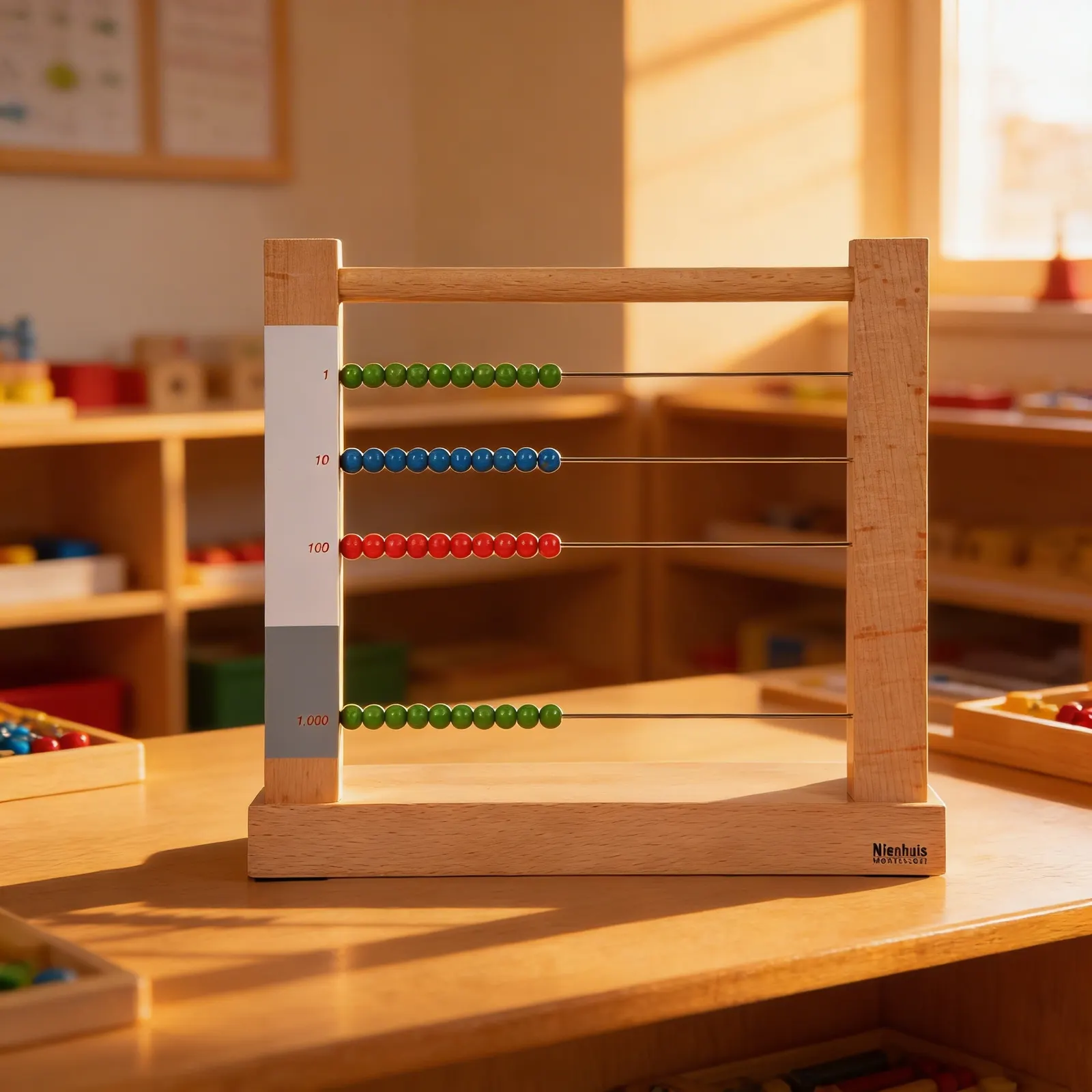
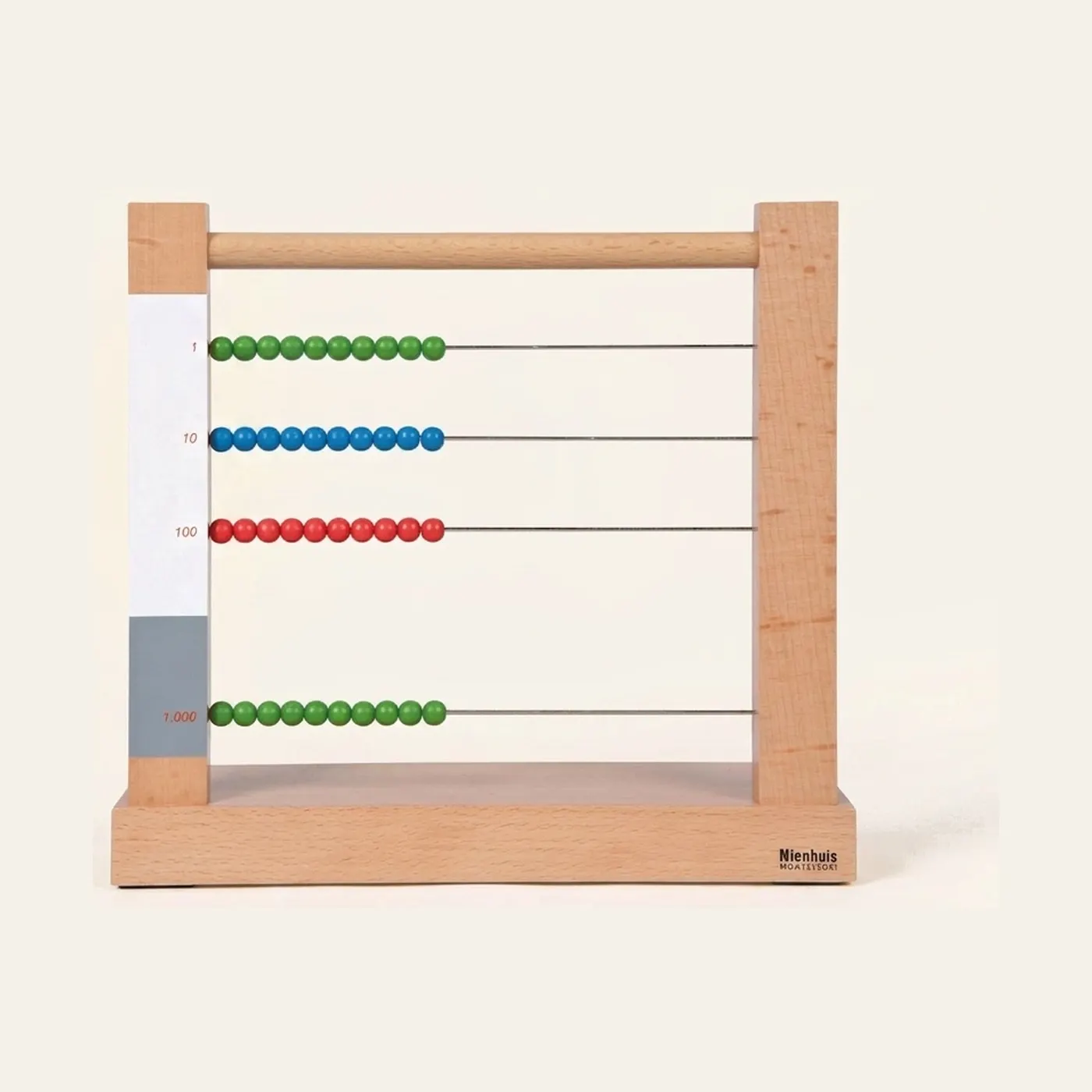
A wooden frame of colour coded beads on wires, the bridge to abstraction for addition and subtraction in the decimal system. This is the smaller of the two frames and the one a child meets first: it handles the operations they already know from the golden beads, so nothing new is being learned except the representation. Changing one thing at a time is the whole method, and it is why the frame for multiplication comes later and larger. Wood, wire and beads, for ages 3 to 6.
“The hands are the instruments of man's intelligence.”
The Small Bead Frame embodies Montessori's principle of concrete to abstract learning, allowing children to physically manipulate quantities before moving to mental calculation.
- Understanding place value through units, tens, hundreds, and thousands
- Building and reading four-digit numbers with confidence
- Developing systematic counting and exchange skills
- Strengthening fine motor control through bead manipulation
Read More
This material respects the child's need for sensorial exploration while introducing mathematical concepts through color-coded, tactile beads. The frame's design isolates the difficulty of place value, presenting it in a clear, organized manner that appeals to the mathematical mind. By providing a concrete representation of the decimal system, children can construct their own understanding of numbers up to 9,999. The material supports the child's natural tendency toward exactness and order, while the repetitive nature of working with beads satisfies their need for practice and mastery. This bridges the gap between the concrete materials like golden beads and the abstract work of written arithmetic.
How to present it
Follow the Montessori method of presentation for optimal child development.
Place the Small Bead Frame on a mat with green unit beads on the right wire, blue ten beads on the second wire, red hundred beads on the third, and green thousand beads on the left wire. All beads should be positioned to the right side of each wire.
- 1
Introduce the frame by naming each wire: 'These green beads are units, these blue beads are tens, these red beads are hundreds, these green beads are thousands.'
Run your finger along each wire as you name it, moving from right to left to reinforce place value hierarchy. - 2
Demonstrate forming a number, such as 2,345: slide 5 unit beads to the left, 4 ten beads, 3 hundred beads, and 2 thousand beads.
Count aloud as you move each bead, emphasizing the place value: 'One thousand, two thousand... one hundred, two hundred, three hundred...' - 3
Show how to read the number by pointing to each wire and stating the quantity: 'Two thousand, three hundred, forty, five makes 2,345.'
Use a slip of paper with the written number to connect the concrete beads to abstract symbols. - 4
Invite the child to form their own numbers, starting with simple ones like 1,234 before progressing to more complex numbers.
Let the child choose their own numbers after initial practice to maintain interest and ownership.
Every Child Is a Little Creator

Heritage
Since 1929

In classrooms
Around the world

European brands
Nienhuis, GAM, Educo

AMI approved
To the association standard
Small Bead Frame: Mathematical Operations with Colour-Coded Beads
