
Small Number Cards 1-9000Wood
The first photo is the maker's own. The other shots are illustrative.
Inv. no. NIE-0071B0
- Maker
- Nienhuis Montessori, since 1929
- Approval
- AMI
- Box
- Natural wood
- Cards
- Plywood with printed numbers
- EAN
- 8719924004316
Final price incl. VAT. Delivery €5.90, €101.10 to go for free delivery.
Advice, warranty and returns are handled by us.
Why it costs €47.90
Behind the price of the original are things you can check yourself.
AMI approval
The material is approved by the Association Montessori Internationale (AMI). Nienhuis has made Montessori materials since 1929.
A verifiable original
The EAN 8719924004316 is on the box. It is the maker's number, not ours.
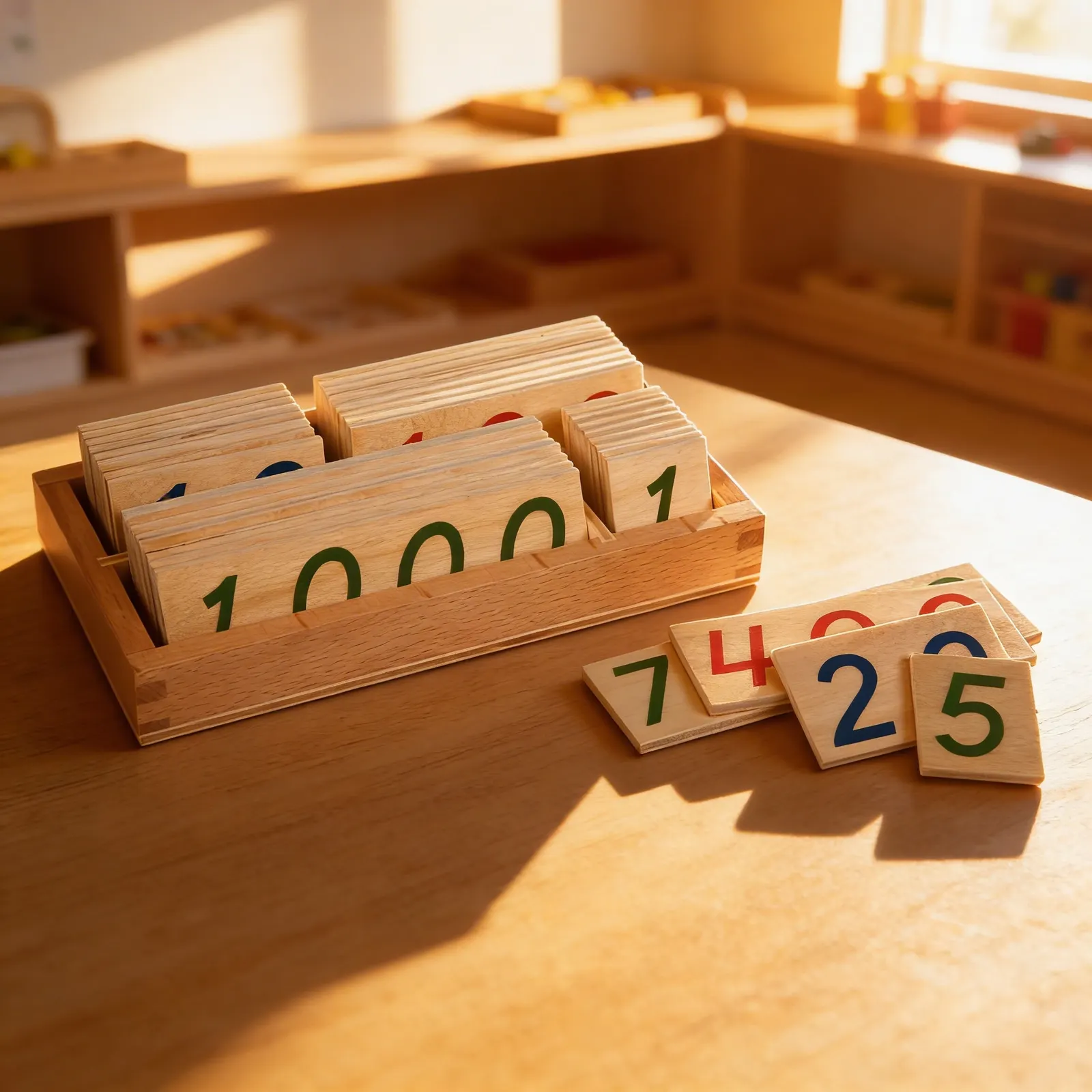
Small Number Cards 1-9000 in a child's hands
Wooden number cards from one to nine thousand in the small size, clear varnished, with a box for handling and storage. Small and large cards are used together and that is the whole design: the large set sits at the bank as the record of what a number is, and each child carries a small set to build their own quantity and bring it back to be checked. One set alone turns a group activity into a queue. Wood with plywood, for ages 3 to 12.
Mathematical Understanding
Builds concrete understanding of place value and the decimal system through color-coded visual representation.
Abstract Thinking
Bridges the gap between concrete materials and abstract number concepts through systematic card work.
Order and Sequence
Develops understanding of numerical order and the hierarchical structure of our number system.
Fine Motor Control
Manipulating individual cards refines pincer grasp and hand coordination needed for writing.
How to present it
Place the wooden storage box on a mat. Arrange the compartments so units (green), tens (blue), hundreds (red), and thousands (green) are clearly visible and accessible from left to right.
- 1Introduce each category by removing one card from each compartment, naming it clearly: 'This is 1 unit, this is 10, this is 100, this is 1000.'
- 2Build a simple number like 2,345 by selecting cards: 2000, 300, 40, and 5. Show how to overlay them with thousands on bottom.
- 3Invite the child to read the formed number, then ask them to build a specific number you name.
- 4Practice 'magic slide' by slowly sliding cards apart to show expanded form: 2000 + 300 + 40 + 5.
3 tips for parents
- Practice reading large numbers in daily life, house numbers, prices, page numbers, connecting to card work
- Play 'number detective' games where your child builds mystery numbers you describe with clues
- Keep a special notebook where your child records interesting numbers they've built with the cards

If you are not sure it suits your child, we answer in person.
Norbert Kovalčín, founder of Faborino · write to him
There is no review here yet. We will ask you for one after you buy. Write the first review
What's in the Box
- Wooden storage box: with compartments
- Number cards 1-9: units (green)
- Number cards 10-90: tens (blue)
- Number cards 100-900: hundreds (red)
- Number cards 1000-9000: thousands (green)
Size and material
| Packaging | 10 × 10 × 4 cm |
| Box | Natural wood |
| Cards | Plywood with printed numbers |
| Recommended Age | 3-6 years |
Care
Wipe with dry cloth, avoid moisture
Frequently Asked Questions
What numbers are included in this Small Number Cards set?
This set includes number cards from 1-9000, organized by place value: units (1-9), tens (10-90), hundreds (100-900), and thousands (1000-9000). Each category is color-coded following the traditional Montessori system - green for units, blue for tens, red for hundreds, and green for thousands.
How does the wooden storage box help with organization?
The wooden storage box features separate compartments for each place value category, making it easy for children to independently access, use, and return cards to their proper places. This compartmentalized design reinforces the concept of place value and supports the development of order and organization skills.
What activities can children do with these number cards?
Children can build any number from 1-9999 by overlaying cards, practice reading large numbers, create number sequences, play number building games, and combine with golden bead materials for concrete representation. The cards also support skip counting, number comparisons, and introduction to addition with large numbers.
Why are the cards color-coded and what do the colors mean?
The color-coding follows the Montessori decimal system hierarchy: green for units (1-9), blue for tens (10-90), red for hundreds (100-900), and green again for thousands (1000-9000). This visual system helps children recognize place value patterns and understand that our number system repeats in groups of three (units, tens, hundreds).
How do these cards prepare children for advanced mathematics?
These cards build a concrete understanding of place value, which is fundamental for all future math work including addition, subtraction, multiplication, and division of large numbers. By physically manipulating and building numbers, children internalize the base-10 system and develop number sense essential for abstract mathematical thinking.
Product safety
Manufacturer: Nienhuis Montessori, Anders Celsiusstraat 15, 7442 PB Nijverdal, Netherlands
Small Number Cards 1-9000