
Small Square Root Board
The first photo is the maker's own. The other shots are illustrative.
Inv. no. NIE-013300
- Maker
- Nienhuis Montessori, since 1929
- Approval
- AMI
- Board
- Solid wood with precision-drilled holes
- Pegs
- Durable plastic in multiple colors
- EAN
- 8719924007249
Final price incl. VAT. Delivery €5.90, €104.10 to go for free delivery.
Advice, warranty and returns are handled by us.
Why it costs €44.90
Behind the price of the original are things you can check yourself.
AMI approval
The material is approved by the Association Montessori Internationale (AMI). Nienhuis has made Montessori materials since 1929.
A verifiable original
The EAN 8719924007249 is on the box. It is the maker's number, not ours.
Small Square Root Board in a child's hands
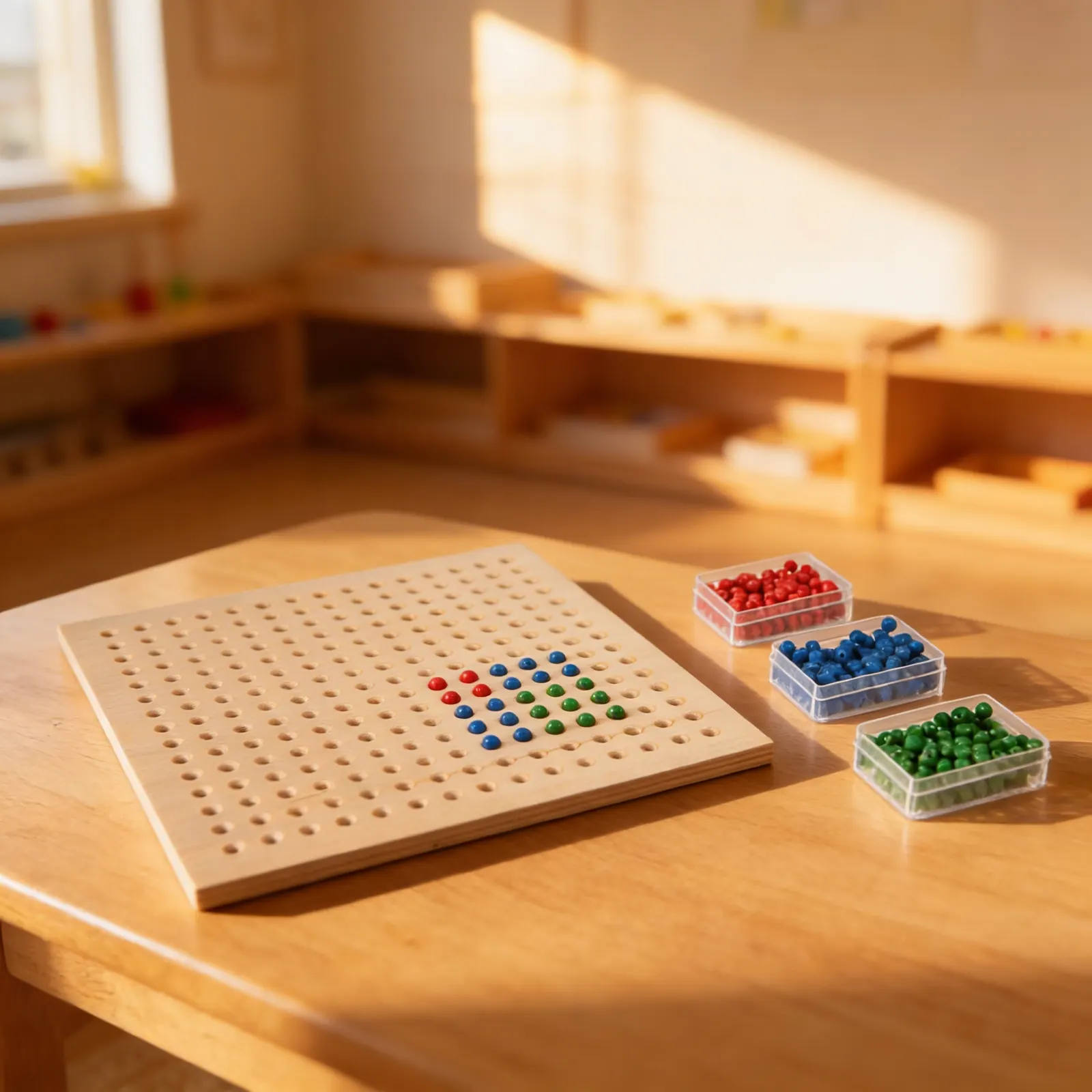
The Small Square Root Board is an essential Montessori mathematics material that provides a concrete, visual representation of square roots through colored pegs arranged in square formations. This finely made board features a grid of holes so children can build squares physically, making abstract mathematical concepts tangible and supporting the transition from tangible to conceptual thinking in upper elementary mathematics work.
Mathematical Abstraction
Bridges concrete manipulation to abstract understanding of square numbers and their roots through visual and tactile exploration.
Pattern Recognition
Develops ability to recognize square formations and understand the geometric relationship between numbers and their square roots.
Sequential Thinking
Strengthens logical progression skills as children build squares systematically from 1² to larger numbers.
Fine Motor Precision
Enhances pincer grip and hand-eye coordination through precise peg placement in the grid holes.
How to present it
Place the Small Square Root Board on a mat with colored pegs sorted by color in separate containers. Have squared number cards (1, 4, 9, 16, 25, etc.) available.
- 1Begin with 4 pegs of one color. Build a 2x2 square in the board's holes
- 2Count the total pegs used and identify this as a square number
- 3Count one side of the square formation to find the square root
- 4Record findings: '4 pegs make a square with sides of 2. The square root of 4 is 2'
- 5Continue with 9 pegs (3x3), 16 pegs (4x4), exploring each square number
3 tips for parents
- Practice skip counting by squares at home (1, 4, 9, 16, 25) to reinforce number patterns
- Point out square shapes in everyday life - tiles, windows - and count their dimensions
- Avoid rushing to abstract notation; let your child work with the physical board extensively first

If you are not sure it suits your child, we answer in person.
Norbert Kovalčín, founder of Faborino · write to him
There is no review here yet. We will ask you for one after you buy. Write the first review
What's in the Box
- Wooden pegboard: 30×30cm with grid pattern
- Colored pegs: Multiple sets in storage containers
- Storage containers: 3 clear plastic boxes for peg organization
Size and material
| Packaging | 26 × 26 × 4 cm |
| Board | Solid wood with precision-drilled holes |
| Pegs | Durable plastic in multiple colors |
| Storage | Clear plastic containers |
| Recommended Age | 6-12 years |
Care
Wipe board with damp cloth; wash pegs with mild soap if needed
Frequently Asked Questions
What mathematical concepts does the Small Square Root Board teach?
The Small Square Root Board teaches square roots, perfect squares, and the relationship between multiplication and square numbers. Children physically build squares using colored pegs, discovering that the square root is the number of pegs on one side of the square formation.
How do children use this material to find square roots?
Children place colored pegs in the grid holes to form perfect squares, starting with 1 peg (1²=1), then 4 pegs in a 2x2 formation (2²=4), 9 pegs in 3x3 (3²=9), and so on. By counting the pegs on one side of the completed square, they discover the square root.
What is included with the Small Square Root Board?
The board includes a wooden grid board with precisely spaced holes and sets of colored pegs in different colors. Each color represents a different number, allowing children to create visual patterns while building their squares.
What prior knowledge should children have before using this material?
Children should be comfortable with multiplication facts, understand the concept of squaring numbers, and have worked with other Montessori mathematics materials like the bead chains and multiplication board. This typically occurs around age 6-7 in the Montessori sequence.
How does this differ from abstract square root calculation?
Unlike abstract calculation, this material allows children to see and feel square roots as actual square formations. This concrete experience creates a strong mental image that supports later abstract work, making the transition to written square root problems more intuitive and meaningful.
Product safety
Manufacturer: Nienhuis Montessori, Anders Celsiusstraat 15, 7442 PB Nijverdal, Netherlands
Small Square Root Board