
Smelling Bottles (Nienhuis)
The first photo is the maker's own. The other shots are illustrative.
Inv. no. NIE-001500
- Maker
- Nienhuis Montessori, since 1929
- Approval
- AMI
- Tray
- Natural wood
- Bottles
- Glass
- EAN
- 8719924000202
Final price incl. VAT. Delivery €5.90, €35.10 to go for free delivery.
Advice, warranty and returns are handled by us.
Why it costs €113.90
Behind the price of the original are things you can check yourself.
AMI approval
The material is approved by the Association Montessori Internationale (AMI). Nienhuis has made Montessori materials since 1929.
A verifiable original
The EAN 8719924000202 is on the box. It is the maker's number, not ours.
Smelling Bottles (Nienhuis) in a child's hands
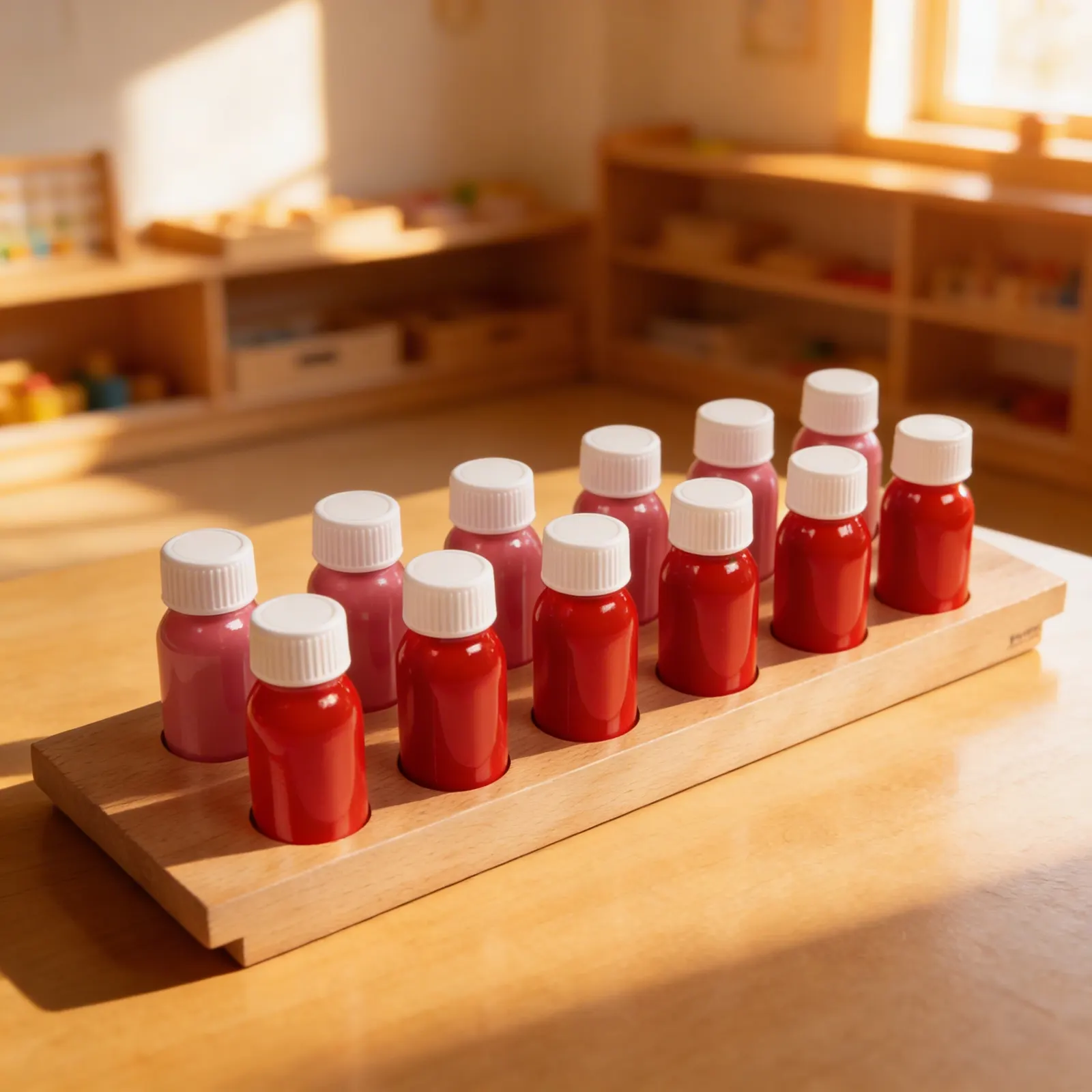
Sharpening perception one step at a time, this authentic Smelling Bottles set invites children to explore and refine their olfactory sense through careful discrimination of various scents. The wooden presentation tray holds pairs of bottles containing matching aromas, encouraging systematic sensory exploration and vocabulary development. Children develop concentration and sensory awareness as they identify, match, and describe different scents in this essential Montessori sensorial experience.
Olfactory Discrimination
Refines the sense of smell through careful comparison and matching of various scents.
Vocabulary Development
Expands descriptive language as children learn to articulate different aromatic qualities.
Memory Enhancement
Strengthens recall abilities through scent recognition and matching activities.
Concentration
Develops focused attention as children carefully explore and compare subtle differences.
How to present it
Place the wooden tray on a table mat. Ensure bottles contain fresh, distinct scents in matching pairs. Have a small tray nearby for completed pairs.
- 1Invite the child to the table and show how to hold one bottle properly
- 2Remove the lid and wave the bottle gently beneath your nose, inhaling slowly
- 3Replace the lid and set the bottle aside. Select another bottle and smell it
- 4Continue sampling bottles until finding a matching scent, then pair them together
- 5Continue until all bottles are matched in pairs on the completion tray
3 tips for parents
- Create a home version using small jars and cotton balls with kitchen extracts like lemon, almond, and peppermint
- During cooking, invite your child to smell individual spices and describe them
- Take 'smelling walks' outdoors, pausing to notice flowers, grass, or rain scents

If you are not sure it suits your child, we answer in person.
Norbert Kovalčín, founder of Faborino · write to him
There is no review here yet. We will ask you for one after you buy. Write the first review
What's in the Box
- Wooden tray: Holds all 12 bottles
- 12 glass bottles: 6 pink and 6 red
Size and material
| Packaging | 23 × 14 × 12 cm |
| Tray | Natural wood |
| Bottles | Glass |
| Recommended Age | 3-6 years |
Care
Wipe tray with damp cloth; clean bottle exteriors only
Frequently Asked Questions
What scents come with the Smelling Bottles and how often should they be replaced?
The bottles come empty, allowing teachers to add their own scents using essential oils, extracts, or natural materials. Scents should be refreshed every 2-3 months or when they begin to fade. Popular choices include vanilla, peppermint, lavender, lemon, cinnamon, and rose.
How do I present the Smelling Bottles activity to children?
Begin with 3-4 pairs of distinct scents. Demonstrate holding one bottle under your nose, inhaling gently, then finding its match. Show the child how to cleanse their palate between scents by breathing fresh air. Gradually increase difficulty by adding more pairs or using similar scents.
Are the bottles safe for young children and what materials are they made from?
The bottles are made from child-safe materials with secure lids to prevent spills. The wooden tray is smooth and splinter-free. Always supervise initial use and ensure children understand to smell, not taste. Check that children don't have allergies to specific scents before use.
Can children with sensitivities or allergies use the Smelling Bottles?
Yes, with careful scent selection. Avoid common allergens and strong synthetic fragrances. Use mild, natural scents and introduce them gradually. For highly sensitive children, start with very diluted scents or familiar food extracts. Always consult parents about known sensitivities.
What extensions can I create with the Smelling Bottles?
Extensions include matching scents to pictures, creating scent memory games, exploring cultural scents, connecting to botany studies, graphing favorite scents, creative writing about smell memories, and making scent books. Children can also learn about how smell relates to taste and memory.
Product safety
Manufacturer: Nienhuis Montessori, Anders Celsiusstraat 15, 7442 PB Nijverdal, Netherlands
Smelling Bottles (Nienhuis)