
Smooth Gradation Board (Nienhuis)
Made by Nienhuis Montessori · shipped by Heutink International (Netherlands) About the maker
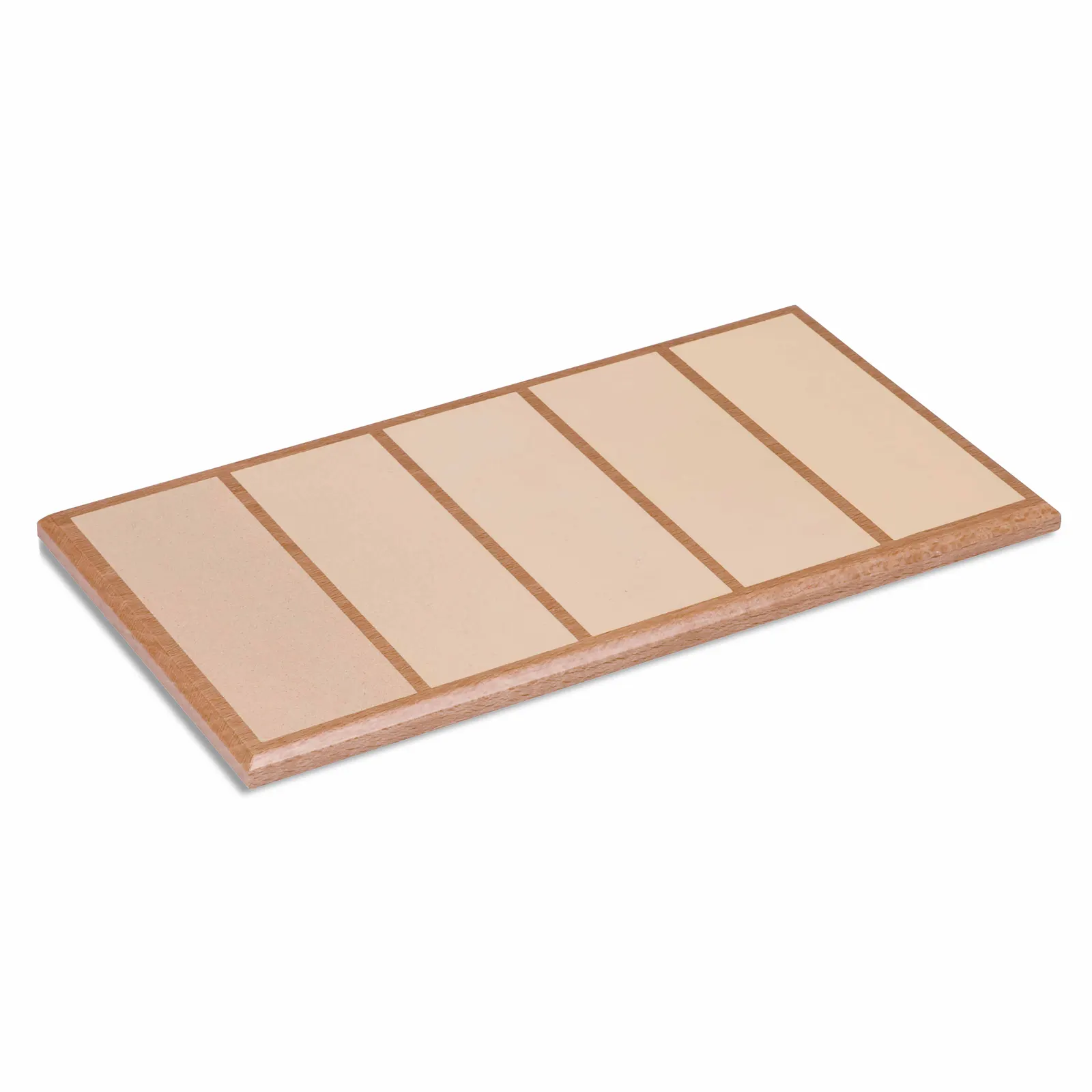
Smooth Gradation Board introduces a child aged 3 to 6 to fine gradations of smoothness, refining the tactile sense through touch alone rather than sight. The wooden board is fitted with sandpaper surfaces arranged from roughest to smoothest, so the child runs fingertips across each strip and learns to order them by feel. As an AMI aligned Nienhuis sensorial material, it sharpens tactile discrimination and prepares the hand for later writing and material work available across the Faborino shelf.
“Free the child's potential, and you will transform him into the world.”
The Smooth Gradation Board serves as a fundamental bridge between sensorial exploration and writing readiness in the Montessori classroom.
- Develops tactile discrimination through five distinct texture gradations
- Refines fingertip sensitivity essential for writing preparation
- Builds vocabulary for describing textures (smooth, rough, smoother, rougher)
- Strengthens finger muscles used in pencil grip through tracing movements
Read More
Through five carefully graded sandpaper strips, children develop the refined finger sensitivity essential for proper pencil grip and pressure control. Each texture on the board, from smoothest to roughest, isolates a specific tactile quality, allowing the child to build discriminatory powers through repeated touch. The wooden board's smooth surface provides crucial contrast, helping children internalize the concept of gradation through their fingertips. This systematic progression from smooth to rough mirrors the sequential nature of all Montessori materials, where each sensory impression builds upon the previous one. The Smooth Gradation Board specifically addresses the developmental need for tactile refinement that emerges around age three, when children's hands become ready for more precise movements. By tracing each sandpaper strip with their dominant fingers, children simultaneously prepare the muscles and sensitivity required for forming letters, making this board an essential precursor to the Sandpaper Letters.
How to present it
Follow the Montessori method of presentation for optimal child development.
Place the Smooth Gradation Board on a table mat at the child's dominant side. Ensure hands are clean and dry for optimal tactile sensitivity.
- 1
Demonstrate tracing the smoothest strip with your index and middle fingers, moving left to right
Use slow, deliberate movements to model careful exploration - 2
Invite the child to trace the same smooth strip, observing their finger pressure
Watch for consistent two-finger contact throughout the tracing - 3
Introduce the roughest strip for maximum contrast, having the child trace both alternately
Use minimal language: 'smooth' and 'rough' only at this stage - 4
Present the remaining three strips in order, exploring each texture thoroughly
Allow ample time for repetition before moving to the next strip - 5
Invite the child to close their eyes and identify strips by touch alone
Start with just smooth and rough before adding intermediate textures
Every Child Is a Little Creator

Heritage
Since 1929

In classrooms
Around the world

European brands
Nienhuis, GAM, Educo

AMI approved
To the association standard
Smooth Gradation Board (Nienhuis)
