
Sound BoxesPaired Cylinders for Auditory Discrimination Training
The first photos are the maker's own. The other shots are illustrative.
Inv. no. NIE-001600
- Maker
- Nienhuis Montessori, since 1929
- Approval
- AMI
- Cylinders
- Solid beechwood, water-based lacquer
- Lids
- Painted wood, red and blue
- EAN
- 8719924000257
Final price incl. VAT. Free delivery.
Advice, warranty and returns are handled by us.
Why it costs €174.90
Behind the price of the original are things you can check yourself.
AMI approval
The material is approved by the Association Montessori Internationale (AMI). Nienhuis has made Montessori materials since 1929.
A verifiable original
The EAN 8719924000257 is on the box. It is the maker's number, not ours.
Sound Boxes in a child's hands
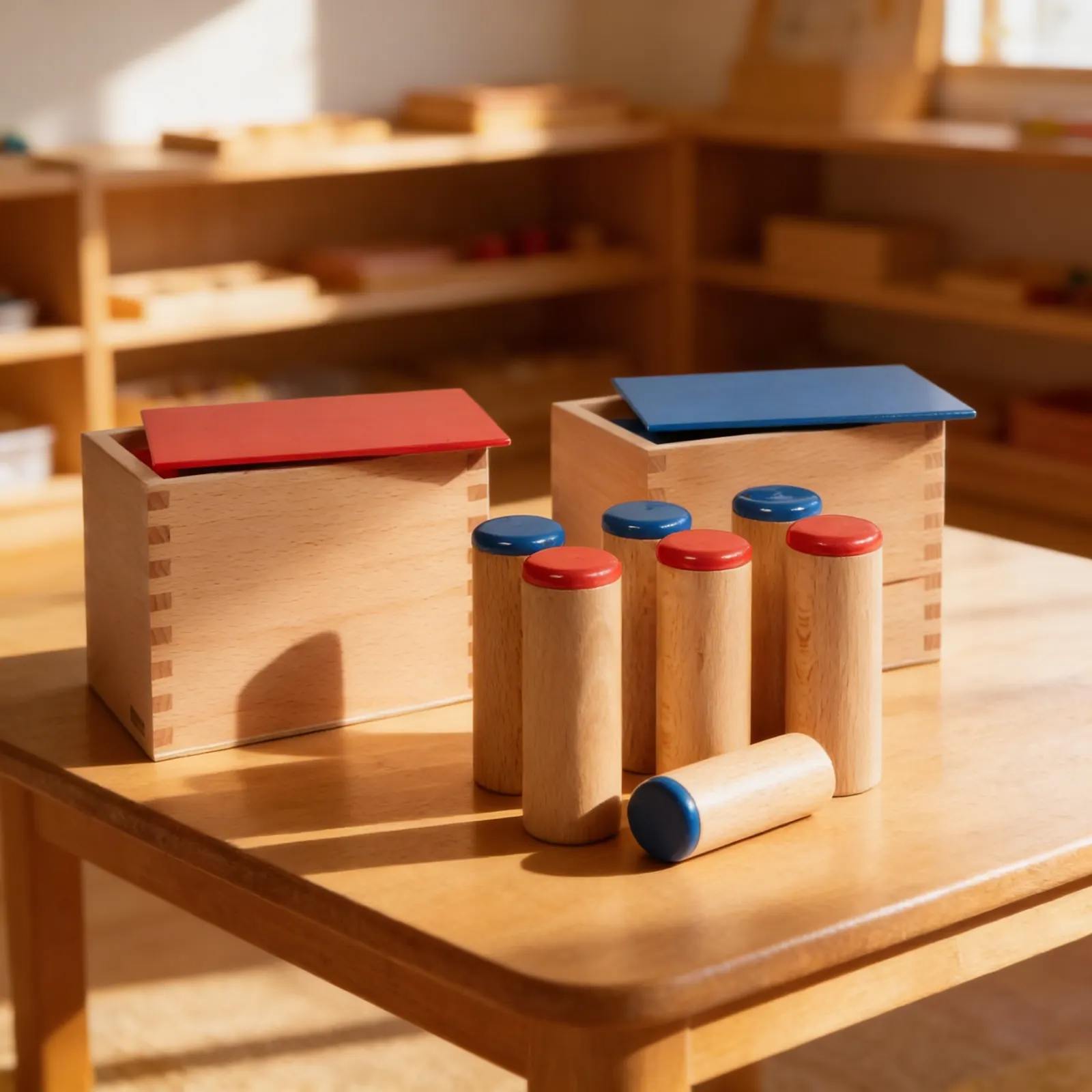
Two sets of six sealed cylinders, each filled to make a distinct sound when shaken, graded from very soft to loud. The child works with eyes free but ears doing the deciding: shake one from the first set, hunt through the second for its match, and set the pair aside. Sealed is the important word, because a cylinder that could be opened would be opened, and the answer would come from looking instead of listening. Grading from softest to loudest follows pairing. Beechwood cylinders, for ages 3 to 6.
Auditory Discrimination
Distinguishing fine differences between similar sounds
Concentration
Deep focus required to compare sounds held in memory
Logical Thinking
Systematic elimination to find matching pairs
Language Preparation
Refined hearing supports phonemic awareness for reading
How to present it
- 11
- 22
- 33
- 44
2 tips for parents
- Play listening games at home, identify sounds with eyes closed
- Encourage noticing sounds in nature: birdsong, wind, water

If you are not sure it suits your child, we answer in person.
Norbert Kovalčín, founder of Faborino · write to him
There is no review here yet. We will ask you for one after you buy. Write the first review
What's in the Box
- Red-lid box: Beechwood box with 6 sound cylinders
- Blue-lid box: Matching beechwood box with 6 sound cylinders
Size and material
| Packaging | 23 × 14 × 12 cm |
| Cylinders | Solid beechwood, water-based lacquer |
| Lids | Painted wood, red and blue |
| Fillings | Natural materials creating graduated sounds |
| Recommended Age | 3-6 years |
| Montessori Level | Primary (Casa) |
Care
| Cleaning | Wipe exterior with dry cloth only |
| Storage | Keep in original boxes to preserve sound integrity |
Frequently Asked Questions
What skills do the Sound Boxes develop?
The Sound Boxes refine auditory discrimination, the ability to perceive and compare subtle differences in sound. Children develop concentration, careful listening skills, and vocabulary for describing sounds (loud, soft, louder, softer, loudest, softest).
How are the Sound Boxes used in the classroom?
Children shake paired cylinders gently, comparing sounds between the red-lid set and blue-lid set to find matching pairs. They begin with the most contrasting sounds and progress to subtler differences, developing systematic comparison skills.
What age is appropriate for this material?
Sound Boxes are typically introduced around age 3-4 years, after children have shown readiness through preliminary sensorial work. The child should be able to handle materials carefully and maintain focus during comparative activities.
Why are there two sets of different colored lids?
The red and blue sets contain identical sound gradations. Children match cylinders from one set to the other by sound alone, providing built-in control of error. The color coding helps organize the activity without giving away the sound matches.
How do Sound Boxes prepare children for music and language?
By training the ear to detect subtle sound differences, this material prepares children for phonetic awareness essential for reading, musical pitch discrimination, and the ability to distinguish similar sounds in spoken language.
Product safety
Manufacturer: Nienhuis Montessori, Anders Celsiusstraat 15, 7442 PB Nijverdal, Netherlands
Sound Boxes