
South America Control MapUnlabeled
The first photo is the maker's own. The other shots are illustrative.
Inv. no. NIE-555600
- Maker
- Nienhuis Montessori, since 1929
- Approval
- AMI
- Base Material
- Paper
- Surface
- Laminate coating
- EAN
- 8719924029524
Final price incl. VAT. Delivery €5.90, €128.10 to go for free delivery.
Advice, warranty and returns are handled by us.
Why it costs €20.90
Behind the price of the original are things you can check yourself.
AMI approval
The material is approved by the Association Montessori Internationale (AMI). Nienhuis has made Montessori materials since 1929.
A verifiable original
The EAN 8719924029524 is on the box. It is the maker's number, not ours.
South America Control Map in a child's hands
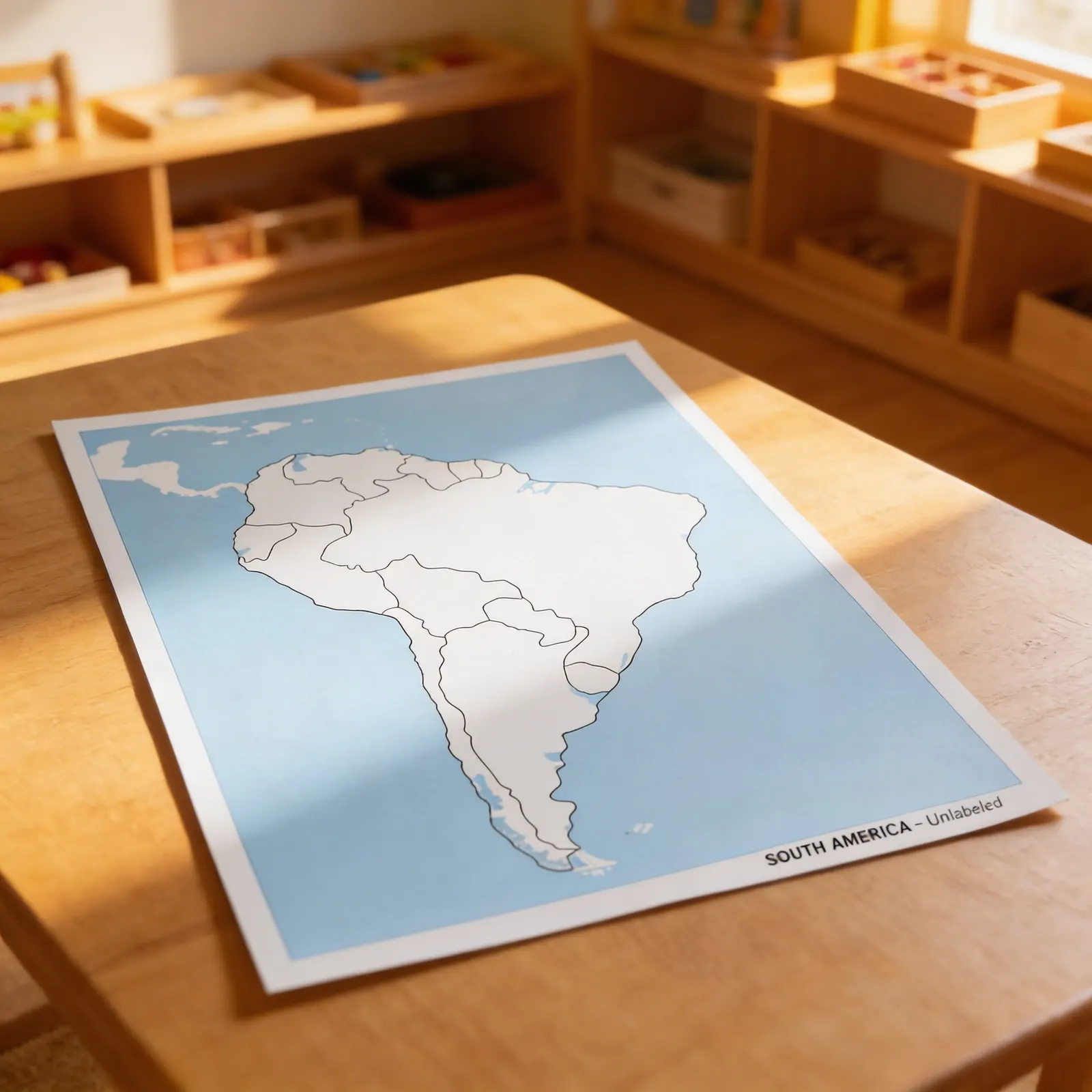
The unlabeled control map for South America: the same map with the names left off, which is the one the child actually works on. The printed labels go onto it one at a time, and the labeled control map is what settles the question afterwards. Both of those are separate items, and so is the puzzle map, so it is worth checking what you already own before ordering a single sheet. Blank is the harder of the two maps and the one that teaches. Laminated print.
Geographic Awareness
Children develop understanding of South American countries, their shapes, sizes, and relative positions through visual reference.
Visual Discrimination
Comparing the control map with puzzle pieces refines perception of subtle differences in country boundaries and shapes.
Independent Learning
The unlabeled format encourages self-directed work as children match puzzle pieces without relying on text labels.
Preparation for Abstract Work
Transitions children from concrete puzzle manipulation to abstract map drawing and geographic understanding.
How to present it
Place the control map flat on a table mat alongside the South America puzzle map. Ensure good lighting and have colored pencils and tracing paper available.
- 1Invite the child to bring one puzzle piece to the control map
- 2Show how to match the puzzle piece to its location on the control map by comparing shapes
- 3Once matched, the child can trace the country on thin paper laid over the control map
- 4Return the puzzle piece and select another, continuing until all countries are matched
3 tips for parents
- Support map work at home by looking at South American countries in atlases or online, connecting shapes to real places
- When your child traces countries, display their work and discuss what they notice about sizes and shapes
- Play 'country detective' games where you describe a country's shape and your child finds it on the control map

If you are not sure it suits your child, we answer in person.
Norbert Kovalčín, founder of Faborino · write to him
There is no review here yet. We will ask you for one after you buy. Write the first review
What's in the Box
- South America Control Map: Unlabeled with country boundaries
Size and material
| Packaging | 43 × 56 × 0 cm |
| Base Material | Paper |
| Surface | Laminate coating |
| Recommended Age | 3-6 years |
Care
Wipe with damp cloth; dry immediately
Frequently Asked Questions
What is the purpose of an unlabeled control map in Montessori education?
The unlabeled control map serves as a reference guide that children use to check their work when assembling puzzle maps or creating their own maps. It shows country boundaries without names, encouraging children to focus on shapes and spatial relationships while building geographic knowledge independently.
How do children use this control map with other Montessori geography materials?
Children typically use this control map alongside the South America puzzle map. They can place puzzle pieces on top of the control map to verify correct placement, trace country outlines onto paper, or use it as a reference when coloring or labeling their own maps of South America.
What are the dimensions and material specifications of this control map?
This control map features a laminated surface for durability and easy cleaning. The map clearly shows all South American country boundaries in appropriate colors that match the Montessori puzzle map pieces. Specific dimensions would depend on the manufacturer but are typically sized to work with standard Montessori puzzle maps.
Is this control map suitable for children who cannot yet read?
Yes, this unlabeled map is specifically designed for pre-readers and early readers ages 3-6. The absence of text allows children to focus on visual discrimination of shapes and boundaries. As children develop reading skills, they can add labels using separate materials or create their own labeled versions.
What activities can extend learning with this control map?
Children can trace countries onto paper, create pin maps marking capitals or features, use it for cultural studies by adding pictures of animals or landmarks, practice with nomenclature cards, or combine it with flag work. The map also supports lessons on neighboring countries and geographical relationships.
Product safety
Manufacturer: Nienhuis Montessori, Anders Celsiusstraat 15, 7442 PB Nijverdal, Netherlands
South America Control Map