
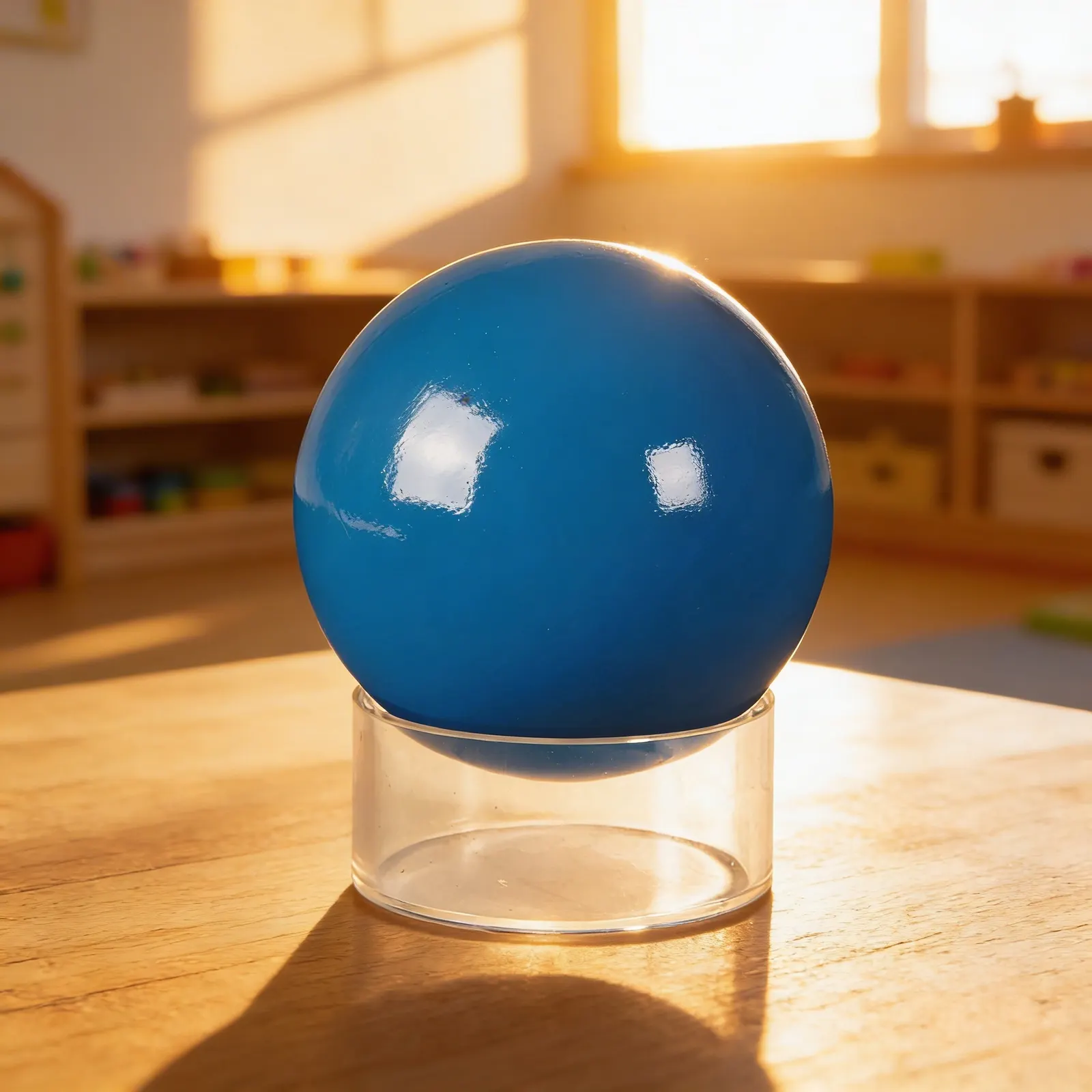
SphereIndividual Geometric Solid
The first photo is the maker's own. The other shots are illustrative.
Inv. no. NIE-018814
- Maker
- Nienhuis Montessori, since 1929
- Approval
- AMI
- Product size
- 6 × 6 cm
- Sphere
- High-quality plastic with glossy finish
- Base
- Clear acrylic
- EAN
- 8719924010041
Final price incl. VAT. Delivery €5.90, €45.10 to go for free delivery.
Advice, warranty and returns are handled by us.
Why it costs €103.90
Behind the price of the original are things you can check yourself.
AMI approval
The material is approved by the Association Montessori Internationale (AMI). Nienhuis has made Montessori materials since 1929.
A verifiable original
The EAN 8719924010041 is on the box. It is the maker's number, not ours.
Sphere in a child's hands
The sphere from the blue geometric solids, derived from a base of 6 x 6 cm and a height of 6 cm, which makes it the odd one in the set and worth noticing. A sphere has no base and no height in the way the prisms do, so its dimensions have to be defined by the cube that would contain it. That is exactly the insight the piece is for: volume needs a frame of reference, and choosing one is part of measuring. Sold individually. Plastic with acrylic, for ages 6 to 12.
Spatial Intelligence
Handling and examining the sphere develops three-dimensional thinking and spatial reasoning crucial for advanced mathematics.
Mathematical Vocabulary
Children learn precise geometric terms like radius, diameter, and circumference through concrete exploration.
Abstract Thinking
Transitions students from concrete shapes to abstract geometric concepts, preparing them for theoretical mathematics.
How to present it
Place the sphere on its transparent acrylic base on a solid-colored mat. Have paper and colored pencils available for recording observations.
- 1Invite the child to examine the sphere from all angles, rotating it on its base
- 2Compare the sphere to other geometric solids, discussing unique properties
- 3Trace the sphere's shadow at different times to observe circular projections
- 4Roll the sphere gently to demonstrate equal distance from center to surface
- 5Create a chart listing sphere properties discovered through exploration
3 tips for parents
- Look for spheres during daily activities: sports balls, fruits, bubbles in the bath
- Use clay or play dough to form spheres and discuss why perfect spheres are challenging to create
- Compare sphere properties to other shapes when cooking: why do meatballs roll but brownies don't?

If you are not sure it suits your child, we answer in person.
Norbert Kovalčín, founder of Faborino · write to him
There is no review here yet. We will ask you for one after you buy. Write the first review
What's in the Box
- Blue Geometric Sphere: Approx. 8 cm diameter
- Clear Acrylic Base: Cylindrical support stand
Size and material
| Product size | 6 × 6 cm |
| Packaging | 13 × 13 × 13 cm |
| Sphere | High-quality plastic with glossy finish |
| Base | Clear acrylic |
| Recommended Age | 6-12 years |
Care
Wipe with soft, damp cloth; avoid abrasive cleaners
Frequently Asked Questions
What is the recommended age range for this geometric sphere?
This educational sphere is designed for children ages 6-12, aligning with elementary Montessori geometry curriculum when students begin exploring three-dimensional shapes and their properties.
How does this sphere support geometry learning?
The sphere enables hands-on exploration of 3D geometry concepts including surface area, volume, diameter, radius, and circumference. Children can physically examine how a sphere has no edges or vertices, developing spatial reasoning through tactile learning.
What are the specifications of this educational sphere?
The sphere features a glossy blue finish for visual appeal and durability, and comes with a transparent acrylic base that provides stable display while allowing 360-degree observation of the sphere's properties.
How is this sphere used in Montessori classrooms?
Teachers use it for lessons on geometric solids, comparing curved vs. flat surfaces, introducing mathematical vocabulary, and connecting to real-world spherical objects. It's often paired with other geometric solids for classification activities.
What mathematical concepts can children learn with this sphere?
Students explore concepts including: identifying characteristics of 3D shapes, understanding curved surfaces, learning terms like diameter and radius, comparing spheres to other solids, and developing foundations for volume and surface area calculations.
Product safety
Manufacturer: Nienhuis Montessori, Anders Celsiusstraat 15, 7442 PB Nijverdal, Netherlands
Sphere