
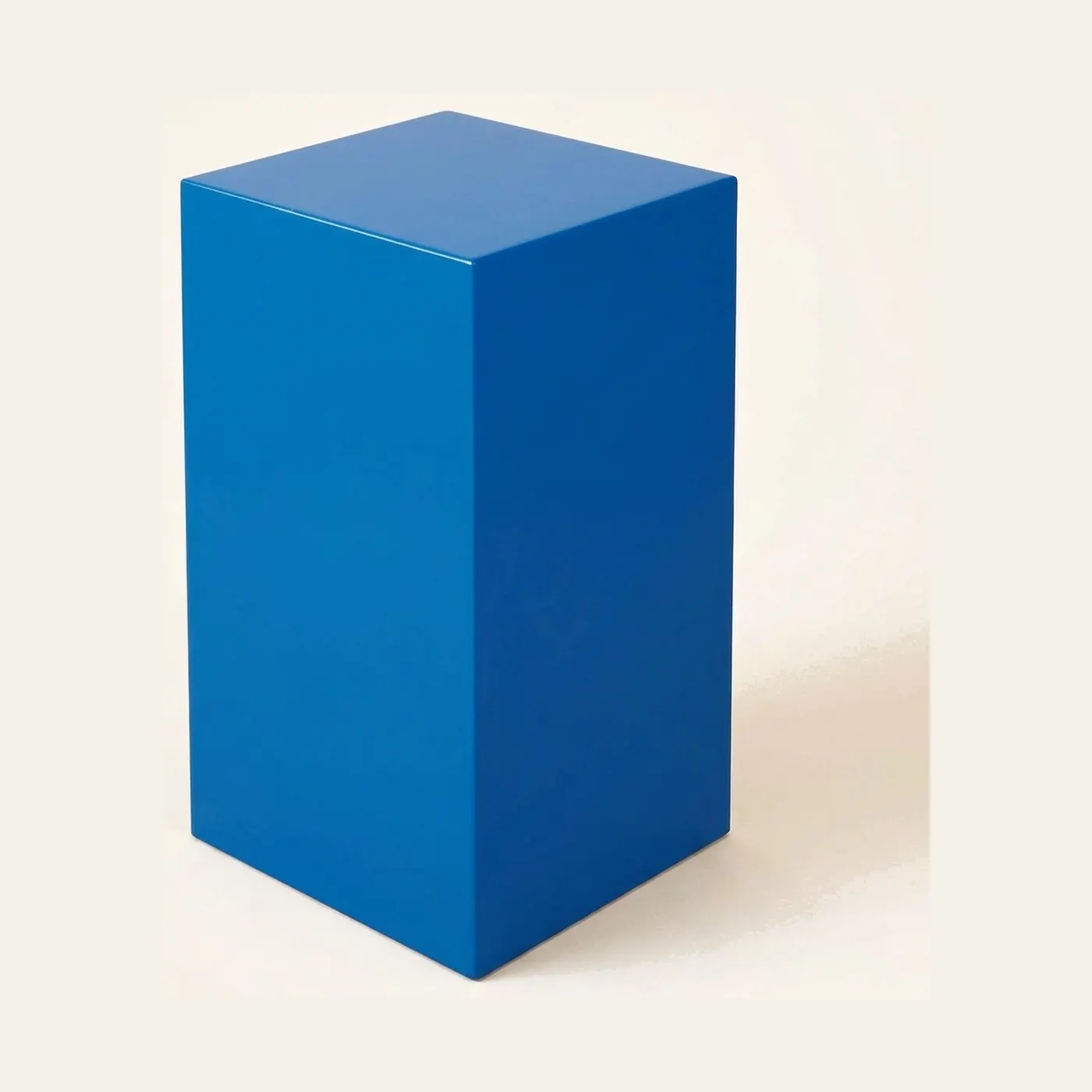
Square Based Prism: Geometric Solid for Spatial Exploration
Made by Nienhuis Montessori · shipped by Heutink International (Netherlands) About the maker
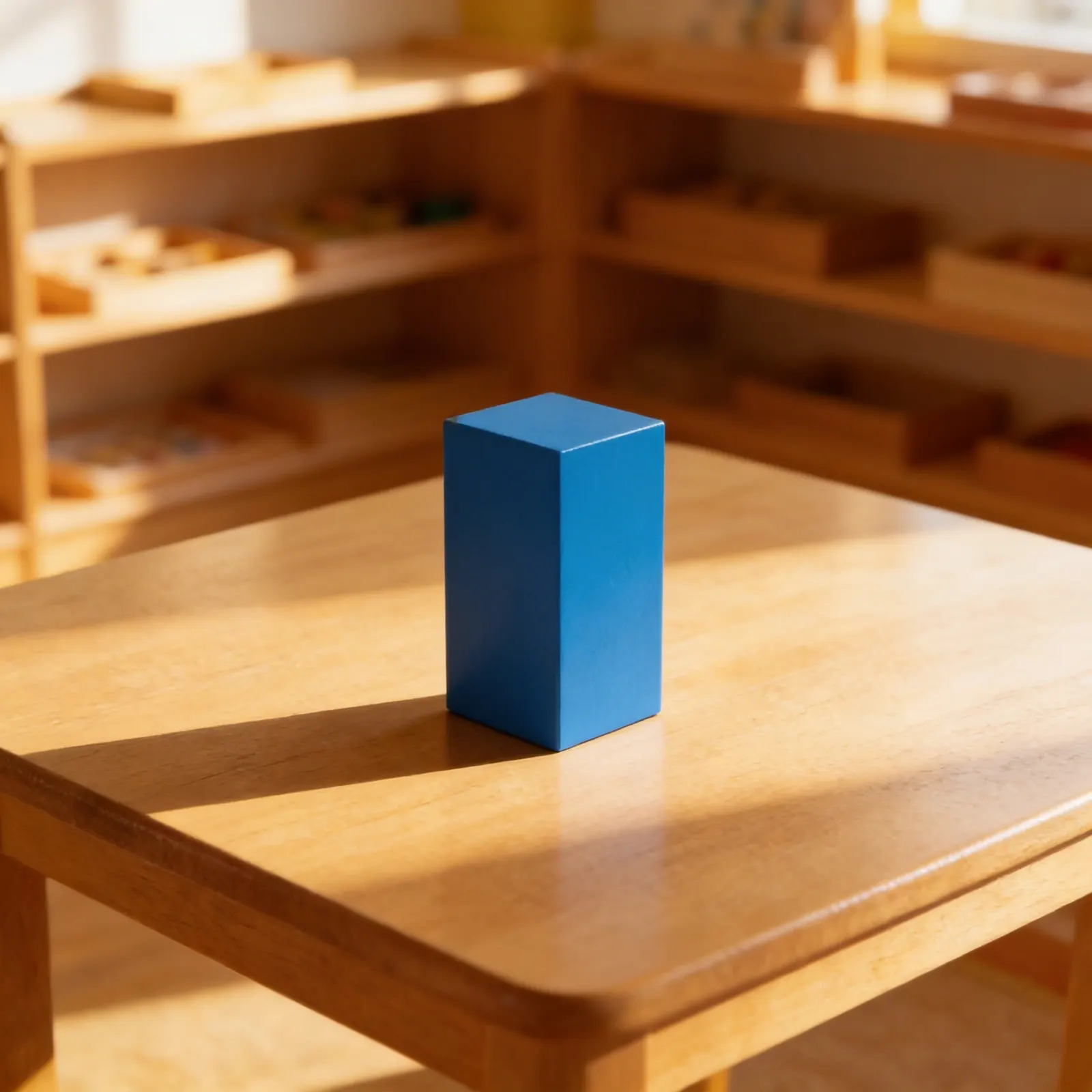
The square based prism is the reference solid of the volume set: a base of 10 by 10 cm and a height of 20 cm, which is a hundred square centimetres of base carried up through twenty, or two litres. Every other solid in the set is derived from those same measurements, so this is the one a child fills first and then compares everything against. Starting from a solid whose volume can be worked out by multiplying three numbers you can see is what makes the harder ones approachable. Sold individually, for ages 6 to 12.
“Free the child's potential, and you will transform him into the world.”
The Square Based Prism embodies Dr. Montessori's principle of educating the senses as the foundation for intellectual development.
- Recognition and naming of three-dimensional geometric forms and their properties
- Development of stereognostic sense through tactile exploration of edges, vertices, and faces
- Understanding of the relationship between 2D shapes (square base) and 3D forms
- Preparation for volume calculations and spatial geometry in advanced mathematics
Read More
Through the manipulation of this geometric solid, children move from concrete sensorial experiences to abstract mathematical concepts. The material's precise dimensions and smooth finish provide clear sensorial feedback, allowing the child to internalize geometric properties through touch and movement. This aligns with Montessori's observation that children construct their intelligence through purposeful interaction with scientifically designed materials. The prism serves as a bridge between the early sensorial work with the Geometric Solids and the advanced mathematical explorations in elementary, demonstrating the spiral curriculum where concepts are revisited with increasing complexity and abstraction.
How to present it
Follow the Montessori method of presentation for optimal child development.
Place the Square Based Prism on a mat alongside other geometric solids. Have sheets of paper and pencils available for tracing work. Ensure the child has experience with the basic Geometric Solids presentation.
- 1
Invite the child to carry the prism carefully to the mat, holding it with both hands
Model slow, deliberate movements to emphasize the material's importance - 2
Explore the prism tactilely, running fingers along edges and counting faces, edges, and vertices
Use the three-period lesson to introduce vocabulary: 'square base', 'rectangular face', 'edge', 'vertex' - 3
Compare the square base with the rectangular faces, noting similarities and differences
Place the prism on different faces to show it has one square base and four rectangular faces - 4
Trace around the base and sides on paper to create a net of the prism
This connects the 3D form to its 2D representation, preparing for later geometry work - 5
Find objects in the environment that have the same form
This helps children recognize geometric forms in everyday life
Every Child Is a Little Creator

Heritage
Since 1929

In classrooms
Around the world

European brands
Nienhuis, GAM, Educo

AMI approved
To the association standard
Square Based Prism: Geometric Solid for Spatial Exploration
