
Subtraction Equations BoxSelf-Correcting Facts Practice
The first photo is the maker's own. The other shots are illustrative.
Inv. no. NIE-014700
- Maker
- Nienhuis Montessori, since 1929
- Approval
- AMI
- Box Construction
- Solid wood
- Tiles
- Durable plastic
- EAN
- 8719924007607
Final price incl. VAT. Delivery €5.90, €96.10 to go for free delivery.
Advice, warranty and returns are handled by us.
Why it costs €52.90
Behind the price of the original are things you can check yourself.
AMI approval
The material is approved by the Association Montessori Internationale (AMI). Nienhuis has made Montessori materials since 1929.
A verifiable original
The EAN 8719924007607 is on the box. It is the maker's number, not ours.
Subtraction Equations Box in a child's hands
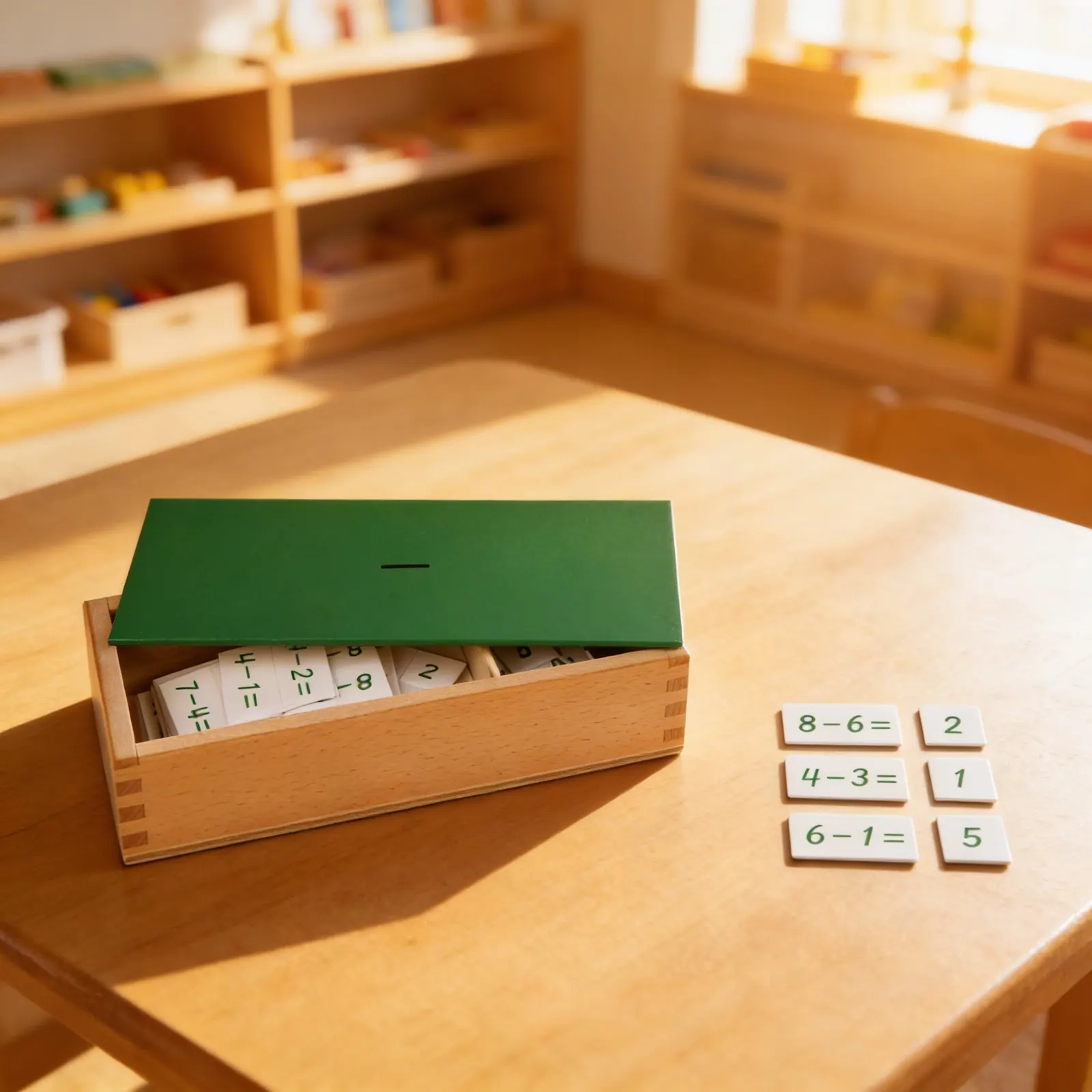
A two compartment wooden box with a lid holding plastic chips, one set printed with equations and one with the differences, covering every subtraction combination from one to eighteen. Subtraction is the operation where a wrong answer looks most plausible, because the digits involved are all small and a slip of one passes unnoticed. Having to find the difference among the chips rather than write it means a wrong answer simply is not there to be found. Used with the subtraction working charts, sold separately. Plastic and wood, for ages 3 to 12.
Mathematical Memory
Repeated matching of equations with differences builds automatic recall of subtraction facts essential for later abstract work.
Visual Discrimination
Children refine their ability to distinguish between similar numerical symbols while developing concentration through focused matching work.
Independence & Self-Correction
The material's design allows children to work autonomously and discover errors themselves, building confidence in mathematical exploration.
How to present it
Place the box on a work mat. Slide open the green lid smoothly. Remove equation tiles from left compartment and difference tiles from right compartment, arranging them separately on the mat.
- 1Select one equation tile (e.g., 7-3). Read it aloud: 'Seven minus three'
- 2Search through the difference tiles to find the matching answer (4)
- 3Place the equation tile and its matching difference tile together as a pair
- 4Continue matching all equations with their differences
- 5When finished, check work by verifying each pair makes mathematical sense
3 tips for parents
- Support at home by noticing subtraction in daily life: 'We had 5 apples, we ate 2, now we have 3'
- Avoid drilling or testing; trust the material's design for self-paced learning
- Celebrate when your child discovers patterns like 'all numbers minus themselves equal zero'

If you are not sure it suits your child, we answer in person.
Norbert Kovalčín, founder of Faborino · write to him
There is no review here yet. We will ask you for one after you buy. Write the first review
What's in the Box
- Wooden storage box: with sliding green lid
- Subtraction equation tiles: approx. 25 problem tiles
- Answer tiles: approx. 25 difference tiles
Size and material
| Packaging | 22 × 10 × 5 cm |
| Box Construction | Solid wood |
| Tiles | Durable plastic |
| Recommended Age | 3-6 years |
Care
Wipe wooden box with slightly damp cloth; clean tiles with dry cloth
Frequently Asked Questions
What subtraction facts are included in this box?
The box typically contains subtraction equations from 1-1 through 18-9, covering all basic subtraction facts where the minuend is 18 or less. Each equation tile has a corresponding difference tile, providing comprehensive coverage of fundamental subtraction combinations.
How does the self-correcting feature work?
Children match equation tiles with their corresponding answer tiles through visual and tactile discrimination. The materials are designed so that each equation has only one correct answer, allowing children to verify their work independently without adult intervention.
Why is this classified as Sensorial rather than Mathematics?
This material bridges sensorial and mathematical work by emphasizing visual discrimination, pattern recognition, and hands-on manipulation. Children develop mathematical understanding through sensorial exploration, matching tiles by sight and touch before fully comprehending the abstract mathematical concepts.
What's the purpose of the sliding green lid?
The sliding green lid serves multiple purposes: it keeps materials organized and dust-free, provides a defined workspace when partially opened, and allows children to reveal equations gradually for focused work. The green color also maintains consistency with Montessori mathematics materials color-coding.
How do children progress with this material?
Children typically begin by matching a few familiar equations, gradually working through more challenging problems. They may start with simple differences like 2-1=1, progress to facts within 10, then advance to larger numbers. The material supports memorization through repetition and pattern recognition.
Product safety
Manufacturer: Nienhuis Montessori, Anders Celsiusstraat 15, 7442 PB Nijverdal, Netherlands
Subtraction Equations Box