
Tasting Exercise
The first photo is the maker's own. The other shots are illustrative.
Inv. no. NIE-001550
- Maker
- Nienhuis Montessori, since 1929
- Approval
- AMI
- Tray
- Beech wood
- Bottles
- Glass
- EAN
- 8719924000219
Final price incl. VAT. Delivery €5.90, €67.10 to go for free delivery.
Advice, warranty and returns are handled by us.
Why it costs €81.90
Behind the price of the original are things you can check yourself.
AMI approval
The material is approved by the Association Montessori Internationale (AMI). Nienhuis has made Montessori materials since 1929.
A verifiable original
The EAN 8719924000219 is on the box. It is the maker's number, not ours.
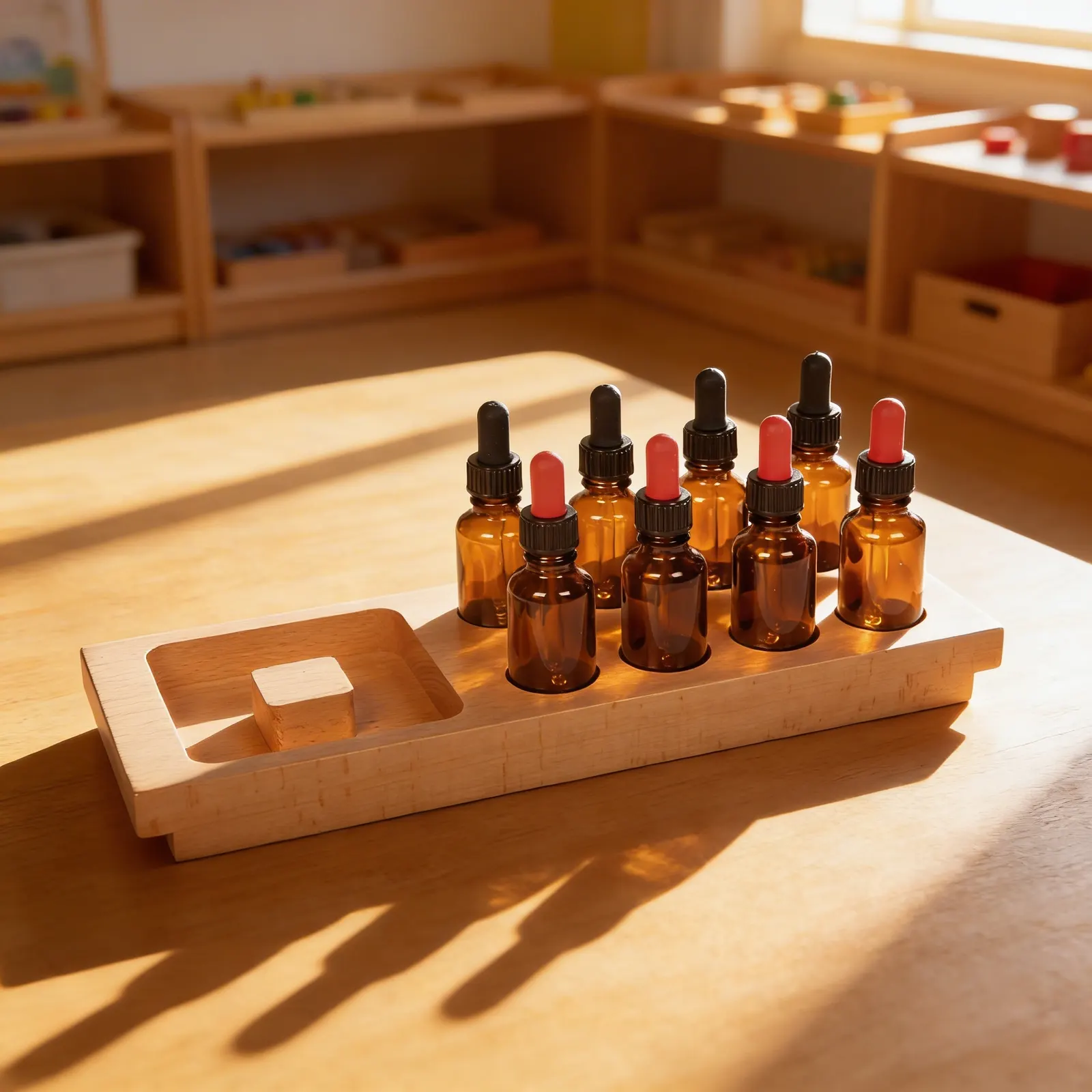
Tasting Exercise in a child's hands
The Tasting Exercise consists of eight tasting bottles and a working tray. The teacher prepares the bottles with the four basic tastes: sweet, sour, salty and bitter. The child samples the bottles one after another and matches them. The tray is made of beech and the bottles of glass; packed, the exercise measures 40 × 14 × 5 cm. The bottles are washed in warm soapy water and left to dry in the air, the tray is wiped with a damp cloth. For children aged 3 to 6.
Gustatory Discrimination
Refines the sense of taste by isolating and comparing different flavors, building sensory awareness and discrimination skills.
Vocabulary Development
Expands descriptive language as children learn to articulate subtle differences between sweet, sour, salty, and bitter tastes.
Scientific Method
Introduces systematic exploration through controlled tastings, developing observation and comparison skills essential for scientific thinking.
Fine Motor Control
Handling the bottles builds hand-eye coordination while teaching precise, controlled movements.
How to present it
Prepare taste solutions: sweet (sugar water), salty (salt water), sour (lemon water), bitter (tonic water). Fill the bottles in matching pairs. Place the bottles on the working tray.
- 1Demonstrate how to take one bottle from the tray and handle it carefully
- 2Show the child how to take a small taste, close the mouth and experience the taste fully
- 3Introduce taste vocabulary: 'This tastes sweet' while child experiences the sensation
- 4Progress to matching exercises: taste from one bottle, then find its pair
- 5Introduce mixed solutions for advanced work
3 tips for parents
- Extend taste exploration during meals by identifying flavors in familiar foods
- Create simple taste tests at home using kitchen ingredients and small spoons
- Respect your child's developing palate - avoid forcing tastes they find unpleasant

If you are not sure it suits your child, we answer in person.
Norbert Kovalčín, founder of Faborino · write to him
There is no review here yet. We will ask you for one after you buy. Write the first review
What's in the Box
- Working tray: Beech wood
- 8 tasting bottles: Glass, for sweet, sour, salty and bitter tastes
Size and material
| Packaging | 40 × 14 × 5 cm |
| Tray | Beech wood |
| Bottles | Glass |
| Recommended Age | 3-6 years |
Care
Wash bottles with warm soapy water, air dry. Wipe tray with damp cloth.
Frequently Asked Questions
What types of tastes should I prepare for this exercise?
Prepare four basic tastes: sweet (sugar water), salty (salt water), sour (diluted lemon juice), and bitter (tonic water). Start with mild concentrations and adjust based on children's sensitivity. You can also introduce umami (mild broth) for older children.
How do I present this activity to a 3-year-old?
Begin with just two contrasting tastes (sweet and salty). Demonstrate how to take a small taste, describe the taste, then invite the child to try. Gradually introduce more tastes as the child becomes comfortable with the exercise.
Why are there eight bottles when there are only four basic tastes?
Eight bottles let you prepare each of the four basic tastes twice, so the child can match tastes in pairs: taste from one bottle, then look for the second one with the same taste.
How often should I change the taste solutions?
Replace taste solutions weekly or biweekly depending on usage. Always use distilled water for preparations, store the tray in a cool area away from direct sunlight, and check solutions before each use. Label preparation dates on the tray's underside.
What language and vocabulary should I introduce with this material?
Start with basic taste names: sweet, salty, sour, bitter. Gradually introduce descriptive language like 'mild,' 'strong,' 'pleasant,' 'sharp.' Encourage comparisons to familiar foods and discuss where we taste different flavors on our tongue.
Product safety
Manufacturer: Nienhuis Montessori, Anders Celsiusstraat 15, 7442 PB Nijverdal, Netherlands
Tasting Exercise