
Tens Bead Box: Glass Bead Bars for Decimal System Introduction
Made by Nienhuis Montessori · shipped by Heutink International (Netherlands) About the maker
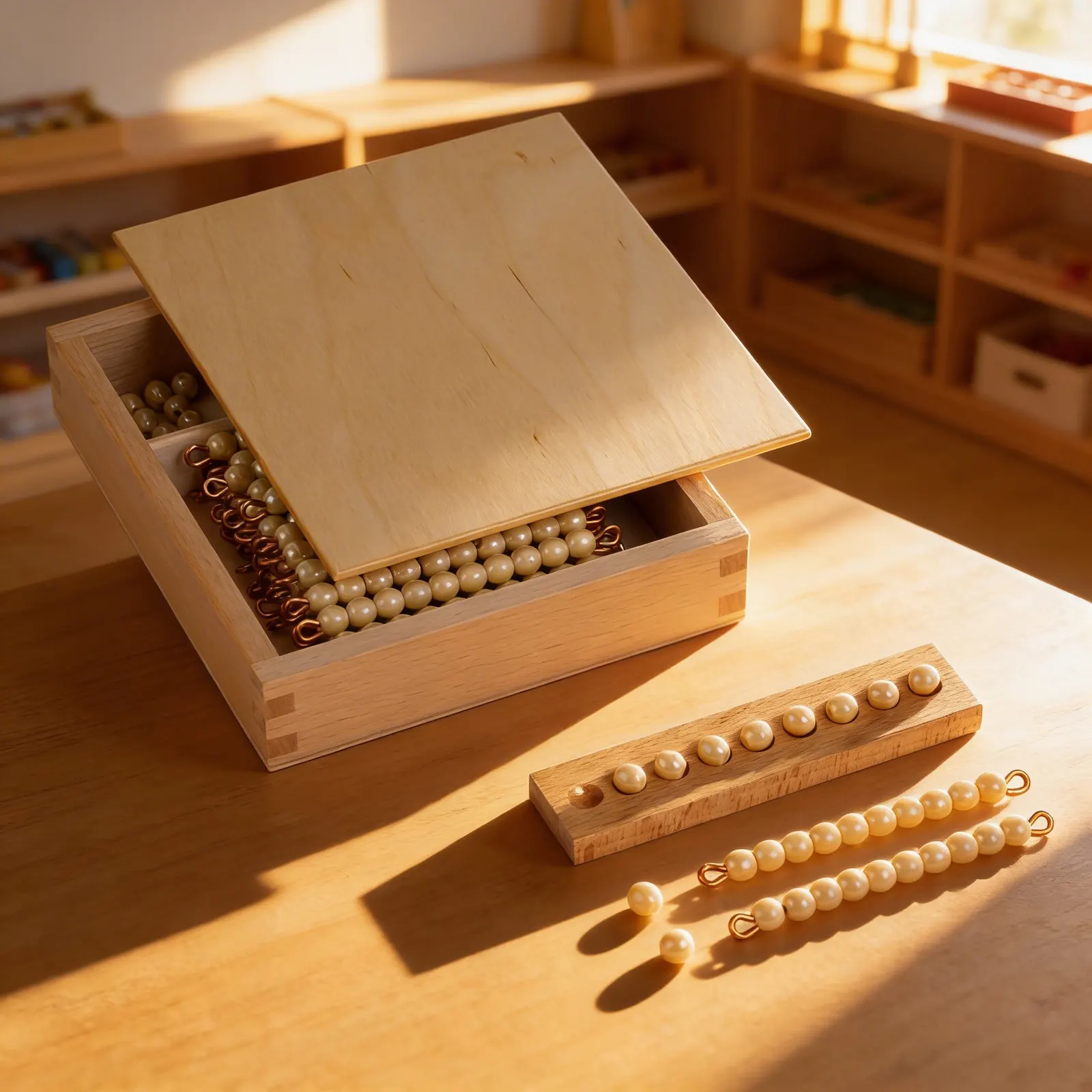
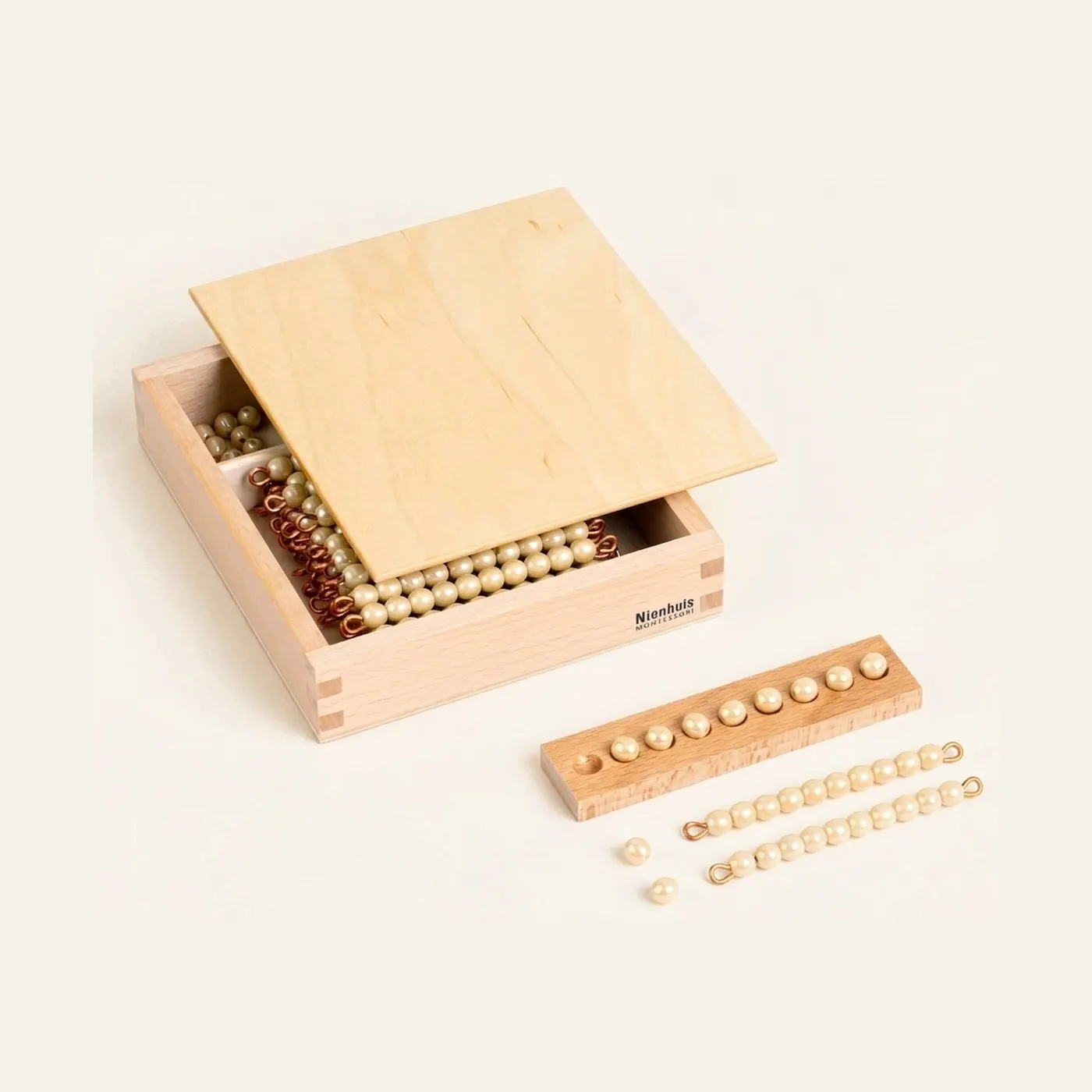
Forty five ten bars, eighteen unit beads and a wooden holder for the units, which is exactly the stock a child needs to lay out the teens and the tens without running short mid-task. Building fourteen as a ten bar and four units, then fifteen, then sixteen, is where the naming of numbers stops being arbitrary: the child can see the ten sitting inside every one of them. Glass beads on wire, for ages 3 to 6.
“Children display a universal love of mathematics, which is par excellence the science of precision, order, and intelligence.”
The Tens Bead Box embodies Montessori's principle of materialized abstraction, making the abstract concept of the decimal system tangible through golden glass beads. This material bridges the gap between concrete sensorial experiences and mathematical understanding, allowing children to physically manipulate quantities before moving to symbolic representation.
- Understanding of quantities 1-10 through concrete manipulation
- Development of one-to-one correspondence and linear counting skills
- Preparation for the decimal system and place value concepts
- Refinement of fine motor control through precise bead handling
Read More
The ten-bead bars provide a visual and tactile representation of our base-ten system, while individual beads offer opportunities for exploration and discovery. Through repeated handling, children internalize mathematical relationships naturally, following their sensitive period for order and precision. The material's self-correcting nature allows independent work, fostering concentration and building the foundation for later mathematical operations without introducing symbols prematurely.
How to present it
Follow the Montessori method of presentation for optimal child development.
Place the box on a table mat. Slowly open the sliding lid. Remove the counting board and place it to the right. Carefully take out one ten-bar and individual beads, handling them with precision to model care of materials.
- 1
Introduce the ten-bar by holding it horizontally, counting each bead slowly from left to right, touching each as you count
Use a three-period lesson format: 'This is ten' (naming), 'Show me ten' (recognition), 'What is this?' (recall) - 2
Place individual beads on the counting board, counting aloud as you place each one in sequence
Move deliberately and pause between each bead to allow the child to absorb the quantity - 3
Compare quantities by placing different amounts of beads in parallel rows on the board
Let the child discover relationships like '9 is one less than 10' through visual comparison - 4
Invite the child to form their own ten by placing individual beads on the wire
This kinesthetic experience deepens understanding of ten as a unit composed of ones
Every Child Is a Little Creator

Heritage
Since 1929

In classrooms
Around the world

European brands
Nienhuis, GAM, Educo

AMI approved
To the association standard
Tens Bead Box: Glass Bead Bars for Decimal System Introduction
