
The Binomial Castle
The first photo is the maker's own. The other shots are illustrative.
Inv. no. NIE-068501
- Maker
- Nienhuis Montessori, since 1929
- Primary Material
- Solid hardwood
- Finish
- Lacquer
- EAN
- 8719924014438
Final price incl. VAT. Delivery €5.90, €129.10 to go for free delivery.
Advice, warranty and returns are handled by us.
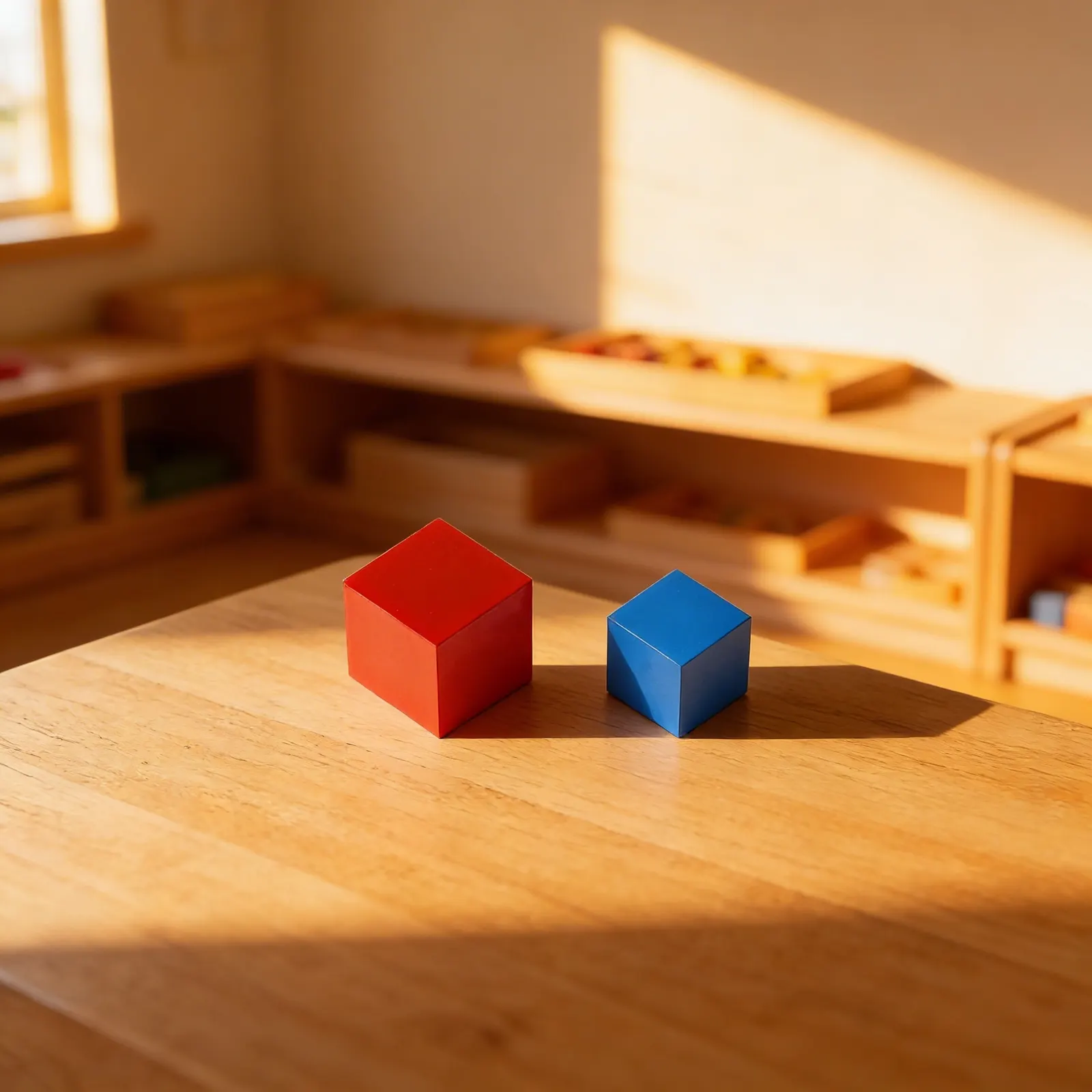
The Binomial Castle in a child's hands
The Binomial Castle introduces fundamental algebraic concepts through real-world practice with precisely crafted wooden cubes. These glossy-finished blocks represent the concrete manifestation of (a+b)² in three dimensions, so children can physically construct and deconstruct the binomial theorem. This simplified version focuses on spatial relationships and size discrimination while preparing for more complex mathematical work.
Mathematical Foundations
Introduces algebraic concepts concretely, allowing children to physically experience size relationships and proportions before abstract symbols.
Spatial Intelligence
Building and comparing the cubes develops three-dimensional thinking and understanding of volume relationships.
Concentration Skills
The precision required to align and stack the cubes perfectly cultivates focus and attention to detail.
Preparation for Abstraction
Creates sensorial memories that support later understanding of squared numbers and algebraic expressions.
How to present it
Place the Binomial Castle blocks on a mat in random order. Ensure the child has adequate workspace and good lighting to see the glossy surfaces clearly.
- 1Examine each wooden block, feeling its weight and observing its size
- 2Sort the blocks by size, placing similar pieces together
- 3Begin construction with the largest cube as the base
- 4Build upward, noticing how pieces align to form a complete cube
- 5Deconstruct the castle systematically, observing the reverse process
3 tips for parents
- Create building challenges at home using blocks of different sizes to reinforce spatial concepts
- Avoid correcting construction attempts - let your child discover solutions independently
- Use mathematical language naturally: 'That piece is twice as tall as the other one'

If you are not sure it suits your child, we answer in person.
Norbert Kovalčín, founder of Faborino · write to him
There is no review here yet. We will ask you for one after you buy. Write the first review
What's in the Box
- Large wooden cube: Glossy finish
- Small wooden cube: Proportionally sized
Size and material
| Packaging | 22 × 21 × 1 cm |
| Primary Material | Solid hardwood |
| Finish | Lacquer |
| Recommended Age | 6-12 years |
Care
Wipe with slightly damp cloth, dry immediately
Frequently Asked Questions
What mathematical concepts does the Binomial Castle teach?
The Binomial Castle introduces the algebraic formula (a+b)² through concrete manipulation. Children explore spatial relationships, size discrimination, and pattern recognition while building the three-dimensional representation of this mathematical theorem, laying groundwork for future algebra studies.
How do young children use this advanced mathematical material?
Children ages 3-6 focus on the sensorial aspects: building the castle, matching colors and sizes, and discovering how the pieces fit together perfectly. They absorb mathematical relationships through hands-on exploration without needing to understand the algebraic notation yet.
What skills does the Binomial Castle develop?
This material develops spatial reasoning, visual discrimination, fine motor control, logical thinking, and pattern recognition. It also builds concentration, order, and precision while introducing mathematical beauty through concrete manipulation.
How does this differ from the traditional Binomial Cube?
The Binomial Castle is a simplified version designed for younger children, featuring glossy wooden cubes that are easier to handle. It focuses on the essential spatial relationships and size discrimination aspects while the traditional cube includes more complex color coding and advanced extensions.
What activities can children do with this material?
Children can build and rebuild the castle, sort pieces by size or color, create patterns, match pieces to control cards, and eventually work with the algebraic notation. The material supports both guided lessons and independent exploration.
Product safety
Manufacturer: Nienhuis Montessori, Anders Celsiusstraat 15, 7442 PB Nijverdal, Netherlands
The Binomial Castle