
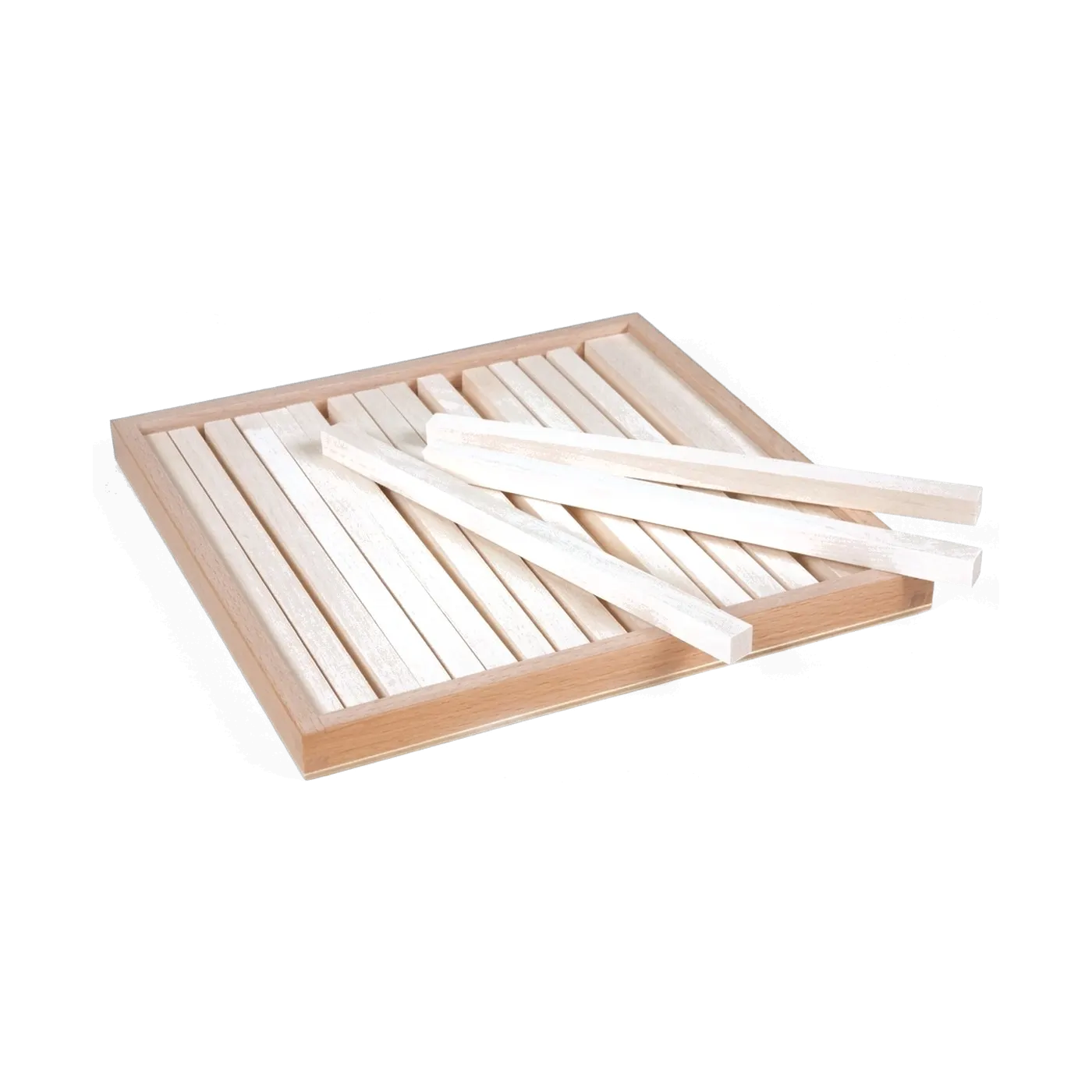
The Brown Stair
The first photo is the maker's own. The other shots are illustrative.
Inv. no. NIE-002500
- Maker
- Nienhuis Montessori, since 1929
- Approval
- AMI
- Primary Material
- Solid hardwood
- Finish
- Natural wood polish
- EAN
- 8719924001155
€174.90
Final price incl. VAT. Free delivery.
✓ In Stock. Delivery in 5 to 9 working days.
1
30 daysto return
Advicebefore and after
Invoicefor companies
Advice, warranty and returns are handled by us.
The original
Why it costs €174.90
Behind the price of the original are things you can check yourself.
AMI approval
The material is approved by the Association Montessori Internationale (AMI). Nienhuis has made Montessori materials since 1929.
A verifiable original
The EAN 8719924001155 is on the box. It is the maker's number, not ours.
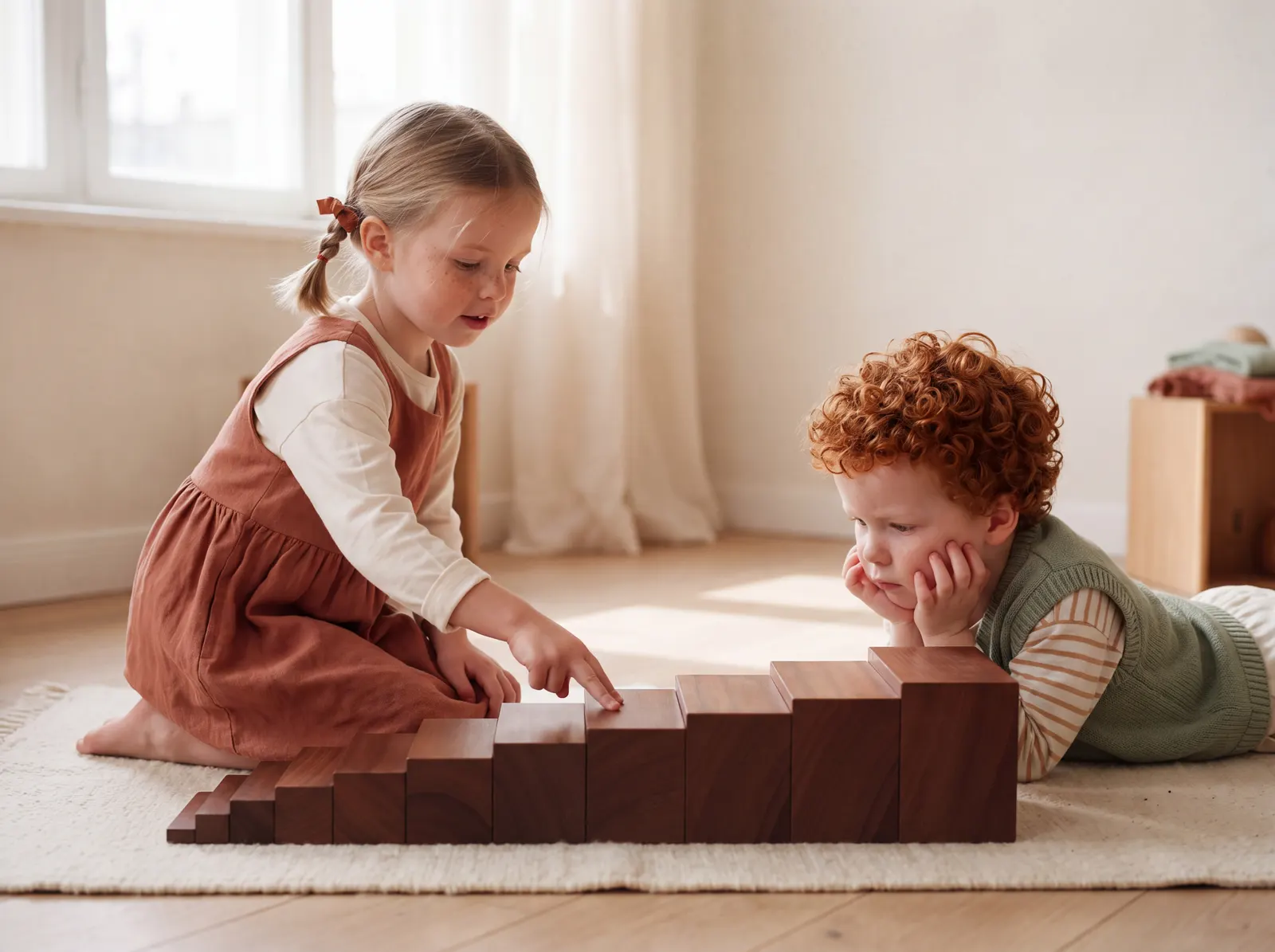
What the child does
The Brown Stair in a child's hands
Ten prisms that change in thickness, width and height together, while the length stays constant, running in exact steps from 1 x 1 x 20 cm to 10 x 10 x 20 cm. Only the thickness changes, never the length, which is what separates this from the Pink Tower and what lets a child feel thickness on its own. Built as a stair, the constant length reads as a straight edge along the top while the thickness steps down beneath it, and that contrast is the lesson. Groundwork for plane geometry, area and volume, met years before those words. Hardwood, for ages 3 to 6.
Visual Discrimination
Refines the ability to perceive subtle differences in dimension, preparing the visual sense for reading and mathematics.
Mathematical Preparation
Introduces concepts of graduation, sequence, and the decimal system through concrete manipulation.
Language Development
Builds vocabulary for comparative and superlative terms: thick/thin, thicker/thinner, thickest/thinnest.
Concentration & Order
The precise sequence required for building the stair develops sustained attention and appreciation for order.
Activity Guide
How to present it
Invite the child to work with the Brown Stair. Have them lay out a work mat. Show how to carry one prism at a time using both hands, starting with the largest. Place prisms randomly on the mat.
- 1Begin building by selecting the thickest prism as the base
- 2Continue selecting the next thickest prism, placing it precisely on top or beside the previous one
- 3Complete the stair with all ten prisms in order
- 4Invite the child to observe the stair from different angles
- 5Dismantle by removing one prism at a time, returning each to the shelf
3 tips for parents
- Create similar experiences at home by collecting boxes or containers that vary in one dimension
- Use comparative language during daily activities: 'Which book is thicker?'
- Allow your child time to self-correct rather than pointing out errors immediately
From the same maker
Accessories and spare parts

Why it is in our selection
If you are not sure it suits your child, we answer in person.
Norbert Kovalčín, founder of Faborino · write to him
There is no review here yet. We will ask you for one after you buy. Write the first review
Details
What's in the Box
- 10 Wooden Prisms: Graduated from 1cm to 10cm square cross-section
Size and material
| Product size | 28 × 21 × 17 cm |
| Packaging | 28 × 21 × 17 cm |
| Primary Material | Solid hardwood |
| Finish | Natural wood polish |
| Recommended Age | 3-6 years |
Care
| Cleaning | Wipe with slightly damp cloth, dry immediately |
| Storage | Store in dry area, avoid direct sunlight |
Frequently Asked Questions
What are the exact dimensions of the Brown Stair prisms?
The Brown Stair consists of 10 wooden prisms, each 20cm in length. The smallest prism measures 1cm x 1cm in cross-section, increasing by 1cm increments up to the largest at 10cm x 10cm. This systematic progression helps children understand dimensional relationships.
How does the Brown Stair differ from the Pink Tower?
While both materials teach dimension discrimination, the Brown Stair focuses on two dimensions (width and height) with constant length, whereas the Pink Tower varies in all three dimensions. Children often use them together to explore relationships between 2D and 3D concepts.
What skills does my child develop using the Brown Stair?
Children develop visual discrimination of size, hand-eye coordination, concentration, and order. They also build vocabulary (thick/thin, thicker/thinner, thickest/thinnest) and prepare for mathematical concepts like measurement, seriation, and the decimal system.
At what age should children start using the Brown Stair?
Most children begin working with the Brown Stair around age 3-3.5, after mastering simpler sensorial materials. They should have developed adequate hand control and be able to carry the prisms carefully. Interest typically continues through age 6.
What extensions can be done with the Brown Stair?
Extensions include combining with the Pink Tower to create patterns, using with the Red Rods for length comparison, tracing prisms to create designs, building various structures, and eventually measuring with rulers to connect to mathematical concepts.
Product safety
Manufacturer: Nienhuis Montessori, Anders Celsiusstraat 15, 7442 PB Nijverdal, Netherlands
The Brown Stair
€174.90