
The Demonstration Tray
The first photo is the maker's own. The other shots are illustrative.
Inv. no. NIE-003800
- Maker
- Nienhuis Montessori, since 1929
- Approval
- AMI
- Frame
- Solid wood construction
- Shapes
- Painted wood with natural knobs
- EAN
- 8719924002282
Final price incl. VAT. Delivery €5.90, €4.10 to go for free delivery.
Advice, warranty and returns are handled by us.
Why it costs €144.90
Behind the price of the original are things you can check yourself.
AMI approval
The material is approved by the Association Montessori Internationale (AMI). Nienhuis has made Montessori materials since 1929.
A verifiable original
The EAN 8719924002282 is on the box. It is the maker's number, not ours.
The Demonstration Tray in a child's hands
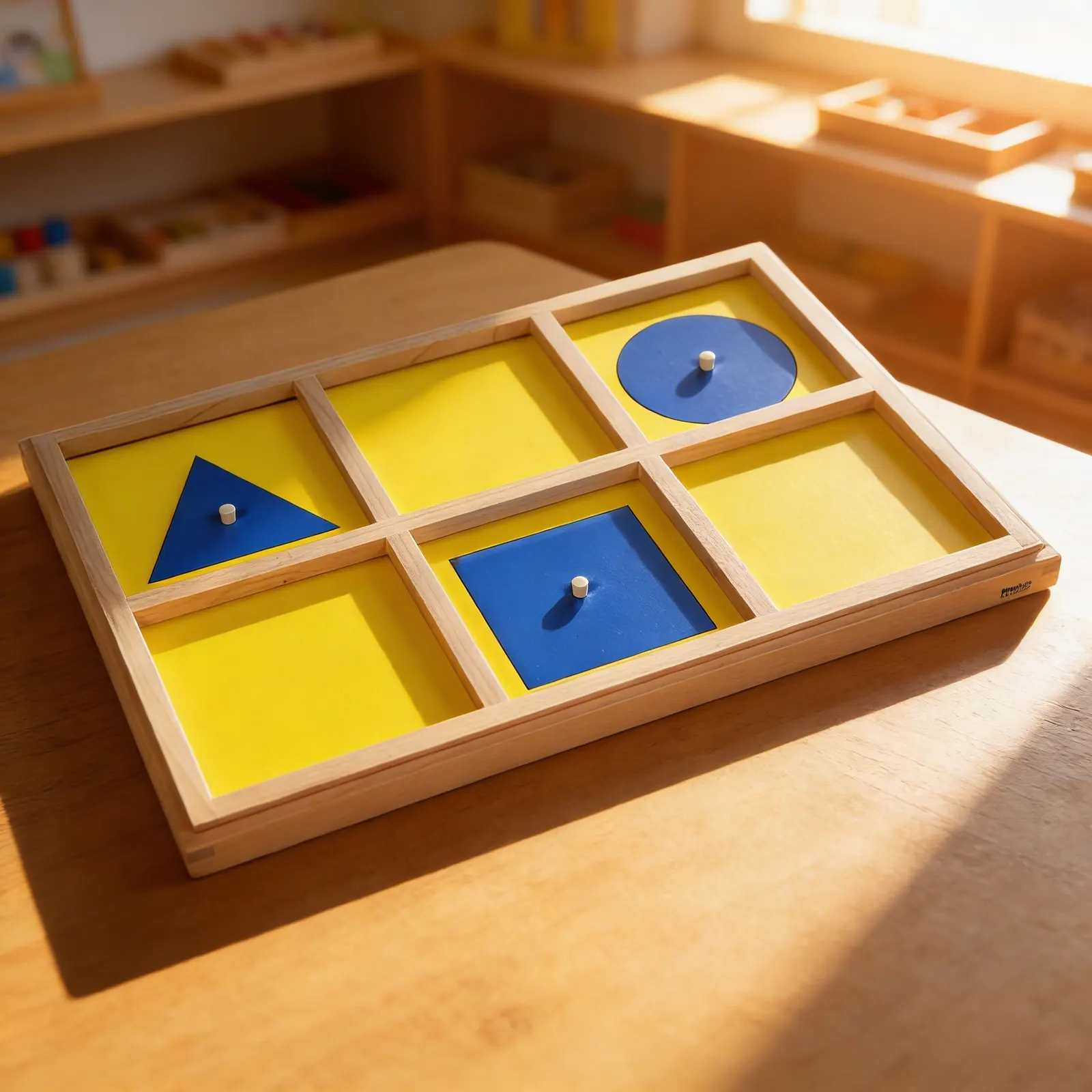
The Demonstration Tray provides a structured presentation format for introducing geometric shapes to young learners. This wooden tray features six compartments arranged in a 2×3 grid, containing three fundamental geometric forms (triangle, circle, and rectangle) with central knobs for easy manipulation. The organized layout supports the Montessori principle of isolation of difficulty, making it possible for children to focus on shape recognition and discrimination.
Visual Discrimination
The contrasting blue shapes against the natural wood background enhance visual perception and shape recognition skills.
Fine Motor Development
Central knobs encourage proper pincer grip, preparing the hand for writing while building dexterity.
Mathematical Concepts
Introduces fundamental geometric forms that serve as the foundation for later mathematical understanding.
Order and Organization
The structured compartments teach concepts of classification and proper material placement.
How to present it
Place the Demonstration Tray on a work mat at the child's eye level. Ensure all shapes are properly seated in their compartments with knobs facing upward.
- 1Remove the circle by grasping its knob with thumb and two fingers, lifting slowly and deliberately
- 2Trace the circle's edge with your index finger, moving clockwise from top
- 3Name the shape clearly: 'This is a circle' while holding it at child's eye level
- 4Return the circle to its compartment, demonstrating precise placement
- 5Repeat the process with triangle and rectangle, emphasizing different properties
- 6Invite the child to choose a shape and repeat the exploration
3 tips for parents
- Create shape hunts at home using the same vocabulary: 'Can you find something shaped like the circle from your tray?'
- Avoid quizzing or testing - instead, make observations: 'I notice you chose the triangle first today'
- Support shape exploration through everyday activities: 'Your sandwich is a rectangle like in your tray'

If you are not sure it suits your child, we answer in person.
Norbert Kovalčín, founder of Faborino · write to him
There is no review here yet. We will ask you for one after you buy. Write the first review
What's in the Box
- Wooden demonstration tray: With 6 compartments
- Blue triangle: With central knob
- Blue circle: With central knob
- Blue rectangle: With central knob
Size and material
| Packaging | 45 × 31 × 4 cm |
| Frame | Solid wood construction |
| Shapes | Painted wood with natural knobs |
| Recommended Age | 3-6 years |
Care
Wipe with damp cloth, avoid soaking
Frequently Asked Questions
What shapes are included in the Demonstration Tray?
The Demonstration Tray includes three fundamental geometric shapes: a triangle, a circle, and a rectangle. Each shape is presented with a central knob for easy handling and manipulation by young children.
How does the compartment design support learning?
The tray features six compartments in a 2×3 grid layout, following the Montessori principle of isolation of difficulty. This organized structure helps children focus on one concept at a time, making shape recognition and discrimination more accessible and less overwhelming.
What age group is this demonstration tray designed for?
The Demonstration Tray is specifically designed for children ages 3-6 years, aligning with the sensitive period for sensorial exploration and geometric shape recognition in early childhood development.
How do the knobs benefit young learners?
The central knobs on each geometric shape support the development of the pincer grip, preparing children for future writing activities. They also make it easier for small hands to manipulate the shapes independently, promoting self-directed learning.
Can this tray be used for activities beyond shape recognition?
Yes, the Demonstration Tray can be used for various extensions including sorting activities, matching exercises, tracing work, and language development as children learn shape vocabulary. The compartments can also hold related materials for comprehensive geometry lessons.
Product safety
Manufacturer: Nienhuis Montessori, Anders Celsiusstraat 15, 7442 PB Nijverdal, Netherlands
The Demonstration Tray