
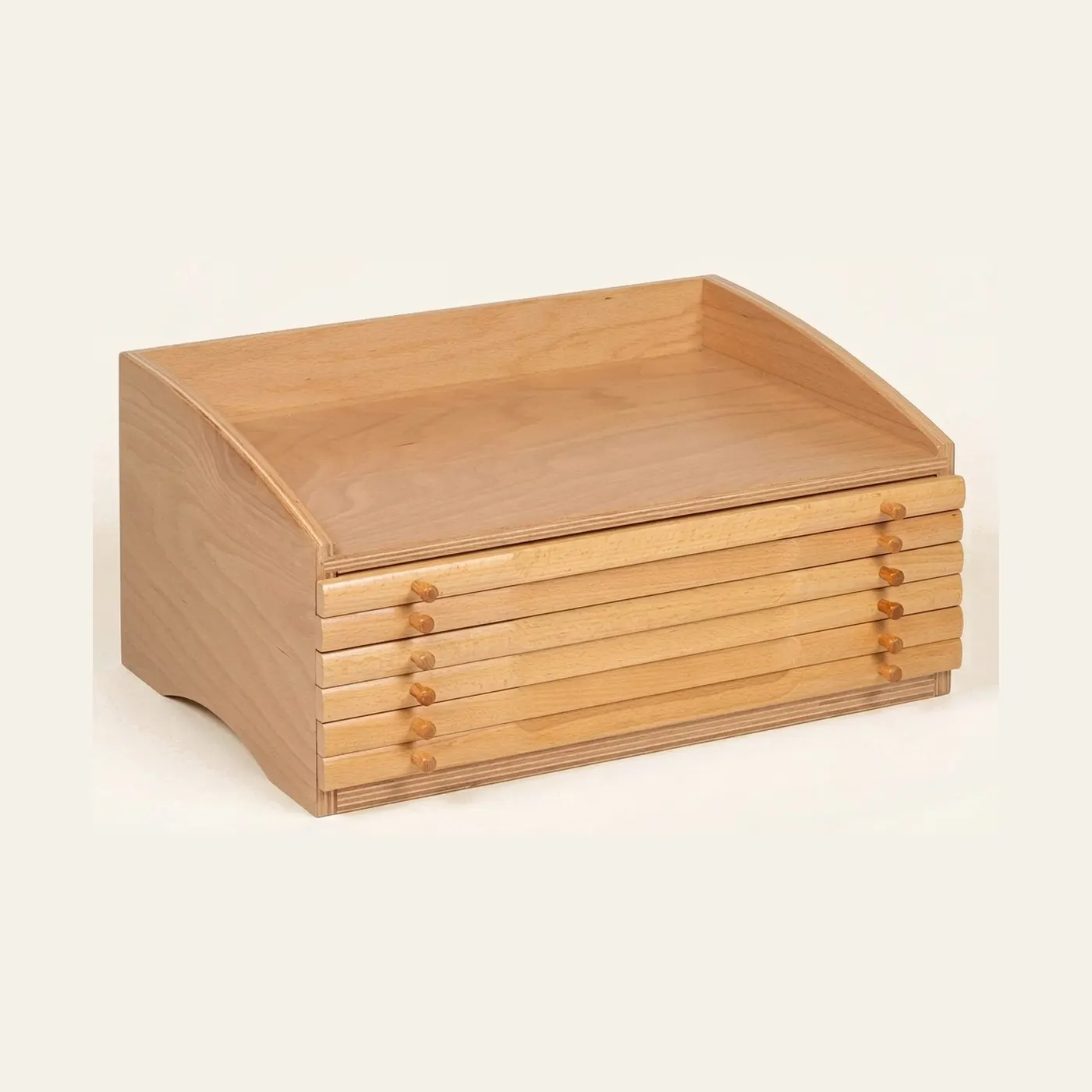
Geometric Cabinet: Six Drawers of Geometric Insets & Frames
Made by Nienhuis Montessori · shipped by Heutink International (Netherlands) About the maker
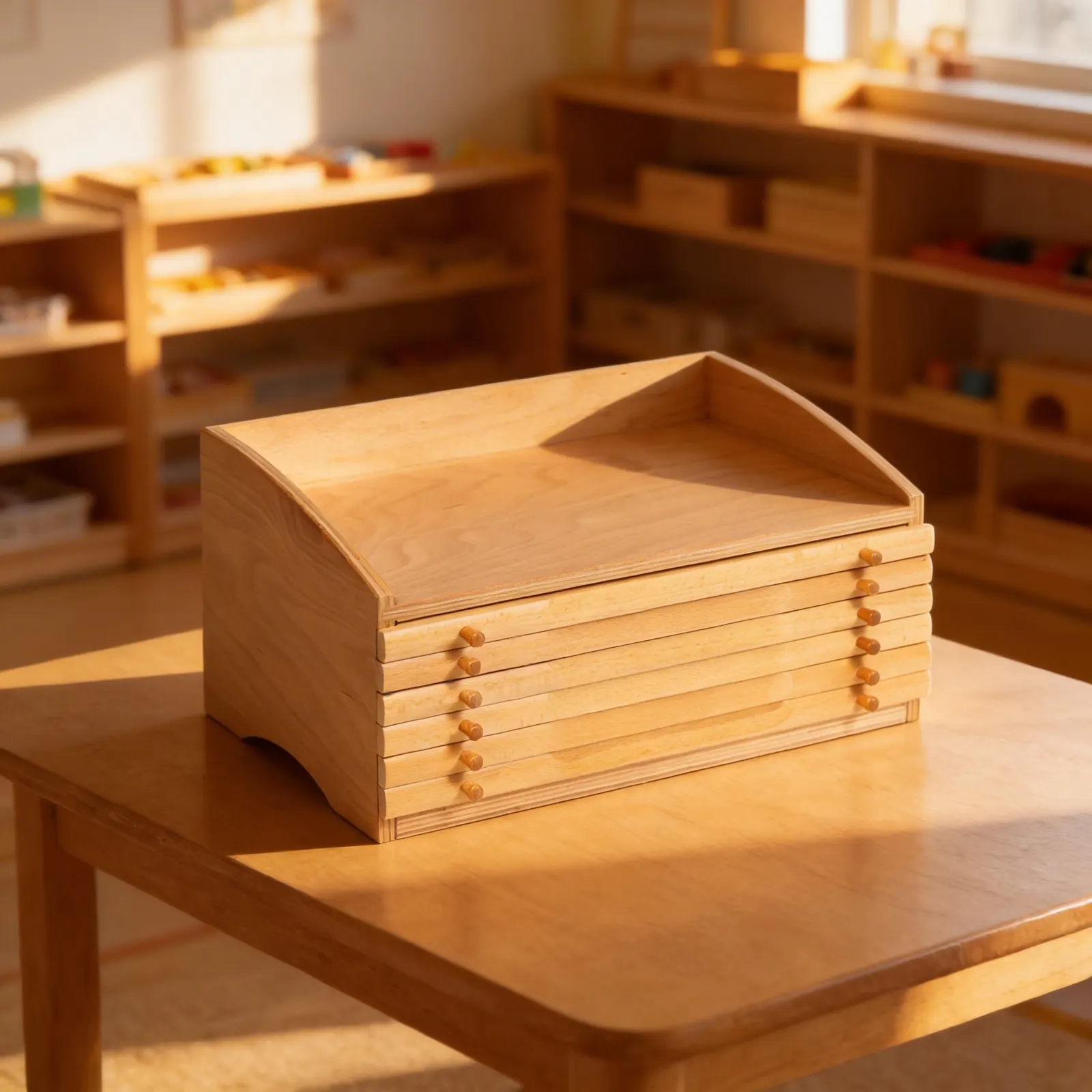
Six shallow drawers of geometric insets, each shape sitting in its own frame, with an angled top that presents the first set at a readable angle. The child traces the edge of an inset with two fingers, then traces its frame, and the shape is learned through the fingertips before it is ever named. That tracing is also direct preparation for writing: the hand is learning to follow a closed line and return to its start. Drawers separate the families, rectangles, triangles, polygons, curved figures and quadrilaterals, so comparison happens within a family before it happens across them. Plywood and solid wood, for ages 3 to 6.
“Free the child's potential, and you will transform him into the world.”
The Geometric Cabinet embodies Montessori's principle of isolation of difficulty by presenting plane geometry in its purest form.
- Visual discrimination of geometric shapes and their properties
- Refinement of pincer grip and hand control for writing preparation
- Development of mathematical language and geometric vocabulary
- Strengthening of visual memory and shape recognition
Read More
Through direct manipulation of geometric insets, children develop visual discrimination and muscular memory essential for mathematical abstraction. This material bridges the gap between concrete sensorial experiences and abstract mathematical concepts, following the child's natural progression from the known to the unknown. The cabinet's design allows for self-directed exploration and repetition, honoring the child's sensitive period for order and refinement of movement. By tracing the geometric forms, children simultaneously prepare their hands for writing while internalizing mathematical relationships, demonstrating Montessori's integrated approach to learning.
How to present it
Follow the Montessori method of presentation for optimal child development.
Place the Geometric Cabinet on a low shelf at child's eye level. Ensure the demonstration tray is clean and accessible. Have a mat ready for floor work.
- 1
Invite the child and bring the demonstration tray to a mat
Use slow, deliberate movements to model careful handling - 2
Remove one inset using the knob with a three-finger grip
Emphasize the pincer grip - this directly prepares for pencil holding - 3
Trace the frame opening with two fingers (index and middle)
Always trace counterclockwise, following the direction of writing - 4
Trace the inset edge with the same two fingers
Match your tracing speed to the child's visual tracking ability - 5
Return the inset to its frame, demonstrating precise placement
Let the child hear the soft 'click' when properly fitted - 6
Invite the child to repeat with the same or different shape
Step back and observe without interfering unless needed
Every Child Is a Little Creator

Heritage
Since 1929

In classrooms
Around the world

European brands
Nienhuis, GAM, Educo

AMI approved
To the association standard
Geometric Cabinet: Six Drawers of Geometric Insets & Frames
