
Geometric Solids: Ten 3D Forms for Tactile Shape Exploration
Made by Nienhuis Montessori · shipped by Heutink International (Netherlands) About the maker
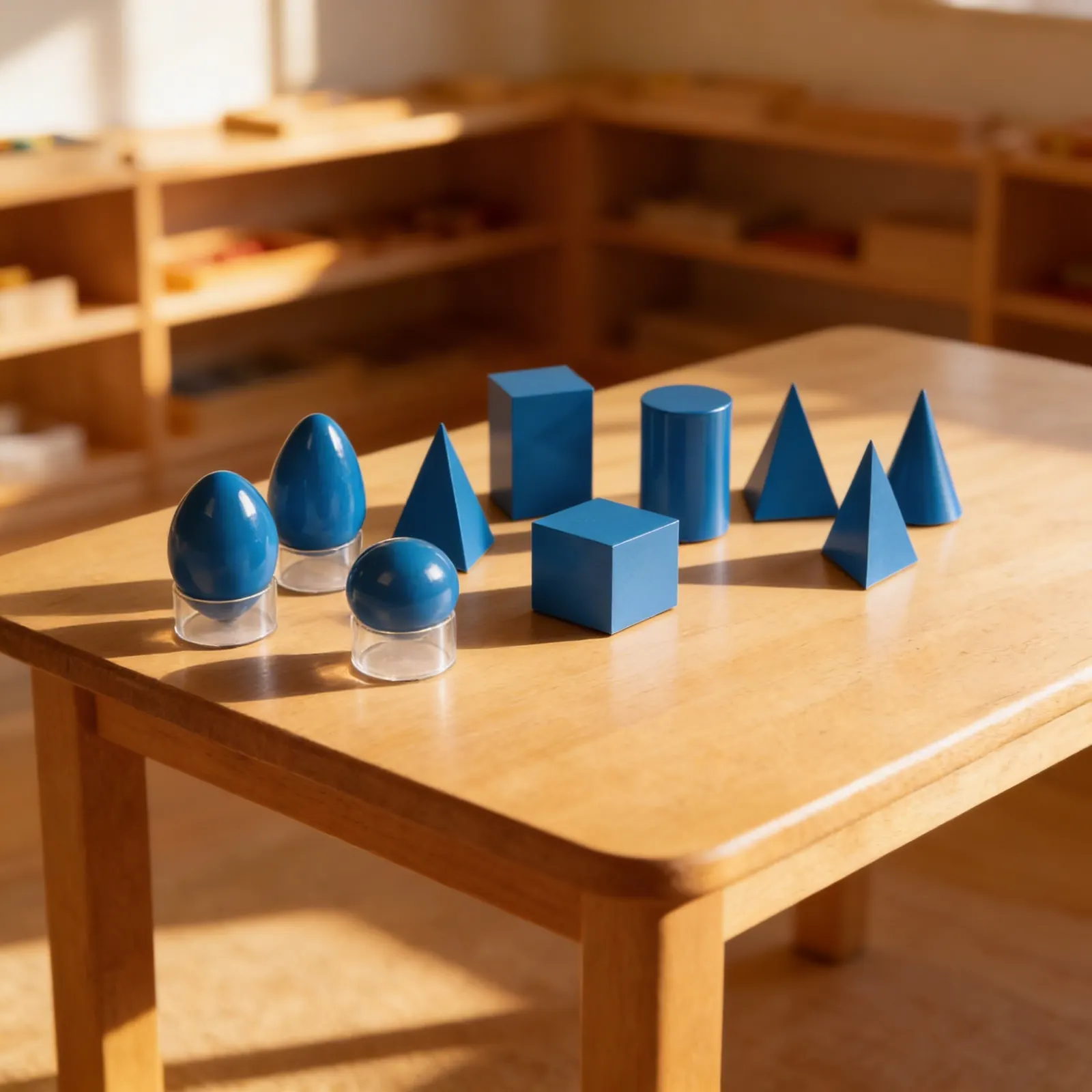
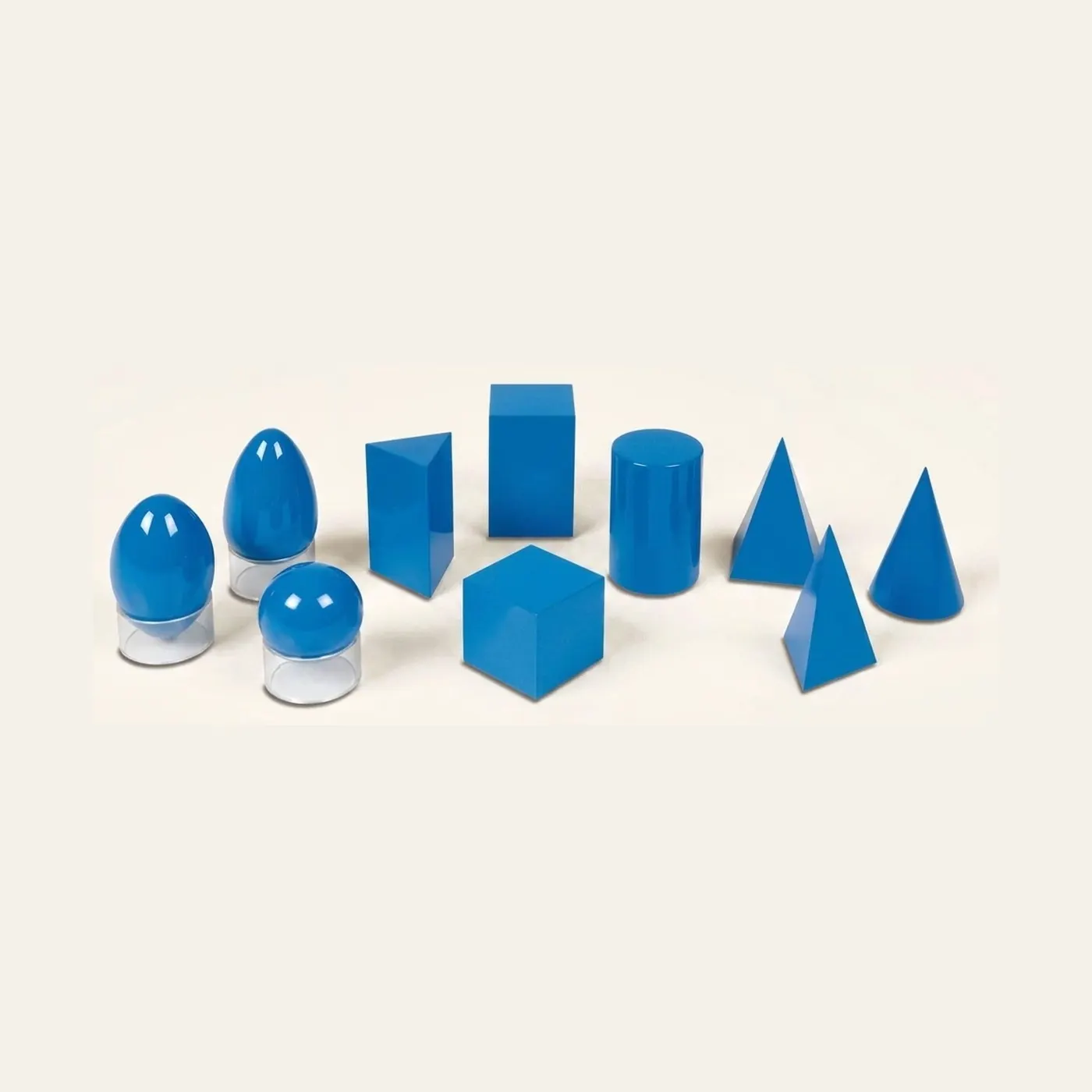
Ten solid forms introducing solid geometry through the hands, with three clear stands included for the ones that will not sit still. A sphere, a cone and an ovoid roll, and that is not a flaw to be corrected: how a solid behaves when you set it down is part of what it is. The child handles each with eyes closed, learns the names, then finds the same forms in the room, in a tin, a ball, the leg of a table. Painted wood with clear stands, for ages 3 to 6.
“The hands are the instruments of man's intelligence.”
The Geometric Solids embody Dr. Montessori's principle that the hand is the instrument of the mind.
- Development of stereognostic sense through tactile discrimination
- Recognition and naming of ten fundamental geometric solids
- Understanding relationships between 2D shapes and 3D forms
- Refinement of visual and tactile perception
Read More
Through tactile exploration of these three-dimensional forms, children build concrete experiences that later support abstract mathematical understanding. This material bridges the gap between the child's sensorial experiences and mathematical concepts, allowing them to absorb the essential qualities of each solid through touch before they can name or define them. The stereognostic sense - the ability to recognize forms through touch alone - is refined as children explore these shapes with closed eyes, creating mental impressions that become the foundation for geometry. This work satisfies the child's need for order and classification while preparing the mathematical mind through concrete manipulation of perfect geometric forms.
How to present it
Follow the Montessori method of presentation for optimal child development.
Place the basket of Geometric Solids on a mat. Prepare a second mat nearby for the three-period lesson. Ensure hands are clean and sensitized.
- 1
Invite the child and bring one solid at a time to the mat, handling each with care using both hands
Model slow, deliberate movements to emphasize the weight and form of each solid - 2
Take the sphere first, roll it between your palms and on the mat, emphasizing its continuous curved surface
Use minimal language initially - let the hands discover - 3
Introduce the cube, exploring its flat faces, straight edges, and sharp vertices with fingertips
Trace edges and count faces silently to maintain focus on sensorial experience - 4
Present contrasting pairs (sphere/cube, ovoid/ellipsoid) to highlight differences
Place contrasting solids in child's hands simultaneously for comparison - 5
Introduce stereognostic exercise: child closes eyes while you place a solid in their hands to identify
Start with most contrasting shapes (sphere and cube) before subtle differences - 6
Conduct three-period lesson for vocabulary once child knows solids through touch
Use precise mathematical language: 'cone,' not 'ice cream shape'
Every Child Is a Little Creator

Heritage
Since 1929

In classrooms
Around the world

European brands
Nienhuis, GAM, Educo

AMI approved
To the association standard
Geometric Solids: Ten 3D Forms for Tactile Shape Exploration
