
Pink Tower: 10 Graduated Cubes for Visual Discrimination
Made by Nienhuis Montessori · shipped by Heutink International (Netherlands) About the maker
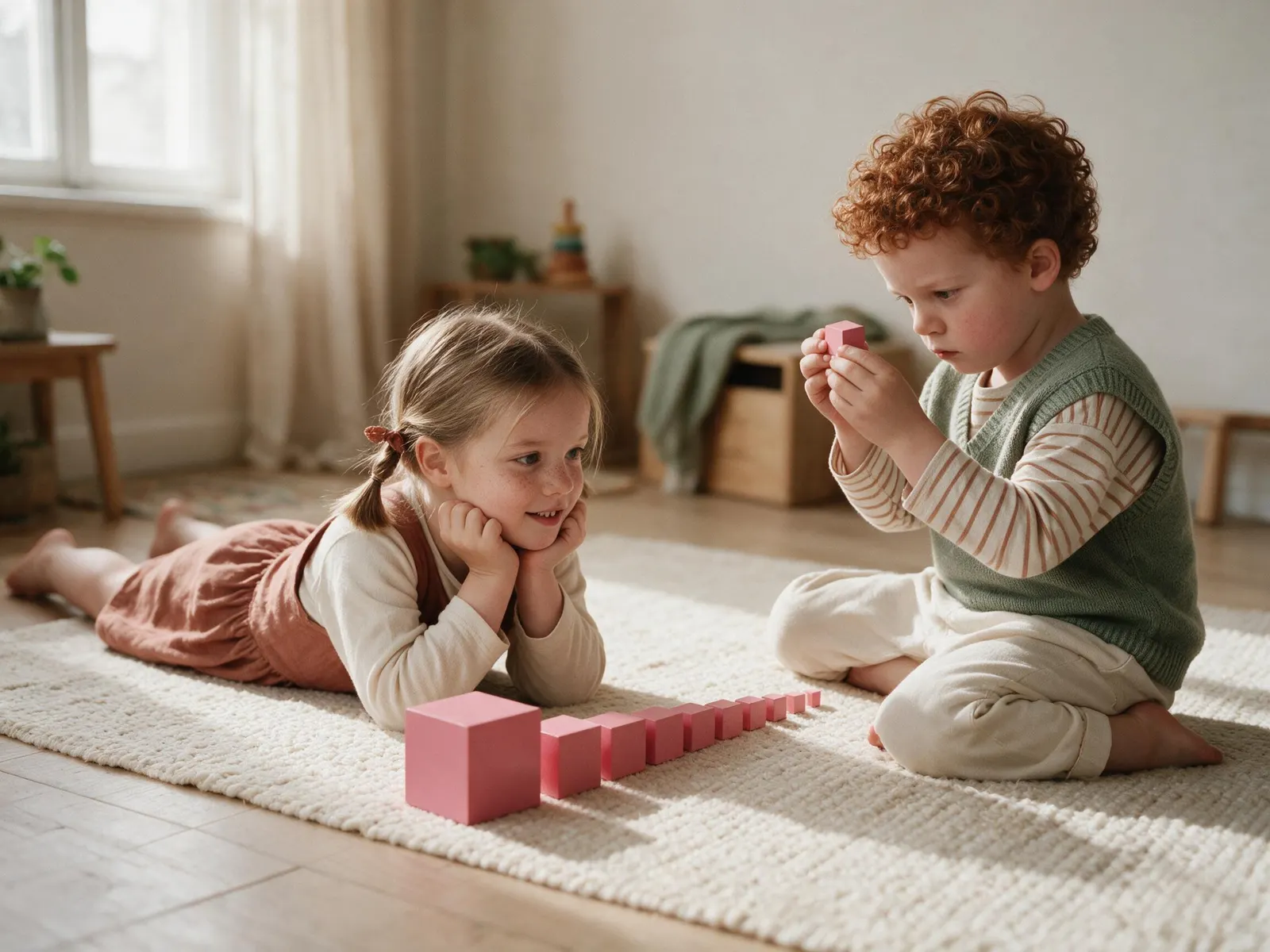
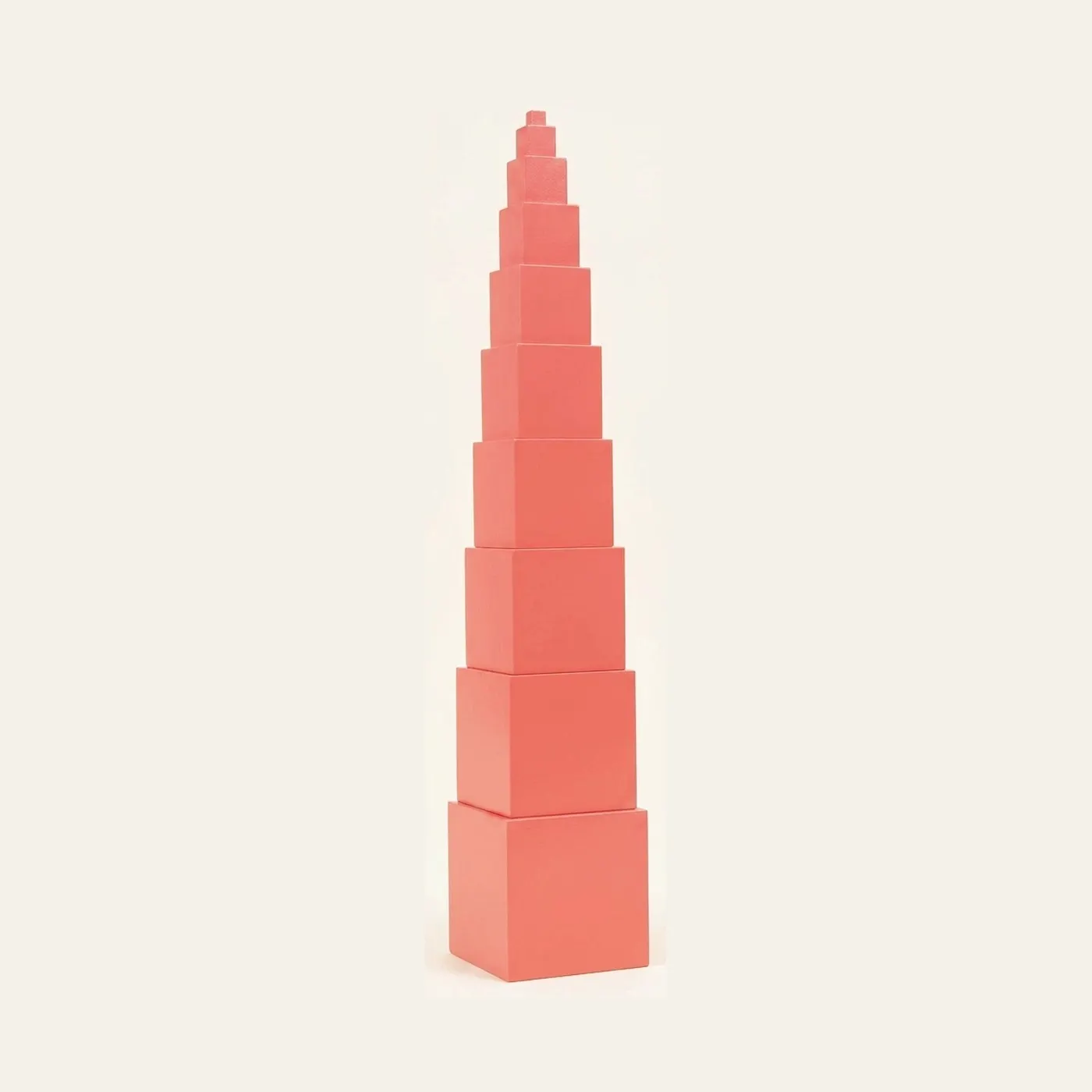
Ten wooden cubes graduated from 1 cm to 10 cm along each edge, carried one at a time and built into a tower. Size changes in all three dimensions at once here, which is exactly what separates it from the Brown Stair and the Red Rods: this is the material where a child meets volume rather than length or breadth. A misplaced cube shows itself as a lean, so the tower corrects the builder without a word. Preparation for the decimal system, geometry and volume. Painted wood, for ages 3 to 6.
“The child is both a hope and a promise for mankind.”
The Pink Tower introduces young children to the mathematical concept of the cube through direct sensory experience with ten precisely graduated wooden blocks. Each pink cube in this iconic material represents a perfect cube progression from 1cm³ to 10cm³, creating a concrete foundation for understanding three-dimensional relationships and volume.
- Develops visual discrimination of three-dimensional size relationships through manipulation of the ten graduated pink cubes
- Builds understanding of mathematical progression and the decimal system through concrete experience with cubes increasing from 1cm³ to 10cm³
- Strengthens spatial reasoning abilities through repeated construction and deconstruction of the Pink Tower structure
- Enhances fine motor coordination and bilateral hand use while handling cubes of varying sizes and weights
Read More
The uniform pink color eliminates visual distractions, focusing the child's attention entirely on the dimensional differences between each cube. Through repeated handling of these graduated cubes, children internalize the decimal system's base-ten structure years before formal mathematics instruction begins. The Pink Tower's precise dimensions create order in the child's mind, as they discover through manipulation that each successive cube contains exactly the volume of all preceding cubes combined. This sensorial exploration builds spatial reasoning abilities essential for geometry, architecture, and engineering concepts. The tower's physical weight progression from the smallest to largest cube provides kinesthetic feedback that reinforces the mathematical relationships. When children stack these pink blocks from largest to smallest, they create a visual representation of decreasing progression that mirrors mathematical concepts they will encounter throughout their academic journey.
How to present it
Follow the Montessori method of presentation for optimal child development.
Place the Pink Tower on a shelf at child's eye level. Prepare a work mat in an open floor space away from traffic. Ensure all cubes are clean and properly arranged with the largest cube at bottom left, decreasing in size.
- 1
Invite the child and demonstrate carrying cubes one at a time, using both hands for larger cubes, from shelf to mat
Model slow, deliberate movements to emphasize care and control - 2
Arrange cubes randomly on the mat, then begin building by selecting the largest cube as the base
Use scanning eye movements across all cubes to model visual comparison - 3
Place each subsequent cube centrally on top of the previous one, using fingertips to check alignment
Pause after placing each cube to allow visual assessment - 4
When complete, walk around the tower to view from all angles, checking alignment
Kneel to child's eye level to see their perspective - 5
Dismantle by removing cubes one at a time, starting from the top
Stack cubes in order on mat before returning to shelf
Every Child Is a Little Creator

Heritage
Since 1929

In classrooms
Around the world

European brands
Nienhuis, GAM, Educo

AMI approved
To the association standard
Pink Tower: 10 Graduated Cubes for Visual Discrimination
