
The Story Of Numbers
The first photo is the maker's own. The other shots are illustrative.
Inv. no. NIE-523161
- Maker
- Nienhuis Montessori, since 1929
- Material
- Polymer
- EAN
- 8719924026516
Final price incl. VAT. Delivery €5.90, €135.80 to go for free delivery.
Advice, warranty and returns are handled by us.
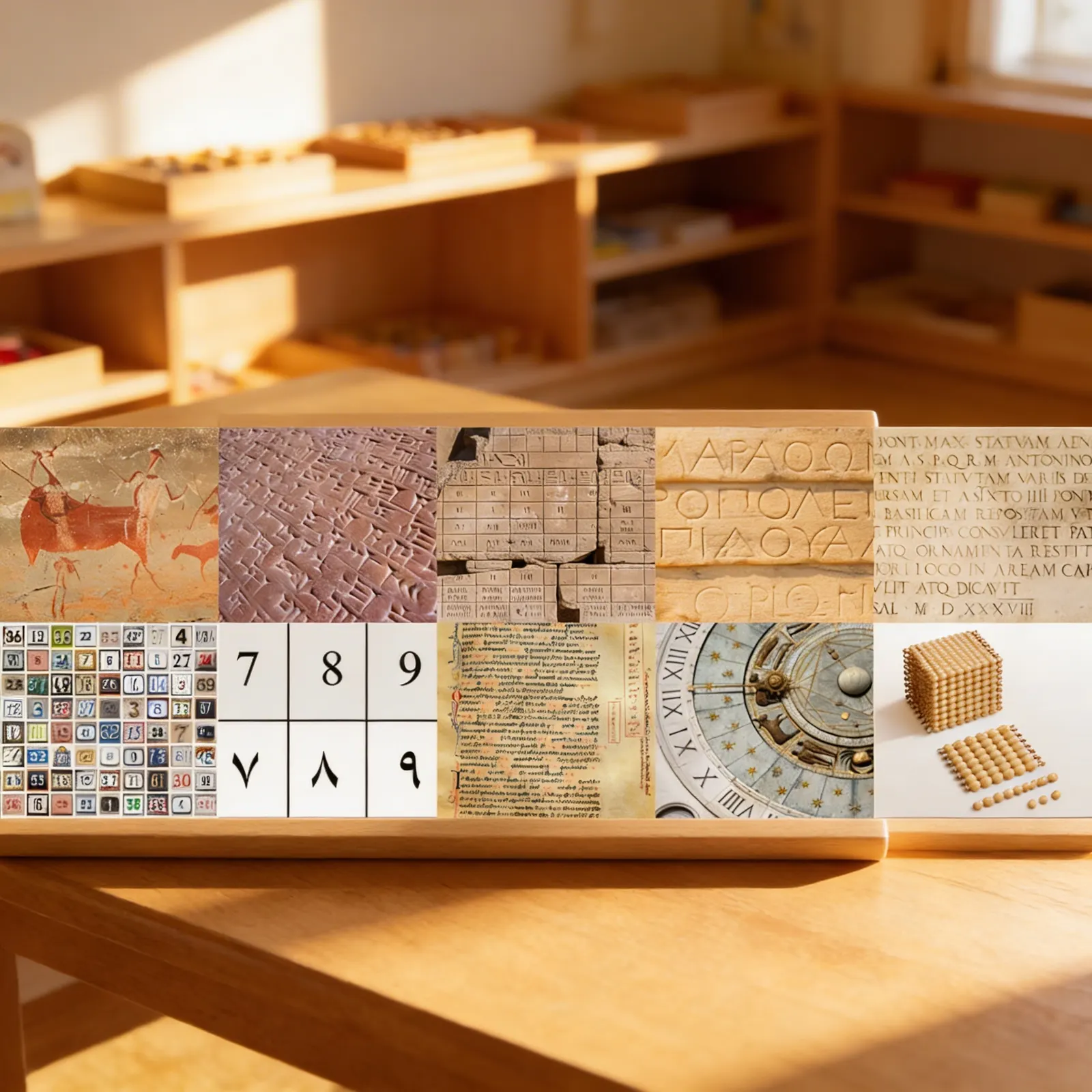
The Story Of Numbers in a child's hands
An essential classroom resource, this educational poster presents the fascinating evolution of numerical systems from prehistoric cave paintings to modern Montessori golden bead materials. The large-format chart visually traces humanity's mathematical journey through cuneiform tablets, Roman numerals, Arabic numerals, and various historical counting systems, providing children with a rich cultural context for their mathematical studies.
Cultural Mathematics
Introduces children to the universal human story of counting and number systems across civilizations.
Historical Perspective
Develops understanding of how mathematical concepts evolved throughout human history.
Visual Learning
Large format presentation supports group discussions and visual exploration of mathematical heritage.
Abstract Thinking
Bridges concrete Montessori materials with abstract numerical concepts through historical context.
How to present it
Mount the poster at child eye level near the mathematics shelf. Place a pointer or thin stick nearby for tracing.
- 1Begin at the cave painting section, asking the child to identify what early humans might have been counting
- 2Move chronologically through each numerical system, comparing how different cultures wrote the same quantities
- 3Have the child find their favorite number across different systems on the poster
- 4Connect the final section showing Montessori materials to the child's daily mathematical work
3 tips for parents
- Point out different numerical systems in daily life (Roman numerals on clocks, for example)
- Share family counting traditions or games from your cultural background
- Visit museums to see ancient artifacts with numerical markings

If you are not sure it suits your child, we answer in person.
Norbert Kovalčín, founder of Faborino · write to him
There is no review here yet. We will ask you for one after you buy. Write the first review
What's in the Box
- Educational Poster: 100×70cm laminated chart
Size and material
| Packaging | 15 × 14 × 1 cm |
| Material | Polymer |
| Recommended Age | 6-12 years |
Care
Wipe with dry or slightly damp cloth
Frequently Asked Questions
What age group is The Story of Numbers poster designed for?
This educational poster is specifically designed for children ages 6-12 years, aligning with the Montessori elementary curriculum for introducing mathematical concepts and number history in an age-appropriate visual format.
How does this poster support Montessori mathematics learning?
The poster provides historical context for numerical systems, connecting to Montessori golden bead materials shown on the chart. It helps children understand that numbers are a human invention with rich cultural heritage, supporting the Montessori approach of presenting mathematics as part of human civilization.
What historical number systems are featured on this poster?
The poster traces mathematical history from prehistoric cave paintings through cuneiform tablets, Roman numerals, Arabic numerals, and various historical counting systems, culminating in modern Montessori golden bead materials used in contemporary mathematics education.
What is the size and format of The Story of Numbers poster?
This is a large-format educational chart designed for classroom display. The poster's size allows children to clearly see the progression of numerical systems throughout history, making it ideal for group lessons and individual exploration in the Montessori environment.
How can teachers incorporate this poster into daily lessons?
Teachers can use this poster during circle time discussions, as a reference during mathematics work, for cultural studies lessons, and as a timeline activity. It serves as a visual aid when introducing new number concepts and helps children understand the evolution of the mathematical symbols they use daily.
Product safety
Manufacturer: Nienhuis Montessori, Anders Celsiusstraat 15, 7442 PB Nijverdal, Netherlands
The Story Of Numbers