
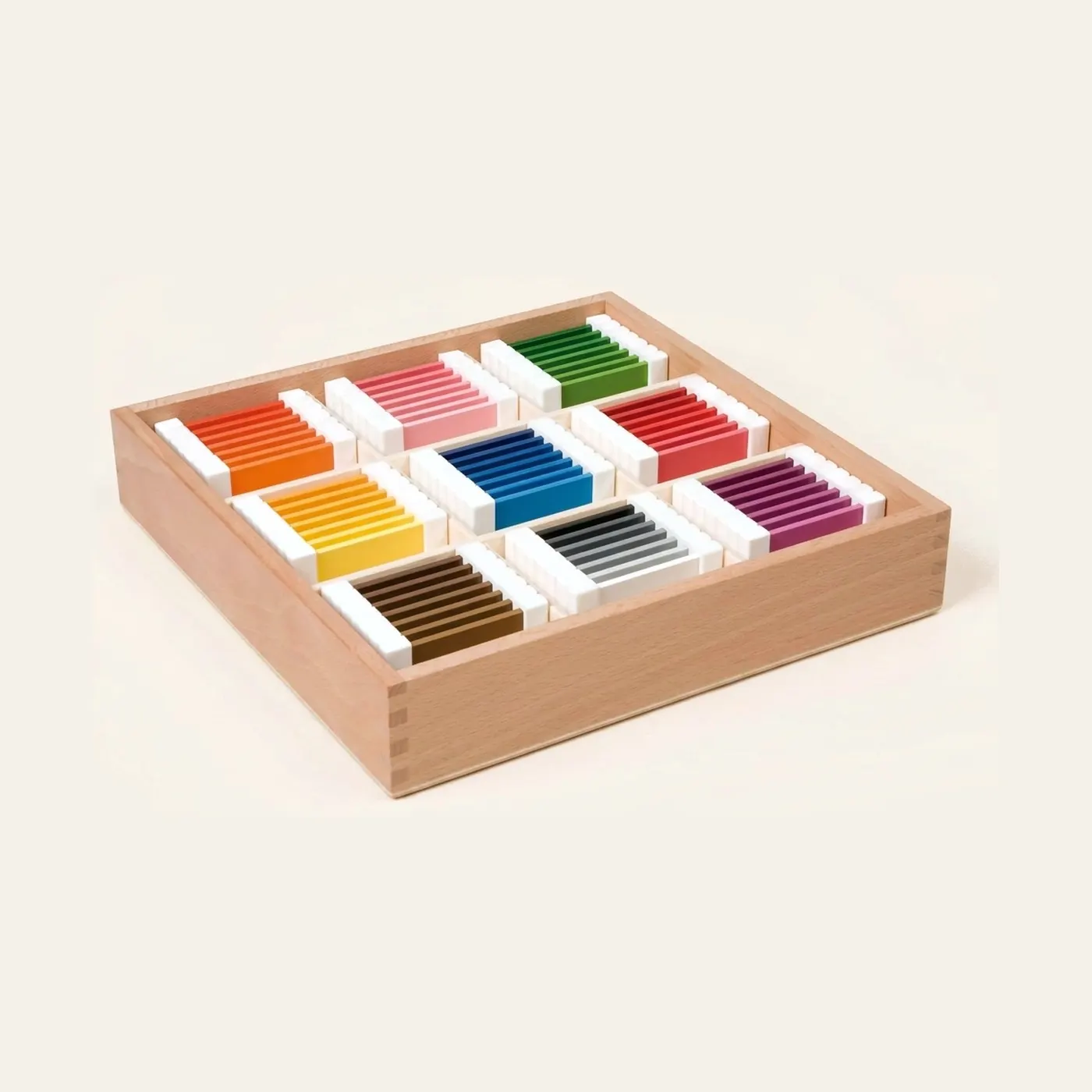
Third Colour Box: 63 Tablets in 9 Colour Families with Gradations
Made by Nienhuis Montessori · shipped by Heutink International (Netherlands) About the maker
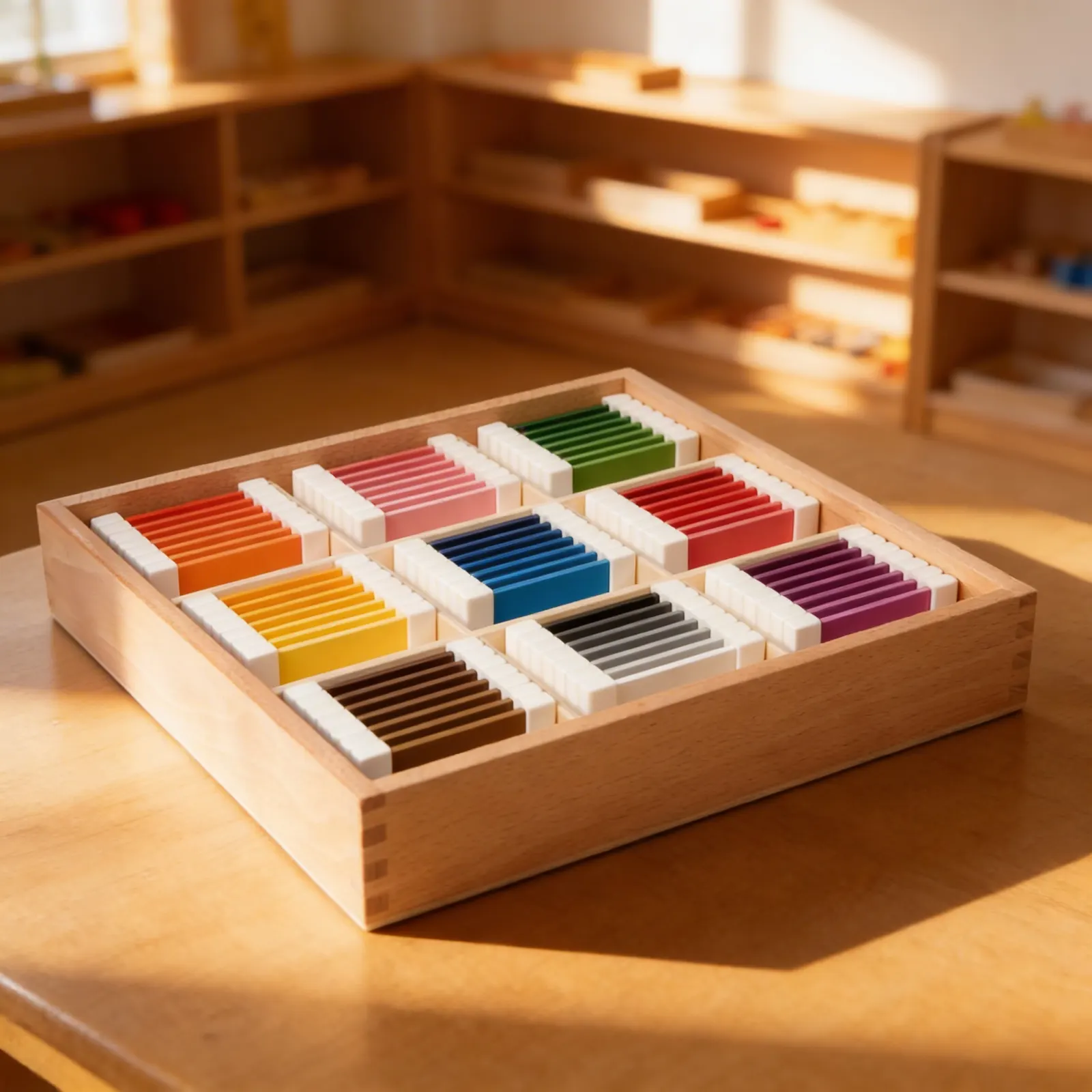
Sixty three tablets covering nine colours in seven graded shades each: red, blue, yellow, green, purple, orange, brown, pink and grey. This is the last stage of colour work and by far the hardest, because seven steps within one colour means the middle pairs differ by almost nothing. A child who can lay all seven in order has a discrimination most adults would have to work at. Grading, not matching, is what this box is for. Solid wood, for ages 3 to 6.
“The child is both a hope and a promise for mankind.”
The Third Colour Box with its 63 tablets across 9 colour families represents the pinnacle of colour discrimination work in Montessori sensorial education.
- Discriminate between seven subtle gradations within each of the 9 colour families
- Arrange tablets in precise gradation sequences from lightest to darkest shades
- Develop comparative vocabulary using terms like lighter, darker, more saturated, less intense
- Strengthen visual memory by matching gradations after studying colour relationships
Read More
These carefully graduated tablets address a fundamental developmental need between ages 3-6 when children's visual perception becomes sophisticated enough to distinguish subtle variations within colour families. The Third Colour Box enables children to isolate and refine their chromatic sense by working with seven gradations from lightest to darkest within each family. This precise gradation system helps children develop the visual discrimination necessary for later mathematical concepts, particularly geometry and measurement. The 63 tablets challenge young minds to create complex ordering sequences while building vocabulary around comparative language - lighter, darker, more intense. The Third Colour Box fulfills Dr. Montessori's vision of preparing the child's sensorial foundations for abstract learning. Each colour family within the Third Colour Box corresponds to specific wavelengths of light, making this material a bridge between sensory experience and scientific understanding. The gradated tablets cultivate patience and concentration as children repeatedly practice subtle discrimination tasks that strengthen neural pathways essential for academic learning.
How to present it
Follow the Montessori method of presentation for optimal child development.
Place the box on a table with good natural light. Ensure a neutral-colored mat is available. Have the child wash hands to enhance tactile sensitivity. Remove tablets carefully, holding by edges to avoid fingerprints.
- 1
Begin with one color family, removing all seven tablets randomly onto the mat
Start with a color family that has clear contrast between shades, such as blue or red - 2
Find the darkest and lightest tablets, placing them at opposite ends of the workspace
Hold tablets up to the light if needed to distinguish subtle differences - 3
Find the middle shade and place it between the extremes
This establishes anchor points for easier gradation - 4
Continue finding intermediate shades, building the complete gradation
Work slowly, allowing time for visual comparison and adjustment - 5
Perform a three-period lesson with specific tablets: 'This is dark blue, this is medium blue, this is light blue'
Use consistent vocabulary across all color families - 6
Mix the tablets and invite the child to grade them independently
Step back and observe without correcting, allow self-discovery
Every Child Is a Little Creator

Heritage
Since 1929

In classrooms
Around the world

European brands
Nienhuis, GAM, Educo

AMI approved
To the association standard
Third Colour Box: 63 Tablets in 9 Colour Families with Gradations
