
Timeline Of American History (Working)
The first photo is the maker's own. The other shots are illustrative.
Inv. no. NIE-TL029W
- Maker
- Nienhuis Montessori, since 1929
- Base Material
- Heavy-duty paper
- Surface
- Laminated coating
- EAN
- 8719924044695
Final price incl. VAT.
This material is no longer made
The manufacturer has withdrawn it, so we cannot order it in. The page stays here because the material itself is still worth knowing about.
Would you buy it if we could source it or make it ourselves? Enough people saying yes is what makes the attempt worth it.
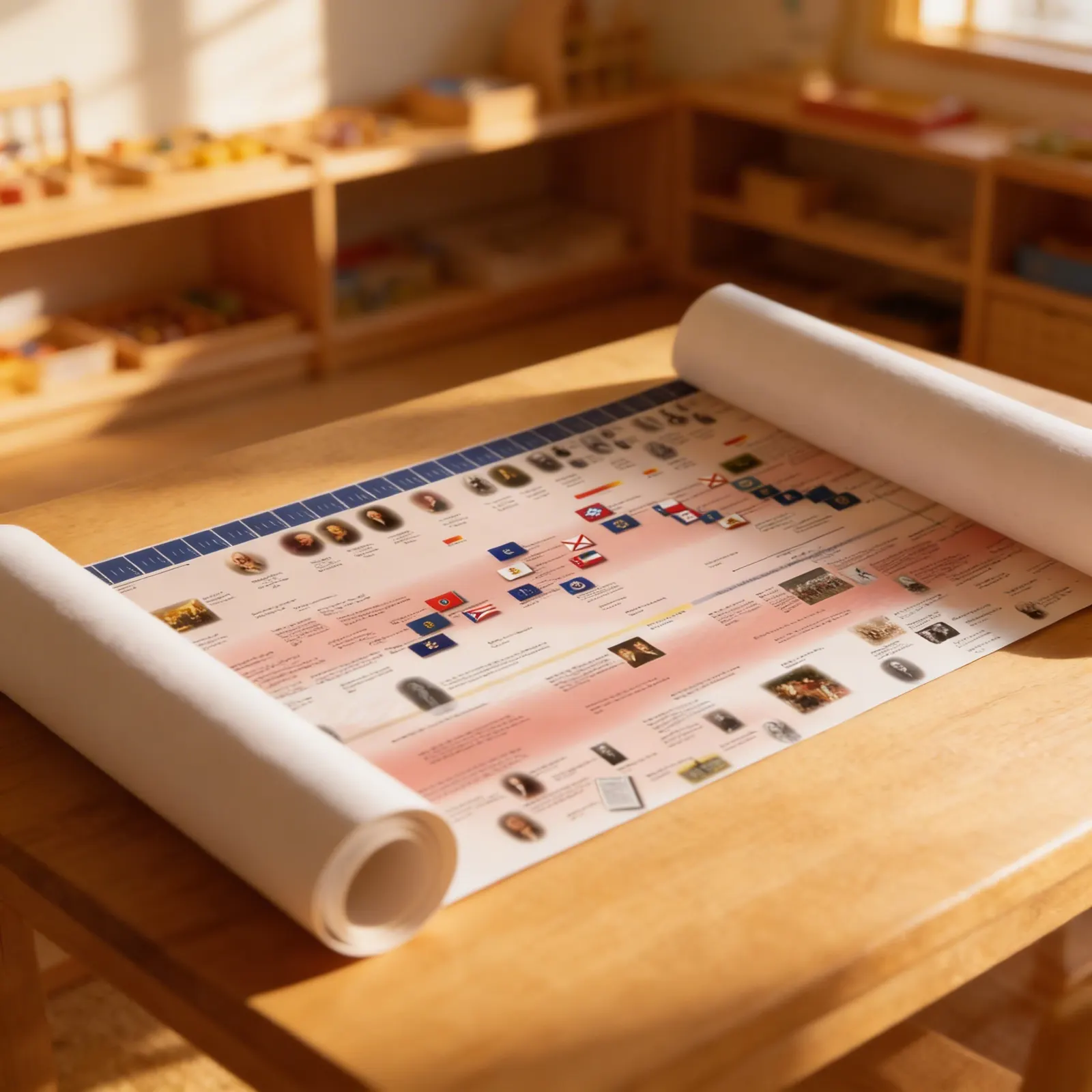
Timeline Of American History (Working) in a child's hands
The working Timeline of American History, with a control timeline, a mute timeline, movable pieces and labels. It follows the history of the United States from beginning to end, and it is worth knowing before ordering that this is a national timeline in English rather than a European one: it earns its place in a classroom studying that country, or as a model of how a national history can be laid out at all. The other timelines are separate items.
Historical Understanding
Develops chronological thinking and understanding of cause-and-effect relationships in history through visual representation.
Geographic Awareness
Connects state formation with historical periods, building spatial-temporal understanding of national development.
Research Skills
Serves as a reference tool for independent research projects and timeline activities in the classroom.
Visual Learning
Supports different learning styles through combination of images, dates, and color-coding systems.
How to present it
Mount the timeline at child eye level along a wall where children can walk its full length. Place a pointer or ruler nearby for tracing dates. Set out blank paper and pencils for children to record discoveries.
- 1Introduce the chronological ruler at the top, showing how to read dates from left to right
- 2Explore one color-coded section together, identifying key events within that time period
- 3Practice finding specific presidents by portrait, then locating their service dates on the timeline
- 4Trace the admission of states, noticing patterns in westward expansion
- 5Encourage children to choose one event to research further using classroom resources
3 tips for parents
- Visit local historical sites or museums and help your child find these places on the classroom timeline
- Share your family's American story, when ancestors arrived, where they settled, their contributions
- Look for historical markers in your community and connect them to periods on the timeline

If you are not sure it suits your child, we answer in person.
Norbert Kovalčín, founder of Faborino · write to him
There is no review here yet. We will ask you for one after you buy. Write the first review
What's in the Box
- Timeline Poster: Large format 150×60cm laminated poster
Size and material
| Packaging | 43 × 31 × 7 cm |
| Base Material | Heavy-duty paper |
| Surface | Laminated coating |
| Recommended Age | 6-12 years |
Care
Wipe with damp cloth, avoid harsh chemicals
Frequently Asked Questions
What age group is this Timeline of American History designed for?
This timeline is designed for ages 3-6, making it perfect for preschool and early elementary classrooms. The visual format with pictures and color-coding helps young children begin to understand historical concepts and sequencing.
What specific content is included on this American history timeline?
The timeline features key historical events, presidential portraits, state admission dates, and a chronological ruler at the top. Content is organized in color-coded sections covering American history from colonial times through the modern era.
How large is this timeline and how should it be displayed?
This is a large-scale poster designed for classroom wall display. The size allows children to easily see and interact with the timeline from various points in the classroom, making it an effective visual learning tool.
How does this timeline support Montessori learning principles?
This timeline aligns with Montessori's emphasis on visual, concrete learning materials. It helps children understand abstract concepts of time and sequence through visual representation, supporting their natural tendency to learn through observation and exploration.
Can young children really understand historical concepts at ages 3-6?
Yes, when presented appropriately. Young children can grasp basic concepts of 'before and after,' recognize that events happened 'long ago,' and begin to understand sequence. The visual format with pictures helps make these abstract concepts more concrete and accessible.
Product safety
Manufacturer: Nienhuis Montessori, Anders Celsiusstraat 15, 7442 PB Nijverdal, Netherlands
Timeline Of American History (Working)