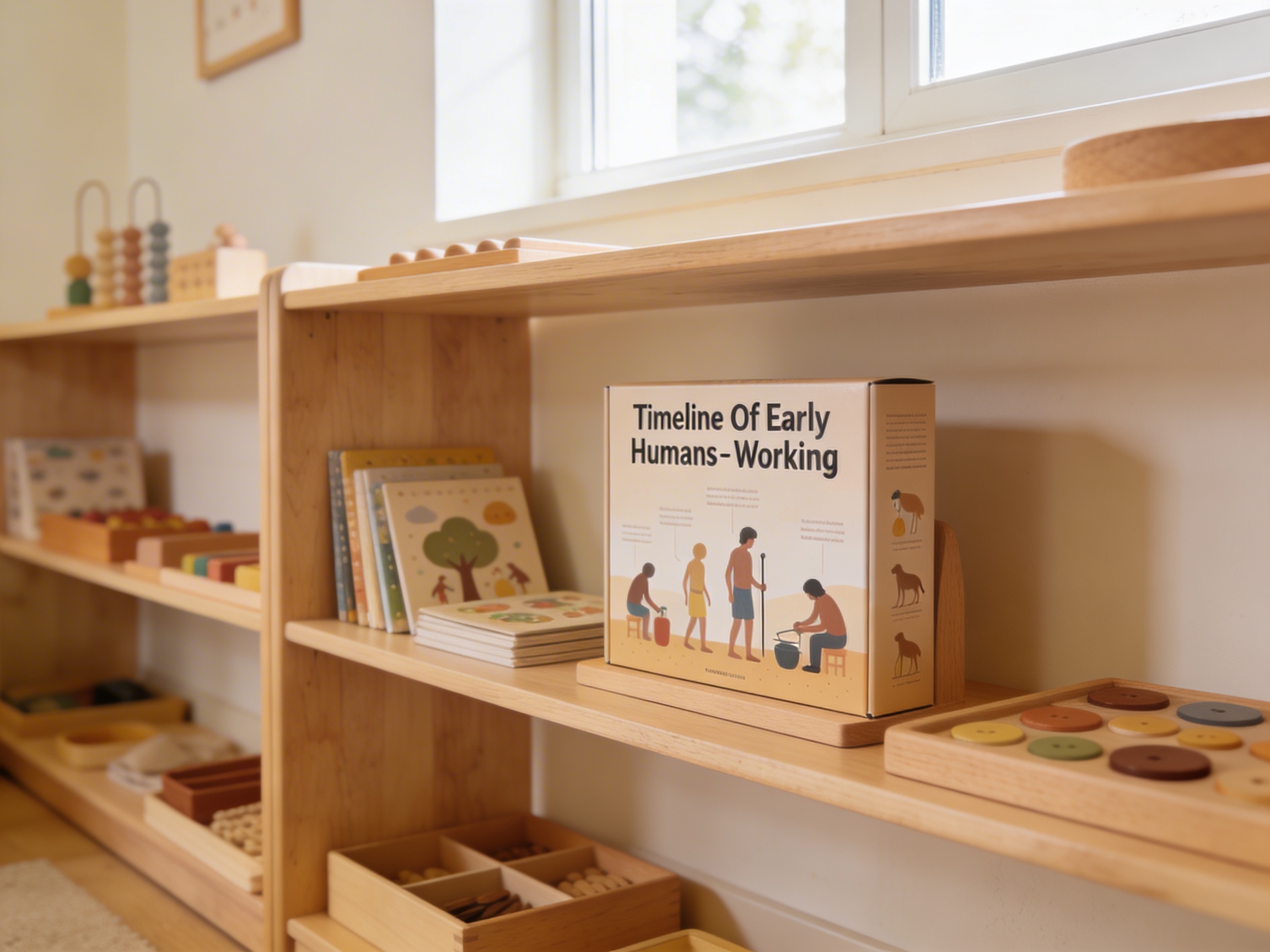
The Timeline Of Early Humans - Working is a Educational Materials Montessori material designed for children aged 3-6, crafted by Nienhuis Montessori to AMI standards.
This comprehensive Timeline of Early Humans introduces children to the fascinating journey of human evolution through carefully sequenced visual cards and materials. Designed for the Elementary classroom, this working material enables children to explore prehistoric periods, early human species, and the development of tools and culture through hands-on manipulation and arrangement of timeline components.
“The child is both a hope and a promise for mankind.”— Maria MontessoriEducation and Peace
“The hands are the instruments of man's intelligence.”
— Maria Montessori, The Absorbent Mind
The Timeline of Early Humans addresses the elementary child's deep need to understand their place in the universe by presenting human evolution as a concrete, manipulable sequence. Through arranging these visual cards chronologically, children satisfy their reasoning mind's hunger for classification and order while exploring humanity's story. The timeline's sequential format allows children to physically construct the narrative of human development, from early hominids to modern humans. Each card in the Timeline of Early Humans serves as a key that unlocks understanding about tool development, migration patterns, and cultural evolution. This material bridges the child's earlier work with the Timeline of Life by focusing specifically on human ancestors, allowing deeper exploration of our species' unique journey. The hands-on manipulation of timeline components transforms abstract concepts of millions of years into tangible learning experiences that elementary children can grasp and internalize.
Each order includes everything needed for proper presentation and long-term use.
Follow the Montessori method of presentation for optimal child development.
Begin by examining the timeline base to understand the time scale represented
Start placing early hominid cards at the beginning of the timeline
Add tool development cards in chronological order
Place cultural development cards (fire, art, agriculture) at appropriate points
Review the completed timeline, noting patterns and connections
Every material is carefully selected for durability, safety, and authentic Montessori experience.
Sourced from sustainably managed European forests. Beechwood is chosen for its exceptional durability, smooth grain, and natural warmth that invites touch.
Natural, unbleached cotton in child-friendly colors. The fabric provides the right amount of friction for developing fingers while being gentle on sensitive skin.
Water-based, child-safe finish that meets the strictest European safety standards. Designed to withstand years of daily use without chipping or peeling.
Each material supports multiple areas of child development simultaneously.
Develops concrete understanding of human evolution and the passage of vast periods of time through visual and tactile learning.
Strengthens ability to order events chronologically and understand cause-and-effect relationships in history.
Introduces concepts of species, evolution, and archaeological evidence in an age-appropriate manner.
Encourages further exploration and research into specific periods or early human species of interest.
Designed for child-sized hands
Professional tips from AMI-trained guides to maximize the educational value of this material.
“Present this material after children have worked extensively with the Timeline of Life for context”
Prepare supplementary materials like books, fossil replicas, and maps to enrich exploration
Allow small groups to work together, fostering collaborative research and discussion
Connect timeline work to current studies in geography by exploring human migration patterns
Everything you need to know about this material.
While listed for ages 3-6, this material is actually designed for Elementary classrooms, typically serving children ages 6-12. The content complexity and abstract concepts of human evolution are more appropriate for elementary-aged children who have developed stronger reading and reasoning skills.
This working material includes carefully sequenced visual cards depicting different prehistoric periods, early human species, evolutionary developments, and the progression of tools and culture. The components are designed for hands-on manipulation and arrangement, allowing children to actively construct the timeline themselves.
This timeline aligns with Montessori's Cosmic Education approach, helping children understand humanity's place in the universe. It supports interdisciplinary learning by connecting history, anthropology, and science, while encouraging children to explore the interconnectedness of human development and cultural evolution.
Yes, after an initial presentation by the teacher, children can work independently or in small groups to arrange and study the timeline. The visual nature of the cards and logical sequence supports self-directed learning and allows children to return to the material multiple times for deeper understanding.
Unlike textbook-based learning, this hands-on timeline allows children to physically manipulate and arrange historical sequences, making abstract concepts concrete. The visual cards and active engagement help children internalize the progression of human evolution and cultural development through tactile and visual learning experiences.
Can't find what you're looking for?
Contact Our Experts
Share your experience with this material and help other educators and parents.


