
Trinomial Cube: Algebraic Formula Introduction Through Manipulation
Made by Nienhuis Montessori · shipped by Heutink International (Netherlands) About the maker
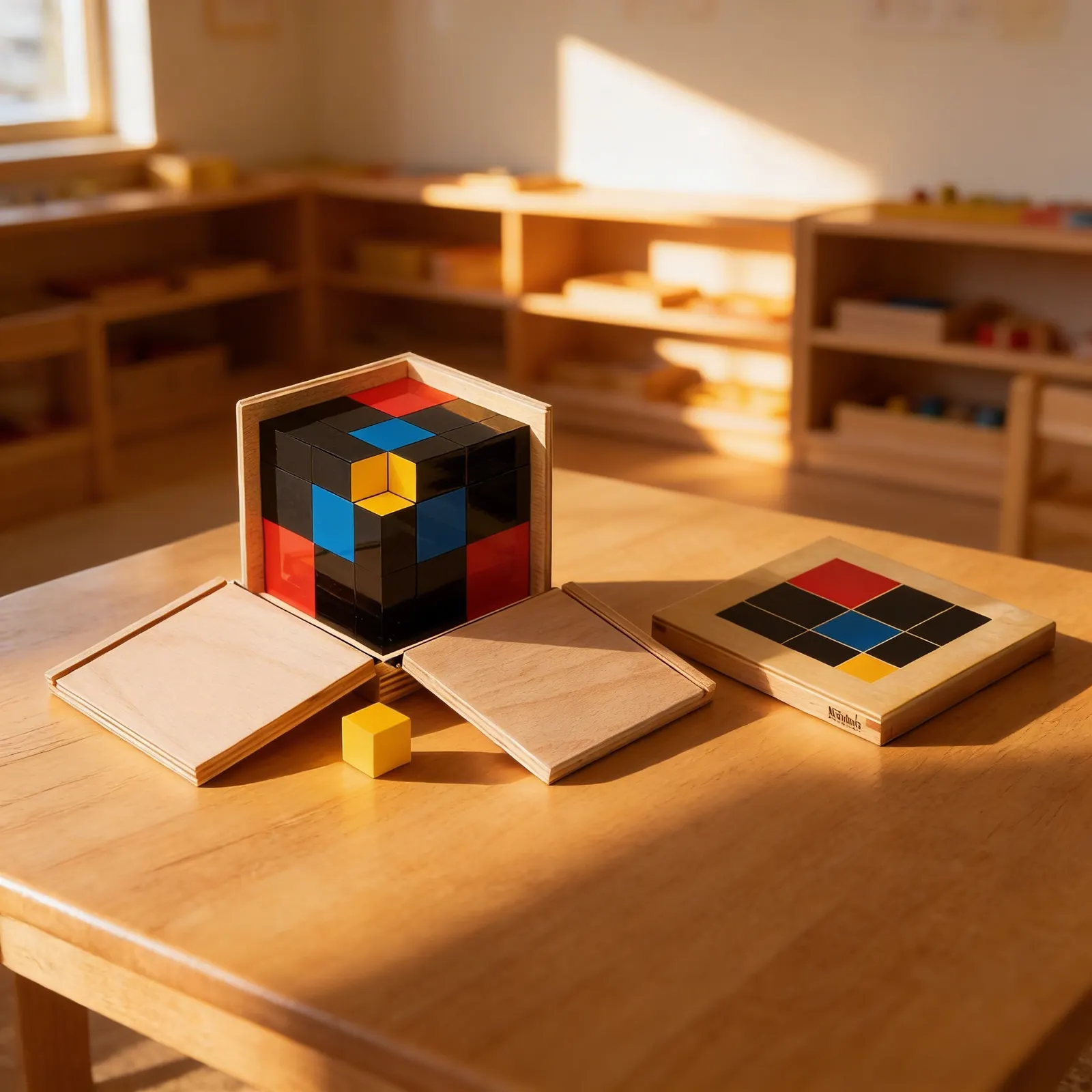
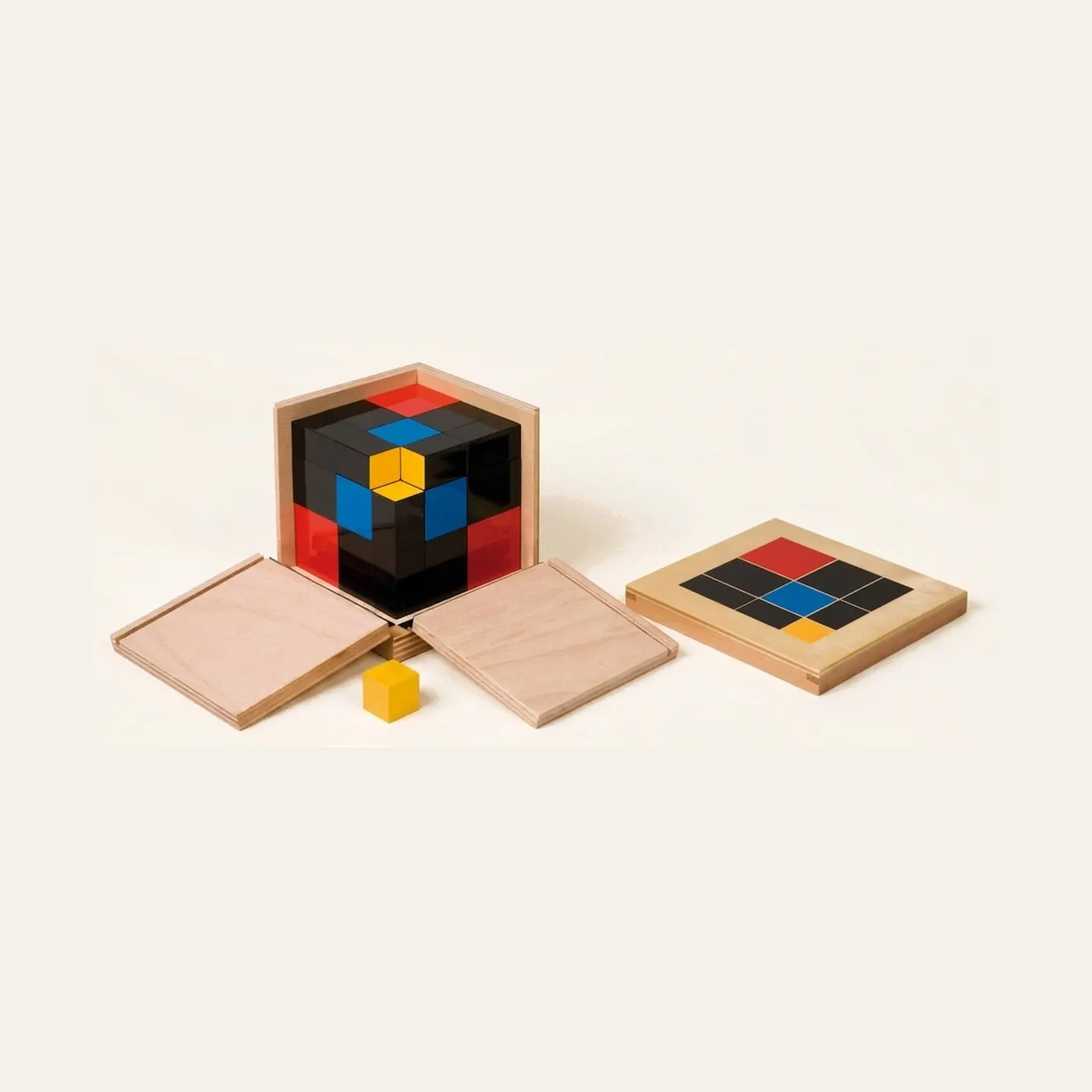
A box of cubes and prisms that fits together one way only, and a child works it long before anyone says the word algebra. What is actually happening is patterning: matching pieces by dimension, by colour and by shape, and noticing how those three properties travel together. The lid closing is the control of error, so the work is self-correcting and can be repeated as often as a child wants without an adult judging it. The formula it embodies arrives years later and arrives already familiar. Beech wood with non toxic paint, for ages 6 to 12.
“The senses, being explorers of the world, open the way to knowledge.”
The Trinomial Cube embodies Montessori's principle of indirect preparation, offering a concrete representation of the algebraic formula (a+b+c)³ years before the child encounters it abstractly.
- Development of visual discrimination through color and size relationships
- Enhancement of spatial reasoning and three-dimensional thinking
- Indirect preparation for algebra and the formula (a+b+c)³
- Refinement of fine motor control and precise hand movements
Read More
This material respects the child's natural mathematical mind, allowing exploration through sensorial discrimination rather than memorization. Following the progression from simple to complex, it builds upon the foundation established by the Binomial Cube. The material's self-correcting nature supports the child's independence and inner discipline, while its beauty and precision attract the child's attention and invite repeated exploration. Through manipulation of this concrete material, children absorb mathematical relationships that will later emerge as conscious understanding, demonstrating Montessori's belief that the hand educates the mind.
How to present it
Follow the Montessori method of presentation for optimal child development.
Place the Trinomial Cube box on a table mat with the hinged sides facing away from the child. Ensure all 27 pieces are present and the child has successfully worked with the Binomial Cube.
- 1
Open two adjacent sides of the box, revealing the completed cube
Allow the child to observe the beauty of the assembled cube before beginning - 2
Remove pieces layer by layer, starting with the top, placing them in order on the mat
Maintain the spatial relationships by keeping pieces from each layer together - 3
Identify the pattern: red, black, and blue pieces representing a³, b³, and c³
Point out how colors help guide the reconstruction without verbal explanation - 4
Begin reconstruction with the largest red cube (a³) in the corner
Let the child discover that this piece anchors the entire structure - 5
Build the first layer using color patterns: place matching colors adjacent
If stuck, suggest the child look at the pattern on the box lid - 6
Continue building layer by layer, using color relationships as guides
Encourage persistence - this is meant to be challenging - 7
Close the box sides to verify correct assembly
The ability to close the box smoothly indicates success
Every Child Is a Little Creator

Heritage
Since 1929

In classrooms
Around the world

European brands
Nienhuis, GAM, Educo

AMI approved
To the association standard
Trinomial Cube: Algebraic Formula Introduction Through Manipulation
