
Unit Division Board (Nienhuis)
The first photo is the maker's own. The other shots are illustrative.
Inv. no. NIE-0096A0
- Maker
- Nienhuis Montessori, since 1929
- Approval
- AMI
- Board
- Natural wood
- Accessories
- Plastic pegs and beads
- EAN
- 8719924005672
Final price incl. VAT. Delivery €5.90, €112.10 to go for free delivery.
Advice, warranty and returns are handled by us.
Why it costs €36.90
Behind the price of the original are things you can check yourself.
AMI approval
The material is approved by the Association Montessori Internationale (AMI). Nienhuis has made Montessori materials since 1929.
A verifiable original
The EAN 8719924005672 is on the box. It is the maker's number, not ours.
Unit Division Board (Nienhuis) in a child's hands
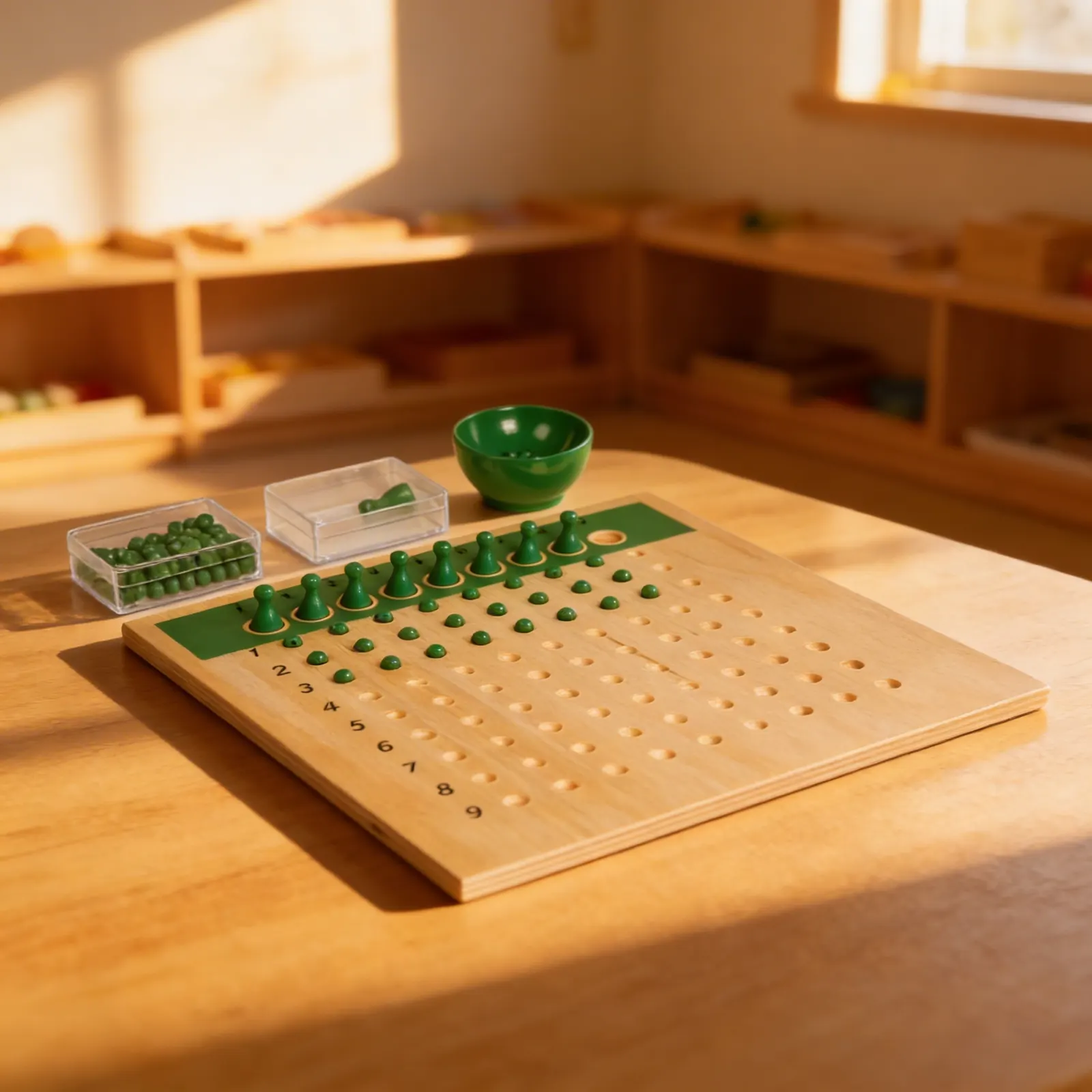
The unit division board with a box of nine green skittles, a green bead cup and eighty one green beads, for the division tables with dividends one to eighty one and divisors one to nine. Division is taught here as literal sharing out: the skittles are the people, the beads get dealt round one at a time, and whatever will not go round evenly is the remainder sitting in plain view. Nobody has to define a remainder to a child who has just been left holding two. Wood with plastic, for ages 3 to 6.
Division Understanding
Children physically distribute beads among pegs, building concrete understanding of division as equal sharing.
Mathematical Reasoning
Discovering quotients and remainders through hands-on manipulation develops logical thinking and problem-solving skills.
Pattern Recognition
Working systematically through division tables reveals mathematical patterns and relationships between numbers.
Fine Motor Coordination
Placing small pegs and beads in specific holes refines pincer grip and hand-eye coordination.
How to present it
Place the Unit Division Board on a mat with a container of beads and green pegs. Position the board so the numbered axes are clearly visible.
- 1Choose a division problem, such as 12÷3. Place 3 green pegs in the top row
- 2Count out 12 beads as your dividend
- 3Distribute beads one at a time to each peg in sequence until all beads are placed
- 4Count the beads under each peg to discover the quotient (4)
- 5Record the equation: 12÷3=4
3 tips for parents
- Practice equal sharing in daily life: dividing snacks among family members reinforces division concepts
- Ask your child to explain their work with the board to strengthen understanding
- Celebrate discovery of patterns, such as any number divided by 1 equals itself

If you are not sure it suits your child, we answer in person.
Norbert Kovalčín, founder of Faborino · write to him
There is no review here yet. We will ask you for one after you buy. Write the first review
What's in the Box
- Wooden division board: 30×30 cm with numbered grid
- Green pegs: Divisor markers in container
- Counting beads: For dividend representation
- Storage containers: For organizing pegs and beads
Size and material
| Packaging | 26 × 26 × 5 cm |
| Board | Natural wood |
| Accessories | Plastic pegs and beads |
| Recommended Age | 3-6 years |
Care
Wipe board with damp cloth, hand wash plastic components
Frequently Asked Questions
What age is the Unit Division Board appropriate for?
The Unit Division Board is designed for children ages 3-6 years old. However, it's typically introduced around age 4-5 after children have mastered addition, subtraction, and multiplication concepts. The material grows with the child as they progress from simple division to more complex problems.
What comes included with the Unit Division Board?
The Unit Division Board includes a wooden 9×9 grid board with numbered axes (1-9), a set of green skittles or pegs representing divisors, and 81 green beads representing dividends. Some sets may also include a small bowl or container for the beads and division problem cards.
How does this material teach division concepts?
Children place green pegs across the top of the board to represent the divisor (how many groups), then distribute beads evenly among the pegs to find the quotient. Any beads that cannot be distributed evenly become the remainder. This concrete manipulation helps children understand division as equal sharing or grouping.
What prerequisite skills should my child have before using this material?
Before introducing the Unit Division Board, children should be comfortable with counting to at least 81, have experience with the golden bead material, understand basic multiplication concepts, and be familiar with the concept of sharing equally. Prior work with the multiplication boards is also helpful.
How is this different from traditional division teaching methods?
Unlike abstract paper-and-pencil methods, the Unit Division Board provides a concrete, visual, and tactile way to understand division. Children physically manipulate materials to see division as the inverse of multiplication, making abstract concepts tangible and building a deep conceptual understanding before moving to abstraction.
Product safety
Manufacturer: Nienhuis Montessori, Anders Celsiusstraat 15, 7442 PB Nijverdal, Netherlands
Unit Division Board (Nienhuis)