
Upper Elementary Geometry - Area
The first photo is the maker's own. The other shots are illustrative.
Inv. no. NIE-ELC3036
- Maker
- Nienhuis Montessori, since 1929
- Material
- Durable plastic
- Finish
- Pre-cut with rounded corners
- EAN
- 8719924043841
Final price incl. VAT. Free delivery.
Advice, warranty and returns are handled by us.
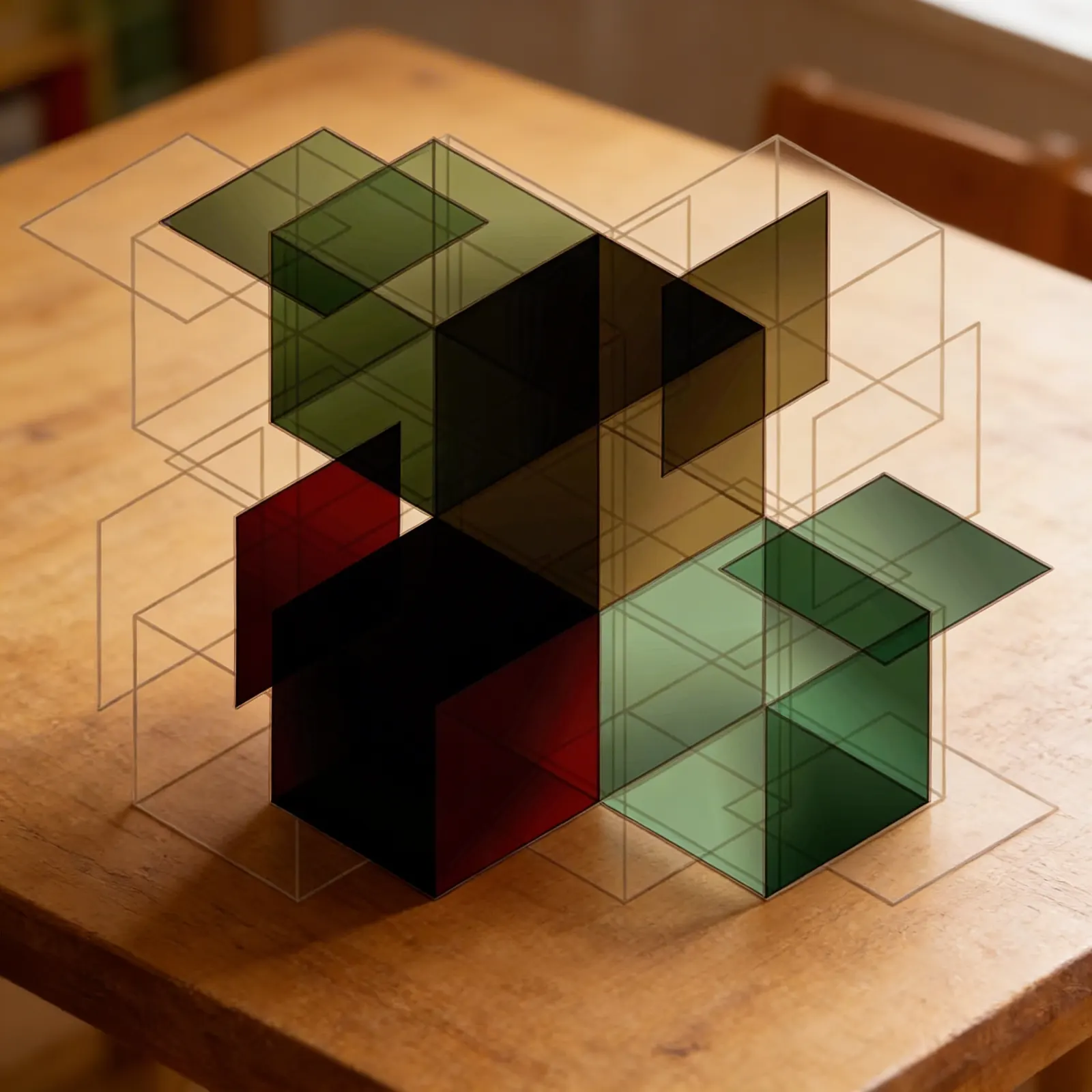
Upper Elementary Geometry - Area in a child's hands
This Upper Elementary Geometry Area task card set introduces students to calculating areas of complex geometric shapes through Montessori's visual approach. The laminated cards feature transparent overlapping geometric forms, helping children understand how composite shapes can be analyzed by breaking them into familiar components. Designed for upper elementary work, these materials support the transition from concrete geometric manipulatives to abstract mathematical thinking.
Mathematical Abstraction
Bridges the gap between concrete geometric materials and abstract area formulas through visual representations.
Analytical Thinking
Develops ability to decompose complex shapes into simpler components for calculation.
Sequential Learning
Progressive card series builds mathematical concepts systematically, following Montessori principles.
Independent Work Skills
Self-correcting format allows students to work autonomously and build confidence in geometry.
How to present it
Place the geometry area cards in sequence from simple overlapping shapes to complex composite forms. Provide graph paper, colored pencils, and a ruler alongside the laminated cards.
- 1Select a card showing two overlapping shapes and trace the outline onto graph paper
- 2Identify and mark the component shapes within the composite form
- 3Calculate the area of each component shape separately
- 4Determine whether overlapping sections should be added or subtracted
- 5Record the total area and check using an alternative decomposition method
3 tips for parents
- Look for composite shapes in everyday life - floor tiles, window panes, or garden layouts - and estimate their areas together
- When your child struggles with a complex shape, suggest they sketch it larger on graph paper for easier visualization
- Celebrate creative decomposition strategies even if they're more complex than the 'obvious' solution

If you are not sure it suits your child, we answer in person.
Norbert Kovalčín, founder of Faborino · write to him
There is no review here yet. We will ask you for one after you buy. Write the first review
What's in the Box
- Geometry Area Task Cards: Complete set with progressive exercises
Size and material
| Packaging | 28 × 12 × 5 cm |
| Material | Durable plastic |
| Finish | Pre-cut with rounded corners |
| Recommended Age | 9-12 years |
Care
Wipe with slightly damp cloth, dry immediately
Frequently Asked Questions
Why is this labeled for ages 3-6 when it's Upper Elementary material?
This appears to be a labeling error. Upper Elementary Geometry - Area materials are designed for ages 9-12 (fourth through sixth grade). The content focuses on calculating areas of complex shapes, which requires mathematical skills typically developed in upper elementary years, not ages 3-6.
What prerequisite Montessori materials should children work with before this set?
Children should have completed work with the Geometric Cabinet, Metal Insets, and basic area materials like the Yellow Area Material. They should understand concepts of perimeter, simple area calculations for triangles and rectangles, and be familiar with decomposing shapes before working with these advanced area cards.
How do the transparent overlapping forms help children understand area calculations?
The transparent overlays allow children to physically see how complex shapes can be broken down into familiar geometric forms. By overlapping triangles, rectangles, and other shapes, students can visualize how to calculate the total area by adding or subtracting component areas, making abstract concepts concrete and visible.
What mathematical concepts are covered in this task card set?
This set covers area calculations for composite shapes, irregular polygons, and overlapping figures. Students learn to identify component shapes, calculate individual areas, understand concepts of addition and subtraction of areas, and apply formulas for triangles, rectangles, parallelograms, and trapezoids in complex configurations.
How does this material support the transition to abstract thinking?
The cards bridge concrete and abstract learning by providing visual representations that can be manipulated and analyzed. Students move from physically tracing and measuring to mental decomposition of shapes, gradually developing the ability to visualize area calculations without physical materials, preparing them for traditional geometry coursework.
Product safety
Manufacturer: Nienhuis Montessori, Anders Celsiusstraat 15, 7442 PB Nijverdal, Netherlands
Upper Elementary Geometry - Area