
Upper Elementary Geometry - Volume
The first photo is the maker's own. The other shots are illustrative.
Inv. no. NIE-ELC3037
- Maker
- Nienhuis Montessori, since 1929
- Material
- Durable plastic
- Finish
- Pre-cut with rounded corners
- EAN
- 8719924043858
Final price incl. VAT. Free delivery.
Advice, warranty and returns are handled by us.
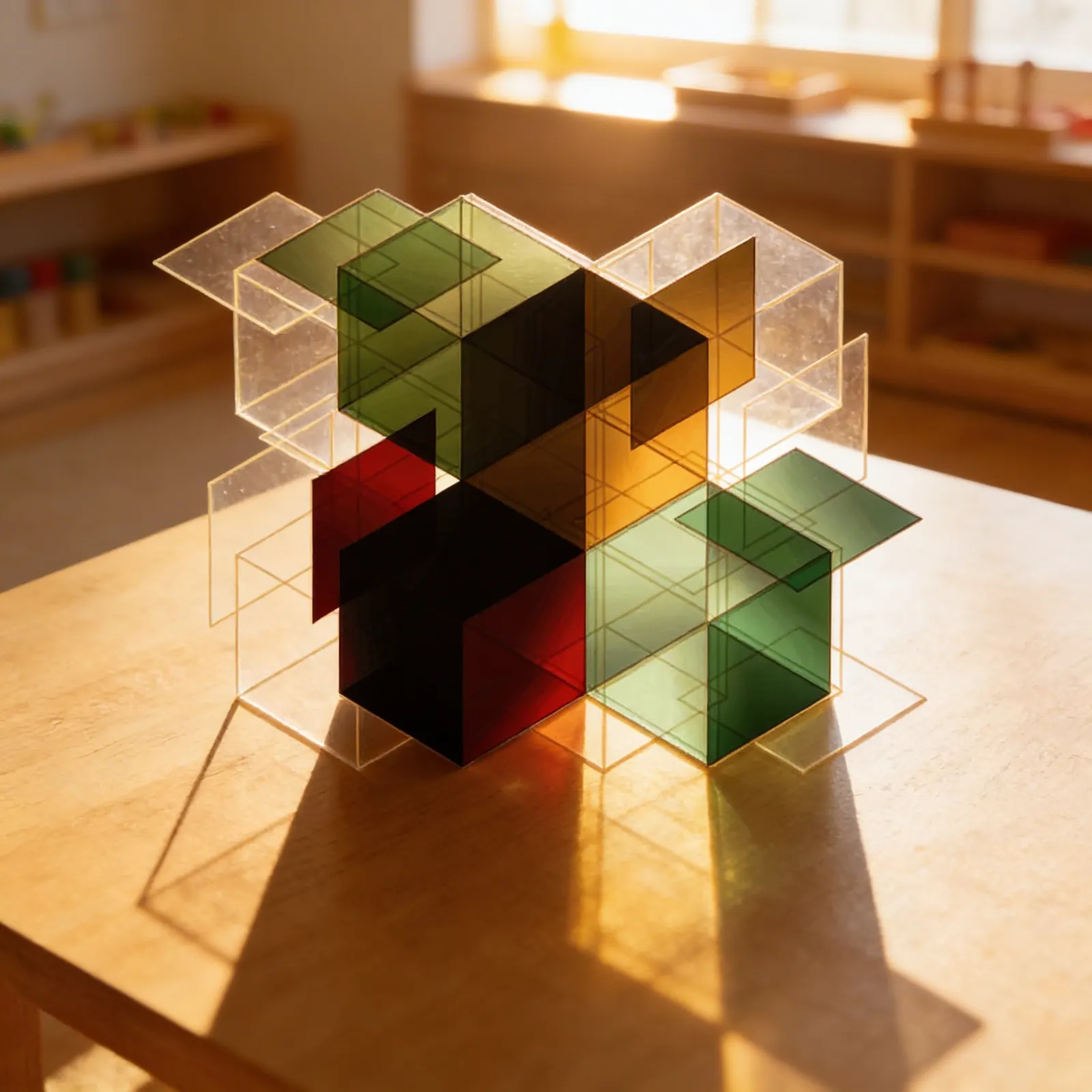
Upper Elementary Geometry - Volume in a child's hands
Volume for upper elementary, nine to twelve, as word problems rather than formulas. A child at this age can calculate a volume and still not know when to, which is what word problems are for: the arithmetic is easy and the reading is where the work is. It follows the sensorial volume work with the blue solids, where volume was something to pour rather than something to compute. Durable plastic with rounded corners. In English.
Spatial Reasoning
Develops understanding of three-dimensional space and how geometric solids occupy volume through visual representations.
Mathematical Abstraction
Bridges concrete geometric shapes to abstract mathematical formulas, supporting advanced mathematical thinking.
Visual Learning
Reinforces volume concepts through clear diagrams and color-coded representations that aid comprehension.
Independent Study
Enables self-directed learning with comprehensive reference material for exploring geometric volume concepts.
How to present it
Place the Volume task card on a work mat alongside geometric solids, unit cubes, and calculation paper. Have a ruler and pencil ready for measurements.
- 1Begin by matching real geometric solids to the transparent outlines on the card
- 2Trace the cube outline and identify length, width, and height dimensions
- 3Build the shape using unit cubes, counting to verify the volume calculation
- 4Apply the formula shown on the card to calculate volume mathematically
- 5Compare the calculated result to the colored volume representation on the card
3 tips for parents
- Practice volume concepts during cooking by discussing measuring cups and ingredient quantities
- Build structures with blocks at home and calculate their volume together
- Look for rectangular prisms in everyday packaging and estimate their volume before measuring

If you are not sure it suits your child, we answer in person.
Norbert Kovalčín, founder of Faborino · write to him
There is no review here yet. We will ask you for one after you buy. Write the first review
What's in the Box
- Geometry Volume Task Card: Laminated reference sheet
Size and material
| Packaging | 28 × 12 × 3 cm |
| Material | Durable plastic |
| Finish | Pre-cut with rounded corners |
| Recommended Age | 9-12 years |
Care
Wipe with damp cloth, dry immediately
Frequently Asked Questions
Why is this labeled for ages 3-6 when it covers upper elementary geometry?
This appears to be a labeling error. Upper Elementary Geometry Volume materials are designed for ages 9-12, not 3-6. The content covers advanced spatial concepts and volume calculations appropriate for upper elementary students who have mastered basic geometric shapes and are ready for three-dimensional mathematical concepts.
What specific volume concepts does this task card teach?
The task card introduces volume calculations for three-dimensional shapes through visual representations. It features transparent cube outlines and colored volume representations that help students understand how geometric solids occupy space, connect visual understanding to mathematical formulas, and develop spatial reasoning skills essential for advanced mathematics.
How does the transparent cube design support learning?
The transparent cube outlines allow students to see through the shapes and understand their internal structure, making abstract volume concepts concrete. Combined with colored volume representations, students can visualize how space is filled within geometric solids, supporting the transition from concrete manipulation to abstract mathematical thinking.
What prerequisites should students have before using this material?
Students should have experience with basic geometric shapes, understanding of multiplication, familiarity with cubic units, and prior work with Montessori geometric solids. They should also have developed abstract thinking skills and be comfortable with mathematical formulas, typically achieved in lower elementary before advancing to volume calculations.
How does this complement other Montessori geometry materials?
This task card builds upon earlier work with geometric solids, the pink tower, and brown stairs. It bridges concrete manipulatives and abstract mathematical concepts, preparing students for advanced geometry while maintaining Montessori's visual and hands-on approach to learning mathematical relationships.
Product safety
Manufacturer: Nienhuis Montessori, Anders Celsiusstraat 15, 7442 PB Nijverdal, Netherlands
Upper Elementary Geometry - Volume