
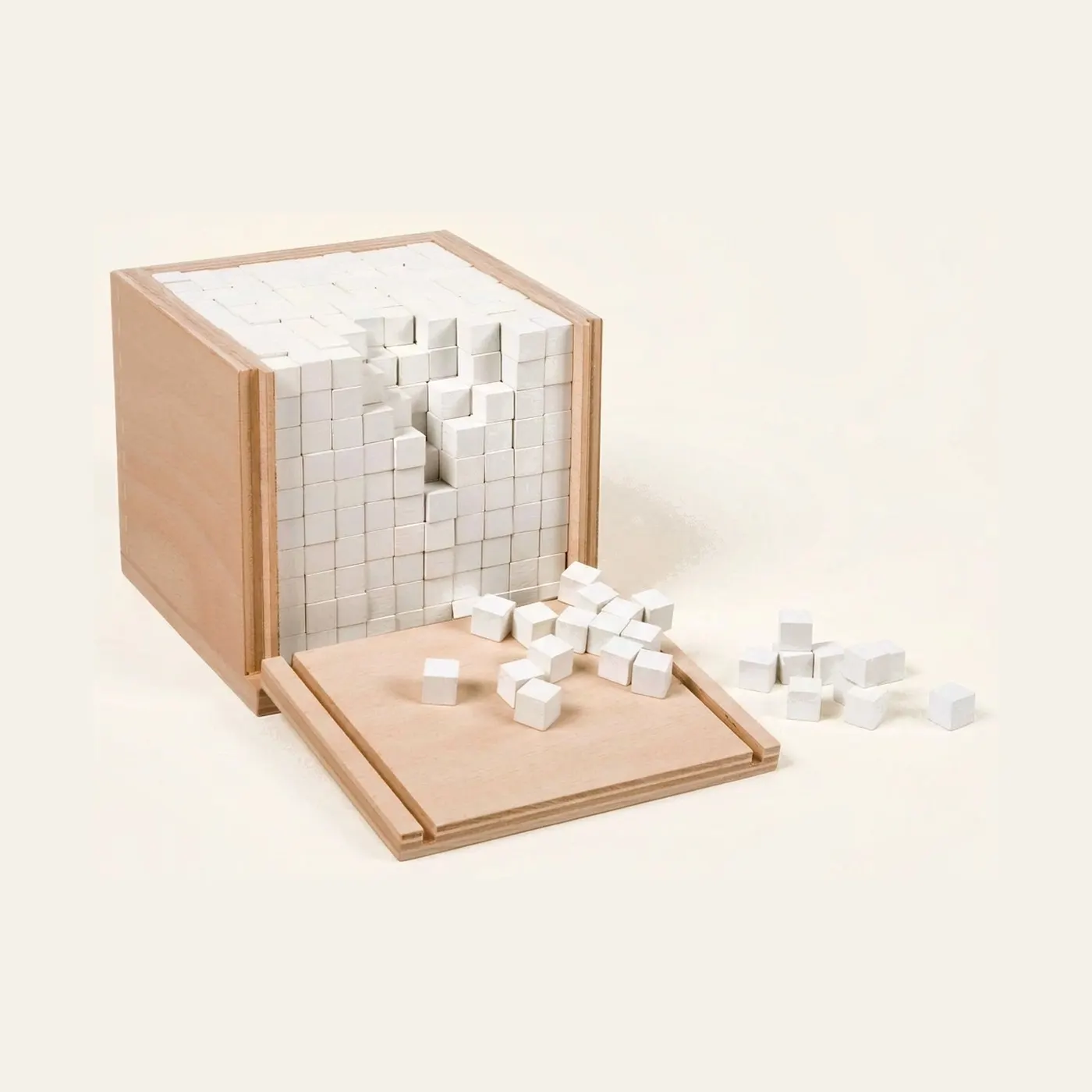
Volume Box: 1000 Unit Cubes with Sliding Demonstration Drawer
Made by Nienhuis Montessori · shipped by Heutink International (Netherlands) About the maker
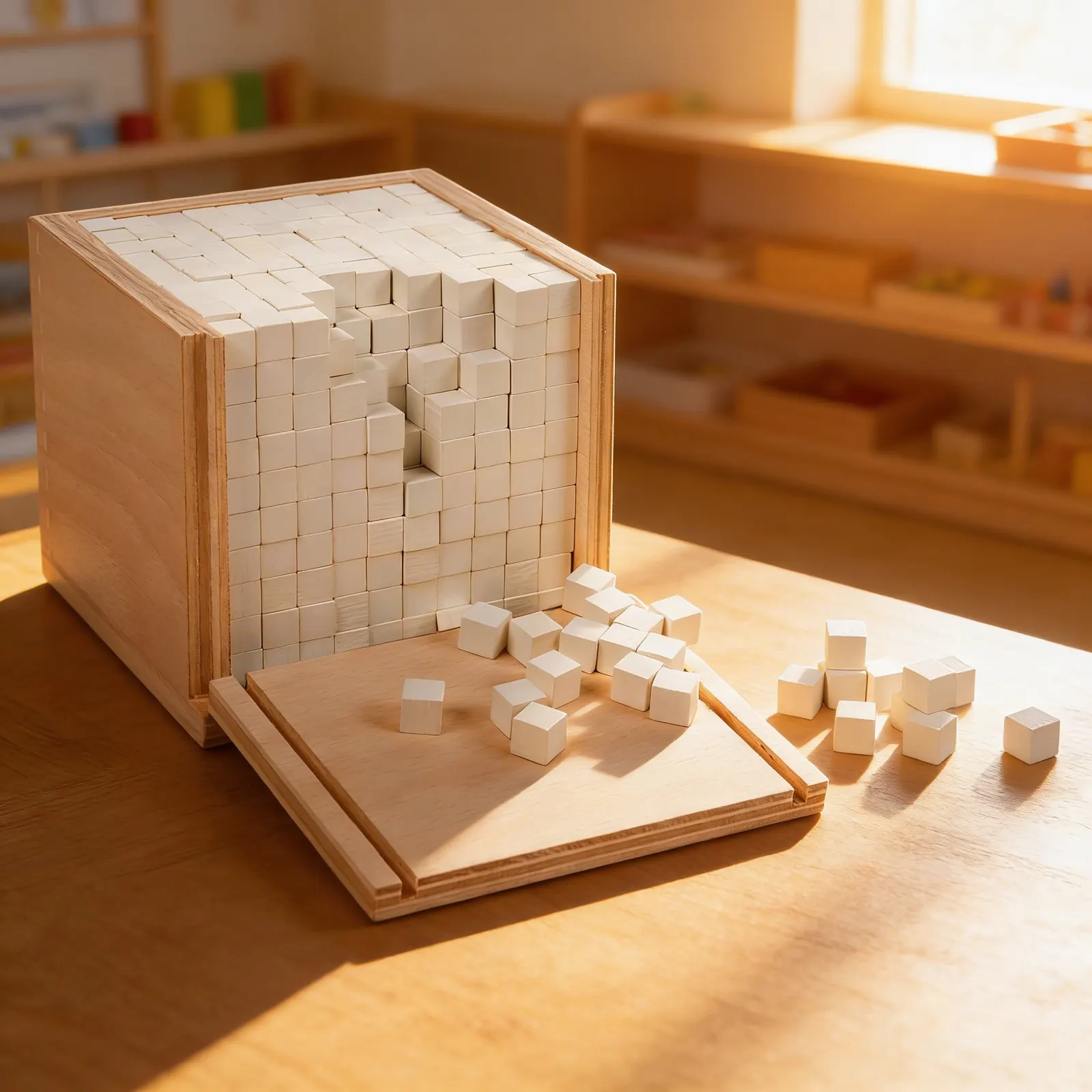
A wooden box with a hinged side holding a thousand wooden centimetre cubes. Sliding the side open and letting the cubes stand as a solid block is the demonstration: a thousand is not an abstraction here, it is a thing a child cannot quite lift. The cubes then break down for building rectangular prisms and reading their volume by counting layers, and the set carries on into the cubing material. Ten by ten by ten stops being a sum and becomes an object on the mat. Plywood with solid wood cubes, for ages 6 to 12.
“Free the child's potential, and you will transform him into the world.”
The Volume Box embodies Dr. Montessori's principle of making abstract concepts concrete through sensorial exploration.
- Understanding the concrete representation of 1000 and its relationship to 10³
- Developing spatial reasoning through three-dimensional cube construction
- Internalizing volume concepts through physical manipulation and measurement
- Building number sense for large quantities through systematic counting and grouping
Read More
This material bridges the gap between the sensorial and mathematical areas, allowing children to literally hold 1000 in their hands. Through the physical manipulation of unit cubes, children construct their understanding of volume, cubic relationships, and large numbers from the concrete to the abstract. The material's self-correcting nature - exactly 1000 cubes fitting perfectly in the 10×10×10 formation - provides immediate feedback and supports the child's natural mathematical mind. This hands-on approach respects the child's need to learn through movement and touch, building a solid foundation for advanced mathematical concepts through repeated sensorial experiences.
How to present it
Follow the Montessori method of presentation for optimal child development.
Place the Volume Box on a large mat with ample space. Ensure all 1000 cubes are present. Have a smaller tray available for organizing counted cubes. Work on a stable surface at the child's height.
- 1
Open the sliding drawer and invite the child to remove one unit cube, examining its dimensions
Allow time for sensorial exploration - weight, texture, and size - 2
Build a 10×10 base layer, counting each cube as placed
Use a three-period lesson to introduce vocabulary: unit, layer, base - 3
Continue building upward, creating 10 complete layers of 100 cubes each
Pause after each layer to count by hundreds: 100, 200, 300... - 4
Once complete, explore the relationship: 10×10×10 = 1000
Connect to prior work with the golden bead thousand cube - 5
Carefully return all cubes to the drawer, observing how they fit perfectly
This self-correcting aspect reinforces the exactness of 1000
Every Child Is a Little Creator

Heritage
Since 1929

In classrooms
Around the world

European brands
Nienhuis, GAM, Educo

AMI approved
To the association standard
Volume Box: 1000 Unit Cubes with Sliding Demonstration Drawer
