
Volume Box: 250 Unit Cubes for Cubic Volume Exploration
Made by Nienhuis Montessori · shipped by Heutink International (Netherlands) About the maker
A wooden box with a hinged side holding two hundred and fifty two centimetre cubes, for calculating volume and for work with the cubing material. Opening the side and letting the block stand on its own is the demonstration: the child sees a volume before counting one. Two centimetre cubes are the size a hand can pick up singly and stack without fumbling, which matters when a calculation needs several dozen of them placed accurately. Plywood with solid wood cubes, for ages 6 to 12.
“The child is both a hope and a promise for mankind.”
The Volume Box with 250 Cubes embodies Montessori's principle of concrete to abstract learning, where mathematical concepts emerge through sensorial exploration.
- Understanding of cubic numbers and their geometric representation
- Development of spatial reasoning and three-dimensional visualization skills
- Concrete comprehension of volume as length × width × height
- Recognition of mathematical patterns in cubic growth
Read More
This material bridges the Sensorial and Mathematics areas, allowing children to physically construct and deconstruct cubic forms to understand volume relationships. Through repeated manipulation of these precision cubes, children develop what Montessori called the 'mathematical mind' - an inherent human tendency to seek order, precision, and patterns. The material's self-correcting nature enables independent discovery of mathematical laws governing three-dimensional space. By building cubes of increasing size (2³, 3³, 4³, 5³), children internalize the concept of cubing numbers through their hands before encountering abstract formulas, creating a deep, embodied understanding of volumetric relationships.
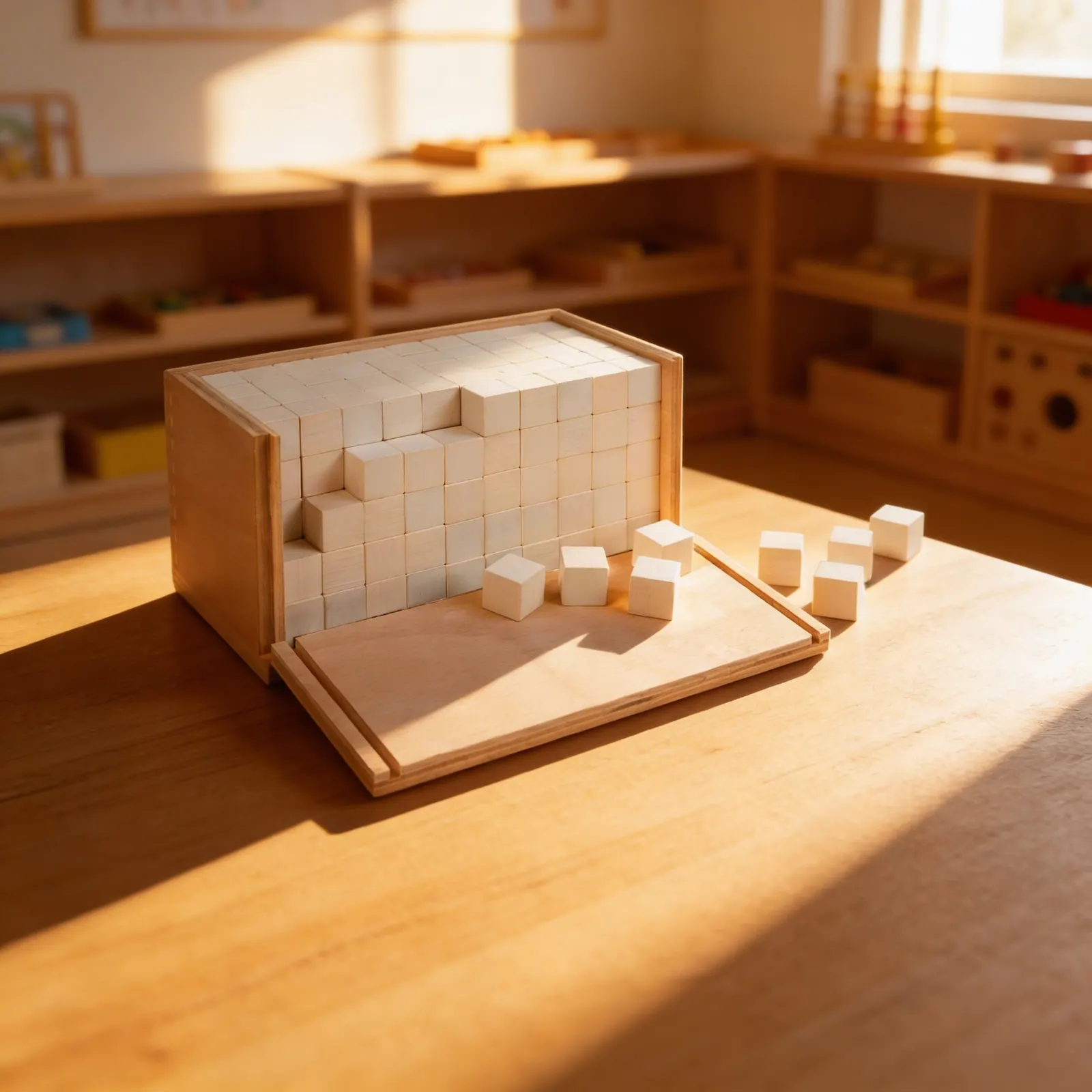
How to present it
Follow the Montessori method of presentation for optimal child development.
Place the Volume Box on a large work mat. Open the hinged lid to reveal the organized cubes. Have the child wash their hands to ensure cleanliness of the material. Prepare a second mat nearby for building activities.
- 1
Begin by inviting the child to count out 8 cubes and construct a 2×2×2 cube
Use slow, deliberate movements to model precision and care - 2
Once complete, have the child count the cubes used and record: 2³ = 8
Use three-finger grip to emphasize the 'cubed' concept - 3
Progress to building a 3×3×3 cube using 27 cubes
Build layer by layer to emphasize the three dimensions - 4
Continue with 4×4×4 (64 cubes) and 5×5×5 (125 cubes)
Point out that 250 cubes allows for all constructions with cubes remaining - 5
Explore the pattern: 1³=1, 2³=8, 3³=27, 4³=64, 5³=125
Create a chart to visualize the rapid growth of cubic numbers
Every Child Is a Little Creator

Heritage
Since 1929

In classrooms
Around the world

European brands
Nienhuis, GAM, Educo

AMI approved
To the association standard
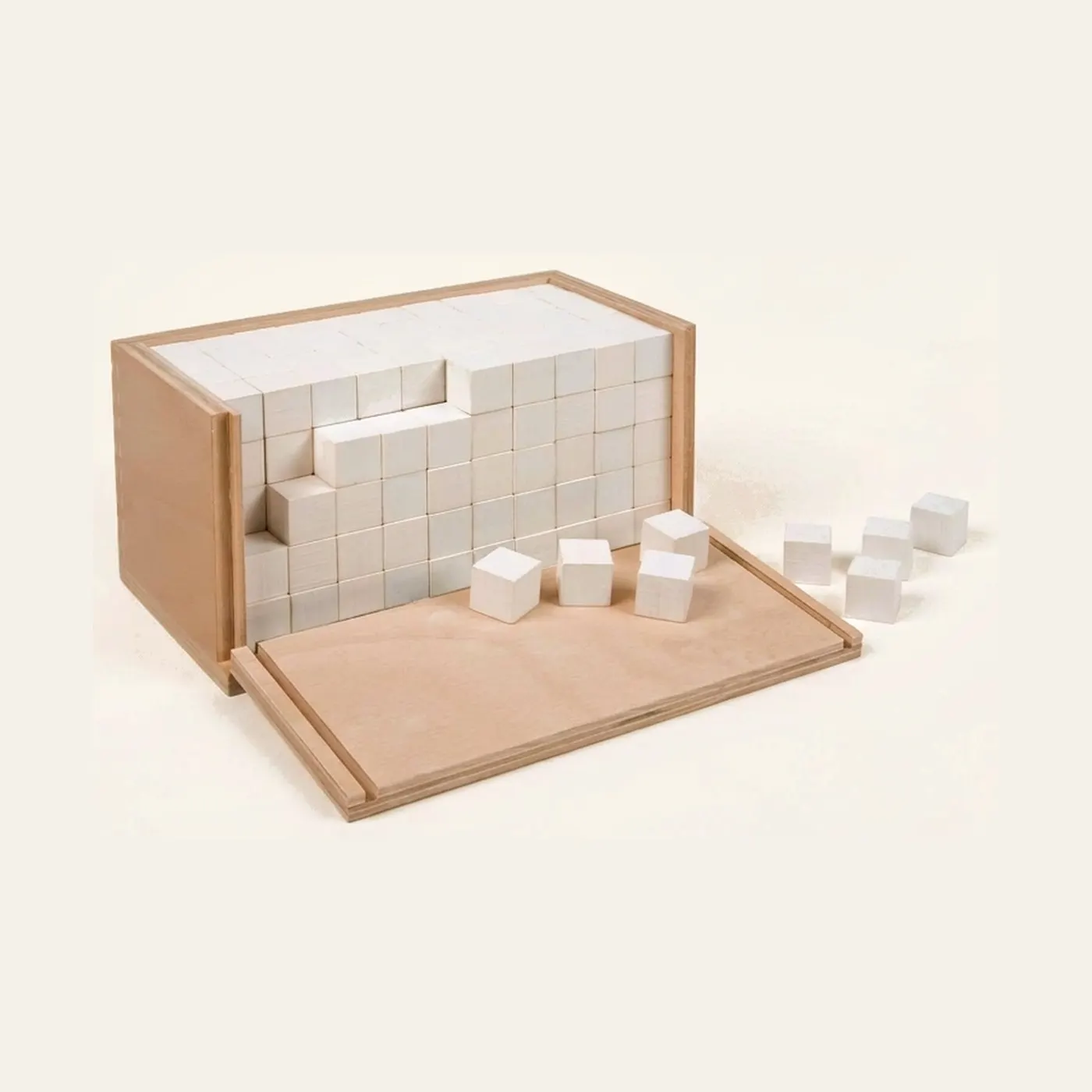
Volume Box: 250 Unit Cubes for Cubic Volume Exploration
