
Wooden Square Of 100Set Of 10
The first photo is the maker's own. The other shots are illustrative.
Inv. no. NIE-007410
- Maker
- Nienhuis Montessori, since 1929
- Approval
- AMI
- Primary Material
- Natural wood
- Surface Treatment
- Smooth finish with recessed dots
- EAN
- 8719924004361
Final price incl. VAT. Delivery €5.90, €124.10 to go for free delivery.
Advice, warranty and returns are handled by us.
Why it costs €24.90
Behind the price of the original are things you can check yourself.
AMI approval
The material is approved by the Association Montessori Internationale (AMI). Nienhuis has made Montessori materials since 1929.
A verifiable original
The EAN 8719924004361 is on the box. It is the maker's number, not ours.
Wooden Square Of 100 in a child's hands
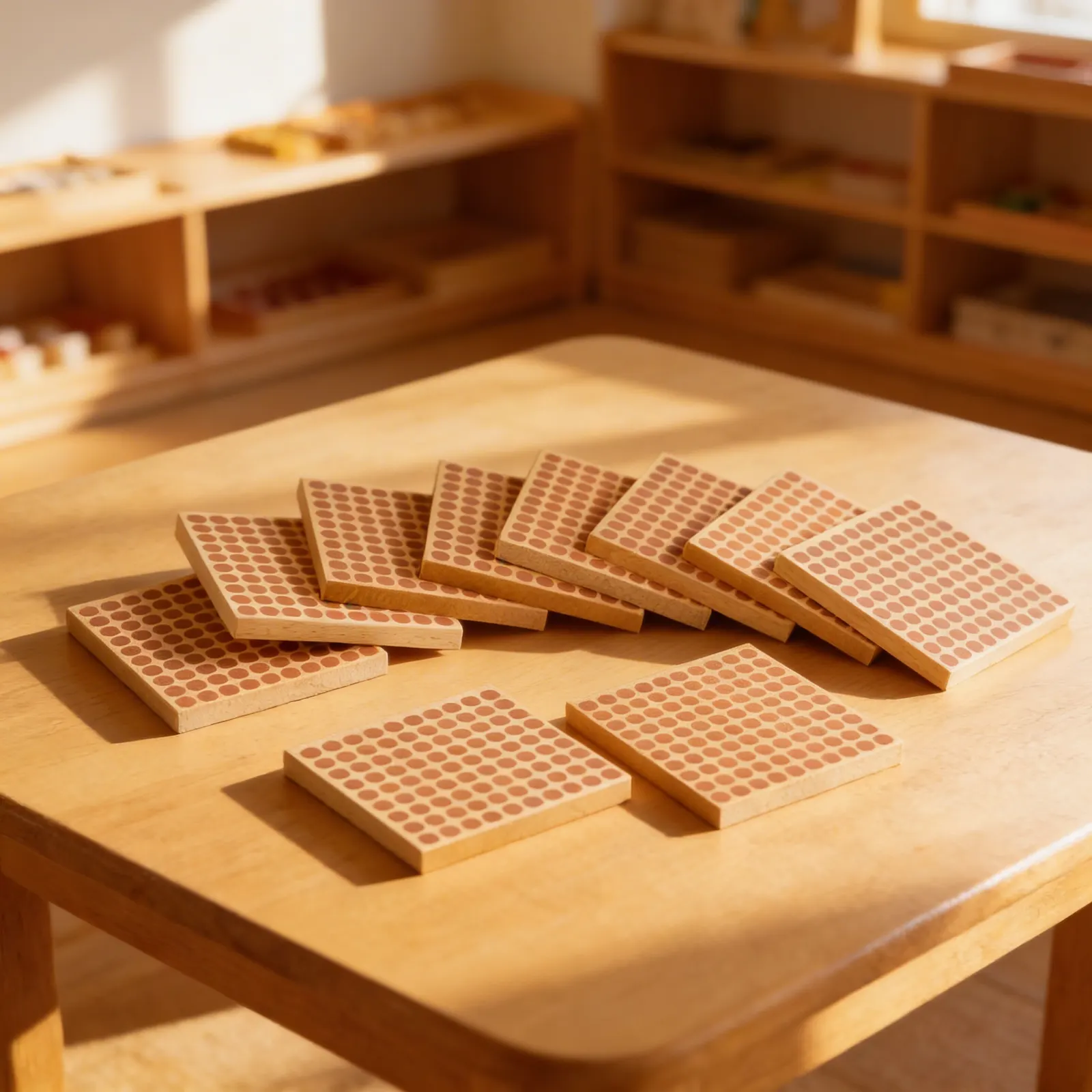
Tangible to conceptual, this set of ten wooden hundred squares provides essential manipulatives for exploring mathematical concepts in the Montessori classroom. Each square tile features 100 recessed circular dots arranged in a precise 10×10 grid, giving children the chance to physically experience the quantity of 100 through tactile counting and pattern recognition. The smooth wooden construction with clearly defined indentations strengthens number sense and prepares children for advanced mathematical work.
Mathematical Foundation
Builds concrete understanding of the quantity 100 and reinforces the decimal system through hands-on exploration.
Pattern Recognition
The 10×10 grid structure helps children internalize mathematical patterns and relationships between numbers.
Fine Motor Development
Tracing and counting the recessed dots strengthens finger muscles and develops precision in movement.
Concentration Skills
The systematic counting of 100 dots develops sustained attention and methodical work habits.
How to present it
Place one wooden square on a mat with good lighting. Have a small pointer or the child's finger ready for counting. Ensure the child can sit comfortably and reach all areas of the tile.
- 1Introduce the square by inviting the child to feel the smooth wood and trace some dots with their finger
- 2Begin counting together, touching each recessed dot systematically from left to right, top row first
- 3After reaching 100, invite the child to count independently while you observe
- 4Introduce skip counting by tens, touching only the last dot in each row
- 5Compare two squares side by side to reinforce that each contains exactly 100
3 tips for parents
- Practice counting to 100 during daily routines to reinforce the magnitude of this number
- Point out groups of ten in everyday life (fingers, toes, eggs in cartons) to build decimal awareness
- Celebrate when your child successfully counts to 100 independently as a significant milestone

If you are not sure it suits your child, we answer in person.
Norbert Kovalčín, founder of Faborino · write to him
There is no review here yet. We will ask you for one after you buy. Write the first review
What's in the Box
- Wooden Hundred Squares: 10 identical tiles
Size and material
| Packaging | 16 × 16 × 4 cm |
| Primary Material | Natural wood |
| Surface Treatment | Smooth finish with recessed dots |
| Recommended Age | 3-6 years |
Care
Wipe with slightly damp cloth, dry immediately
Frequently Asked Questions
What are the dimensions of each wooden hundred square?
Each square typically measures approximately 10cm x 10cm, featuring 100 recessed dots arranged in a 10x10 grid pattern. The tiles are designed to be easily handled by young children while providing clear visual and tactile representation of 100.
How do children use these hundred squares in Montessori activities?
Children use these squares for counting to 100, skip counting, understanding place value, and exploring number patterns. They can trace the dots with their fingers, use them for comparison with other quantities, and as a concrete representation when learning multiplication and squaring numbers.
Why does this set include 10 hundred squares?
Having 10 hundred squares allows children to physically build and understand 1000, supporting the decimal system concept. Multiple squares enable group activities, comparison exercises, and advanced work like creating number chains or exploring multiples of 100.
What is the benefit of the recessed dots versus printed numbers?
The recessed dots provide crucial tactile feedback that engages multiple senses in learning. Children can feel each unit as they count, which creates stronger neural pathways and memory formation. This concrete, sensorial approach is fundamental to Montessori mathematics education.
At what stage should children begin working with these hundred squares?
Children typically begin exploring hundred squares after mastering quantities to 20 and showing readiness for larger numbers, usually around age 4-5. They should have experience with the golden bead material and understand the concept of ten before working extensively with hundreds.
Product safety
Manufacturer: Nienhuis Montessori, Anders Celsiusstraat 15, 7442 PB Nijverdal, Netherlands
Wooden Square Of 100