
Working With Advanced Fractions
The first photo is the maker's own. The other shots are illustrative.
Inv. no. NIE-ELC3030
- Maker
- Nienhuis Montessori, since 1929
- Material
- Durable plastic
- Finish
- Pre-cut with rounded corners
- EAN
- 8719924043834
Final price incl. VAT. Delivery €5.90, €6.10 to go for free delivery.
Advice, warranty and returns are handled by us.
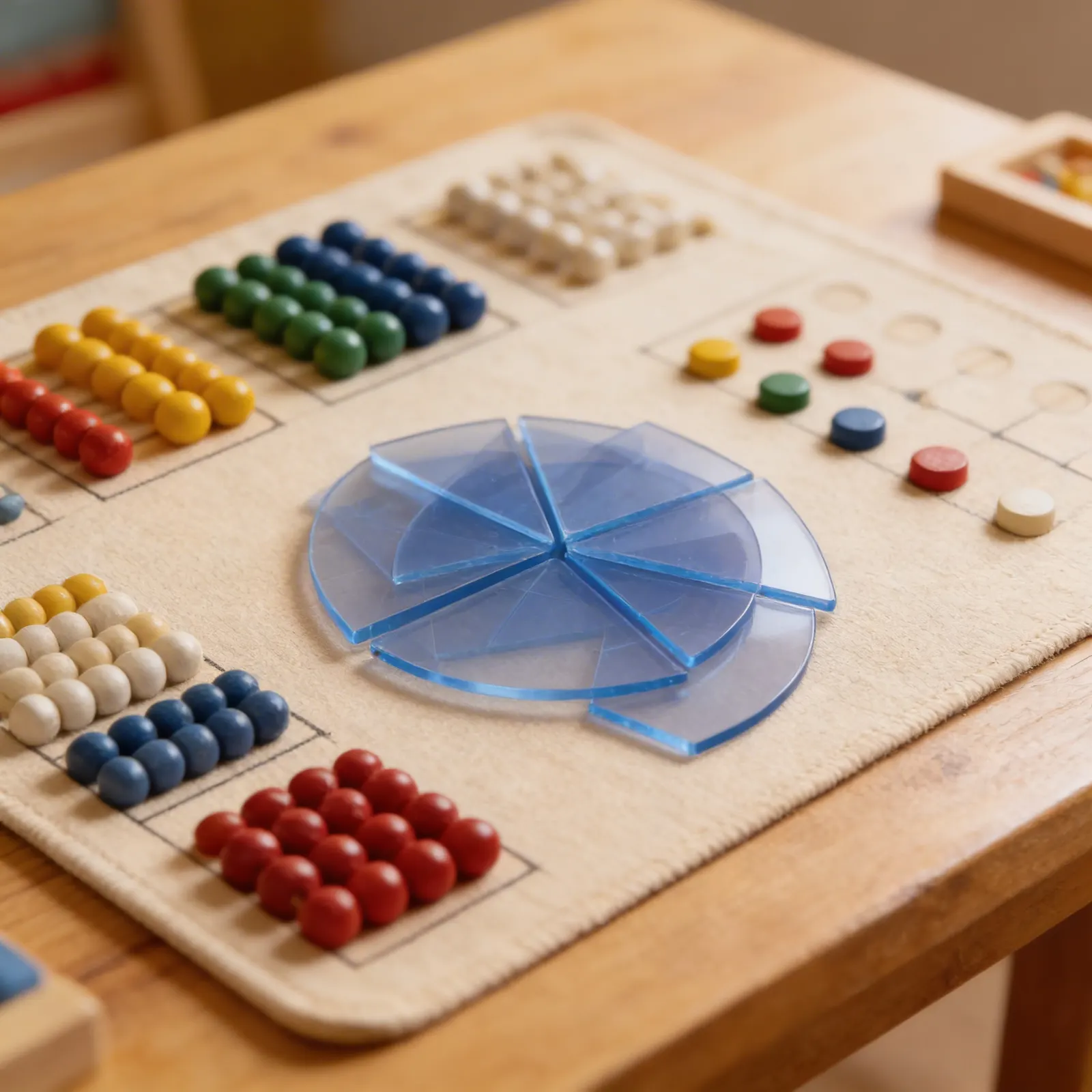
Working With Advanced Fractions in a child's hands
Advanced fraction work on task cards, for the point where fractions stop being pieces of a circle and start being numbers that can be added, compared and turned into each other. That transition is where most children lose fractions, because the material that made them obvious is put away just as the arithmetic gets hard. Task cards keep the work going without an adult supplying every problem. Durable plastic with rounded corners. In English.
Mathematical Abstraction
Bridges concrete manipulation to abstract fraction concepts through visual and tactile exploration of parts and wholes.
Visual Discrimination
Color gradation supports recognition of fraction relationships and proportional reasoning development.
Sequential Thinking
Organized presentation encourages systematic exploration from larger to smaller fraction divisions.
Problem-Solving Skills
Enables discovery of equivalent fractions and relationships through hands-on comparison and combination.
How to present it
Arrange the fraction circles on a mat with sectors organized by denomination. Place whole circles on the left, followed by halves, thirds, quarters, progressing to smaller divisions. Ensure each blue gradation group stays together.
- 1Introduce the whole circle first, tracing its complete edge with your finger
- 2Present halves by placing two semi-circles together to recreate the whole
- 3Explore thirds by counting aloud as you place each sector: 'one third, two thirds, three thirds make one whole'
- 4Invite the child to match sectors by their blue shades, creating complete circles
- 5Compare different fractions by overlaying sectors: 'Which is larger, one half or one third?'
3 tips for parents
- Practice fraction language during snack time: 'You ate three fourths of your apple'
- Point out fractions in everyday life: pizza slices, sandwich halves, orange segments
- Avoid rushing to written fractions - concrete understanding with circles must come first

If you are not sure it suits your child, we answer in person.
Norbert Kovalčín, founder of Faborino · write to him
There is no review here yet. We will ask you for one after you buy. Write the first review
What's in the Box
- Fraction circle sectors: Approx. 15 pieces in graduated blue tones
- Multiple fraction divisions: Including wholes, halves, thirds, quarters, and smaller divisions
Size and material
| Packaging | 28 × 22 × 2 cm |
| Material | Durable plastic |
| Finish | Pre-cut with rounded corners |
| Recommended Age | 6-12 years |
Care
Wipe gently with dry cloth; avoid moisture
Frequently Asked Questions
Is this material really appropriate for children as young as 3 years old?
Yes, in Montessori education, young children are introduced to fraction concepts through concrete, sensorial experiences. The material allows 3-6 year olds to explore the physical relationships between wholes and parts without requiring formal fraction notation, building an intuitive understanding that prepares them for later abstract work.
What specific fraction concepts can children learn with this material?
Children explore equivalence (how different combinations equal the same amount), part-to-whole relationships, comparison of fractions, and basic operations like combining and separating parts. The color gradations help them visually distinguish between different fraction families while understanding their relationships.
How does the fan-arranged paper segment feature work?
The paper segments can be arranged in a fan pattern to show the progression from whole to increasingly smaller parts. This visual demonstration helps children see how one whole can be divided into equal parts and how these parts relate to each other in size and quantity.
What makes this different from standard fraction circles?
This Montessori material uses color-graduated sectors in shades of blue to create visual distinction between fraction families, includes paper segments for additional manipulation and comparison work, and is designed specifically for the developmental needs of 3-6 year olds with appropriately sized pieces for small hands.
How should this material be presented to ensure proper use?
Begin with simple explorations of wholes and halves, allowing the child to physically manipulate the pieces. Gradually introduce more complex fractions as the child shows readiness. Use precise mathematical language while demonstrating, and provide opportunities for the child to make their own discoveries through guided exploration.
Product safety
Manufacturer: Nienhuis Montessori, Anders Celsiusstraat 15, 7442 PB Nijverdal, Netherlands
Working With Advanced Fractions